
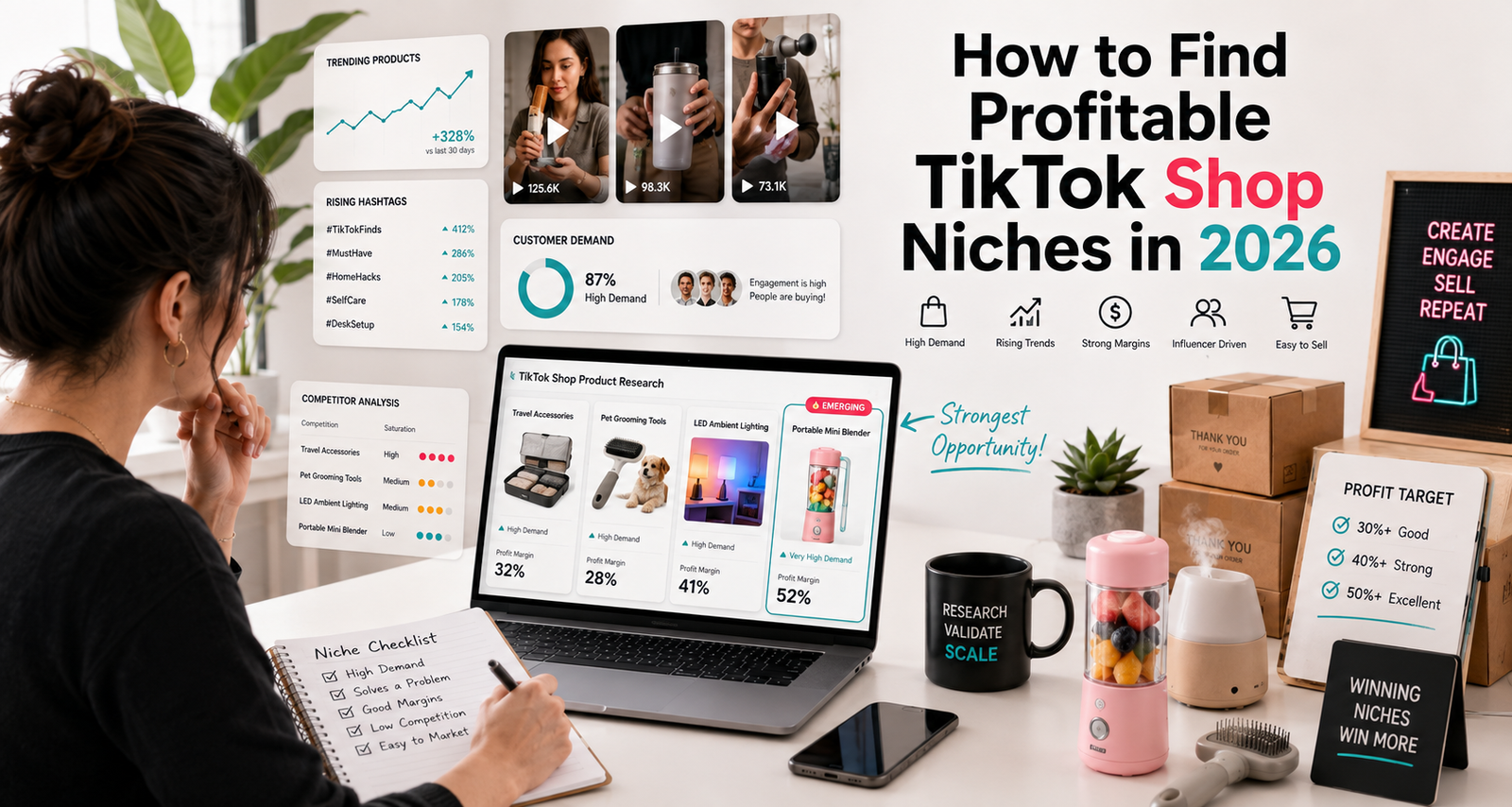
How to Find Profitable TikTok Shop Niches in 2026
Finding profitable TikTok Shop niches in 2026 requires more than jumping on whatever product happens to be viral this week. TikTok Shop combines product discovery, short-form content, creator recommendations, search, and social commerce, which means strong products need both genuine demand and the ability to perform naturally in content.
The best opportunities often appear where customer interest is growing but competition, content coverage, or product availability has not fully caught up. TikTok now provides tools such as Creative Center and, for eligible Shop users in supported markets, Product Opportunities and Product Marketplace features that can help identify trending products, keywords, hashtags, and emerging opportunities.
This guide explains how to conduct TikTok Shop product research, analyze competitors, validate demand, evaluate profit potential, identify emerging trends, and avoid products that may be difficult to scale.
Quick Answer: How Do You Find Profitable TikTok Shop Niches?
To find profitable TikTok Shop niches, research emerging trends, validate customer demand, analyze competing sellers, calculate your full costs and profit potential, check product quality and compliance, and test the product before scaling. TikTok’s native research tools, creator content, customer feedback, and external search data can all help confirm whether an opportunity is worth pursuing.
What Makes a TikTok Shop Niche Worth Testing?
| Research Signal | What to Look For | Warning Sign |
|---|---|---|
| Demand | Repeated interest, searches, product clicks, questions, and purchase intent | One isolated viral spike with little ongoing interest |
| Competition | Active demand with room for different positioning or offers | Many nearly identical products competing mainly on price |
| Profit Potential | Enough margin after product, shipping, platform, creator, and marketing costs | Strong revenue potential but little profit after expenses |
| Content Potential | Several natural demonstrations, hooks, tutorials, and creator angles | Product depends on one repetitive viral concept |
| Product Quality | Reliable supplier, acceptable quality, manageable returns | Poor reviews, inconsistent quality, or high support requirements |
| Compliance | Product meets applicable TikTok Shop and market requirements | Restricted, unsupported, or documentation-sensitive product |
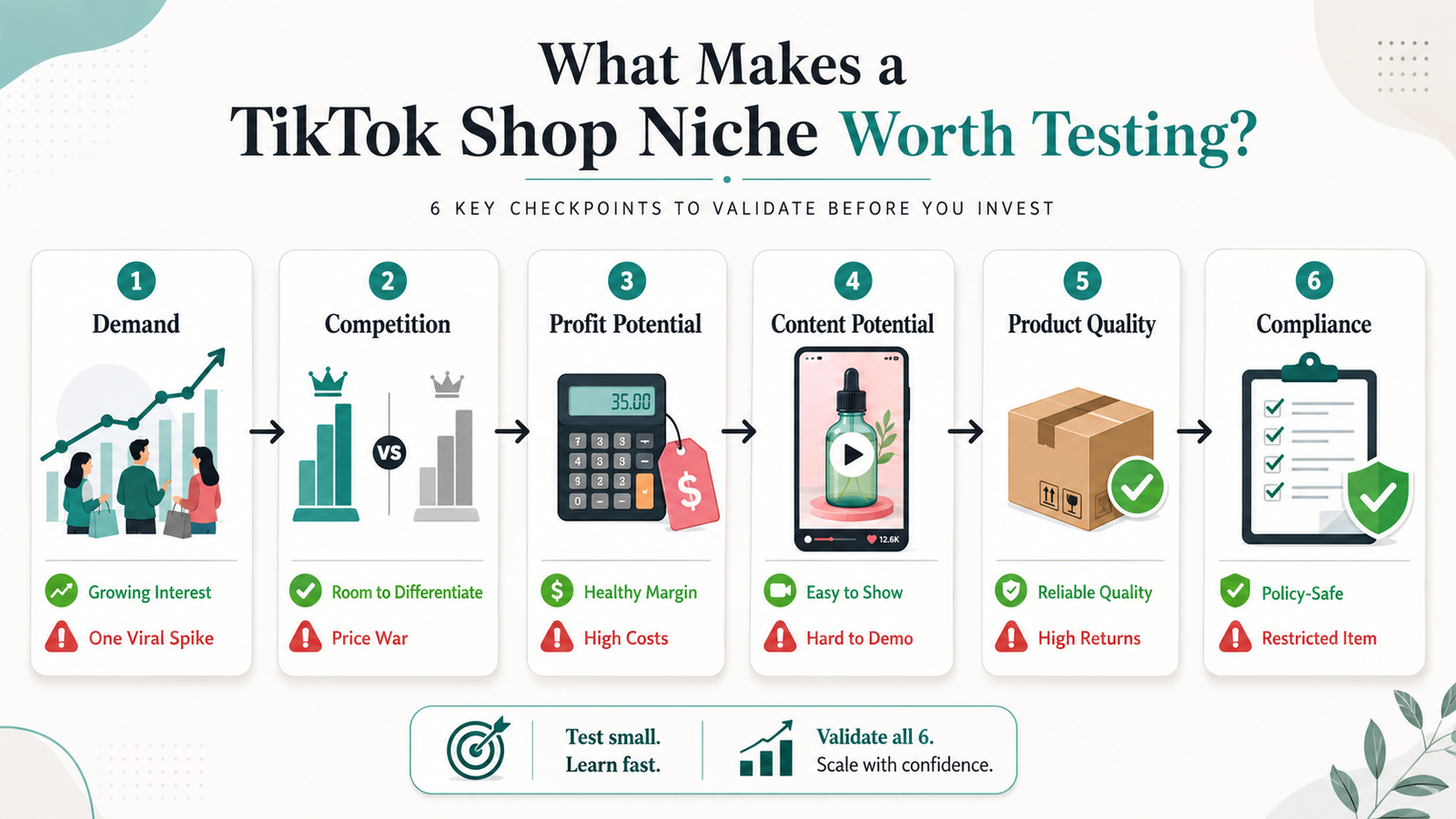
Six key signals can help sellers decide whether a TikTok Shop niche is worth testing.
How TikTok Shop Product Discovery Works
TikTok Shop combines ecommerce with TikTok’s content-driven discovery experience. Shoppers can discover products through videos, LIVE content, search results, product links, and the Shop Tab where available. This means product discovery can happen both actively, when someone searches for an item, and passively, when a product appears in relevant content.
Products that are easy to demonstrate, solve recognizable problems, or create visually engaging content may be especially well suited to this environment. The goal is not simply to find something that looks viral, but to identify products that can attract attention while still offering genuine customer value.
This ecosystem shapes your entire product selection approach, therefore, understanding it is vital. Products that can be demonstrated clearly, generate useful or entertaining content, encourage user-generated content, and solve a recognizable customer need are often easier to market through TikTok’s discovery-driven environment.
Approach 1: Use TikTok’s Native Product Research Tools
The For You Page is one of the easiest places to begin researching emerging products and content trends. As you peruse your FYP, set aside some time to focus on the sponsored material, product placements, and organic product mentions.
Explore different product categories, creators, hashtags, searches, and content themes to broaden the signals you see during research. Keep a spreadsheet of recurring products, engagement patterns, content formats, and customer questions.
Use TikTok Creative Center and TikTok Shop Research Tools
TikTok’s own tools should be one of your first sources for product research. TikTok Creative Center provides trend discovery tools that can help you explore popular hashtags, creators, videos, ads, and broader platform trends. You can use these signals to understand which themes and product categories are gaining attention before validating them elsewhere.
TikTok Shop also provides additional product-discovery features depending on your market, account type, and eligibility. Sellers may have access to Product Opportunities, which can surface trending products, high-volume keywords, hashtags, and areas where demand may exceed available supply. Eligible creators can use Product Marketplace to discover products to promote through features such as New Arrivals, Curated Choices, Product Rankings, and Exposure Plus.
Use these tools as research signals rather than guarantees. A trending product still needs acceptable margins, reliable supply, appropriate competition levels, and a strong fit with your audience before you invest heavily.
Track Creators and Top Sellers for Product Signals
Find popular vendors and influencers in your niche on TikTok who have achieved success. Keep an eye on their material for trends in the things they endorse. Repeated product promotion can be a useful signal, but validate it with engagement, customer comments, sales indicators where available, and broader demand data before drawing conclusions. Make a note of all these accounts and go through them once a week to see if there are any deals or new products. Create organized lists to track their posting patterns and product recommendations systematically.
Approach 2: Validate TikTok Trends with External Research Tools
What Are the Best Social Media Monitoring Platforms for Finding Trending TikTok Products?
Brandwatch, Hootsuite Insights, and Sprout Social are some of the tools that can help you monitor mentions of particular items on TikTok and other social media sites. You can use the sentiment analysis, engagement metrics, and trend spotting capabilities provided by these tools to help you choose the right products. Set up automated alerts for product mentions and trending keyword notifications.
Use Analytics to Spot Emerging TikTok Product Trends
You may learn more about how your content is doing, how effective your hashtags are, and what’s trending on TikTok with the use of specialized analytics tools like TikTok Analytics by Pentos, Analisa.io, and TikTok Business Center.
These tools can help you monitor engagement patterns, hashtag activity, content performance, and emerging trends. Use them to identify products worth investigating further rather than assuming that rising engagement automatically predicts future sales.
Which Multi-Platform Research Tools Should You Use to Validate TikTok Product Trends?
To verify TikTok trends on other platforms, you can use tools such as Google Trends, SEMrush, and Ahrefs. A product showing consistent interest across TikTok, search data, and other relevant channels may have stronger demand signals than one driven by a single short-lived spike. Seasonal patterns and demand forecasting are two other areas where these technologies shine. Cross-reference data across multiple platforms to ensure trend sustainability and longevity.
Approach 3: Analyze TikTok Shop Competitors
Competitor research can reveal which products are already gaining traction, how sellers position them, what customers are responding to, and where gaps may still exist. Review competing sellers’ product ranges, pricing, content, customer feedback, offers, and positioning rather than simply copying their best-selling products.
What Can You Learn from Analyzing Your Competitors’ TikTok Content Strategy?
Study their highest-performing product content. Look at video formats, hooks, demonstrations, calls to action, posting patterns, creator collaborations, customer comments, and user-generated content. Pay particular attention to products that appear repeatedly and the angles competitors use to position them.
The goal is not to copy their content. Use the analysis to identify proven formats, unanswered customer questions, weak positioning, and opportunities to differentiate your own products.
How to Track Your Competitors’ Product Performance and Stay Ahead of Market Changes
To keep tabs on when your competitors release new products or have sales, set up alerts and monitoring systems. To keep up with the ever-changing market, you need this real-time intelligence to spot new trends as they emerge.
Approach 4: Research Viral Content and Emerging Trends
What Are the Most Effective Hashtag Research Strategies for Product Discovery on TikTok?
Start with TikTok Creative Center Trends, which allows you to explore popular hashtags and broader TikTok trends. Compare hashtag momentum, related content, regional interest, and the types of videos generating engagement.
Product-focused hashtags such as #TikTokMadeMeBuyIt can provide ideas, but do not use a single hashtag as proof of demand. Look for repeated product appearances across creators, customer comments, search behavior, and other validation sources.
How to Analyze Viral Videos to Identify Products with High Demand Potential?
Examine popular videos that showcase products on a regular basis, regardless of whether they are directly advertising them or not. Products that are featured in popular content forms, such as “day in my life” videos, room tours, or content that focuses on addressing problems, should be considered. Repeated organic product mentions can indicate genuine interest, especially when viewers ask about the product, its price, availability, or where to buy it.
How Do Seasonal Varieties and Events Impact TikTok Product Trends?
Be sure to keep an eye on how product trends relate to the passing of time and significant events. Predictable spike patterns are common for products that coincide with back-to-school, summer, or holiday gifting seasons. To organize product launches more effectively, create a seasonal product calendar showing when demand typically begins to rise, reaches its peak, and starts to decline.
Approach 5: Research Customer Demand and Buying Behavior
Use Social Listening to Discover Product Opportunities
Social listening can reveal what potential customers are already saying about products, problems, and unmet needs. Monitor conversations on TikTok, Reddit, Instagram, X, and other communities relevant to your target audience.
Pay attention to recurring complaints, product requests, questions, and pain points. These conversations can uncover potential product ideas that solve genuine problems rather than relying only on short-lived trends.
Use Surveys and Customer Feedback
Surveys can help you understand what your audience wants, what they dislike about existing products, how they shop, and what influences their purchasing decisions.
Tools such as Google Forms and SurveyMonkey can help you collect direct feedback. You can also use polls and questions on social platforms to test early product ideas.
Use this information to support your TikTok Shop product research, rather than choosing products based entirely on assumptions.
Monitor Communities for Emerging Demand
Online communities can reveal product opportunities before they become widely discussed on mainstream social media.
Join relevant groups, forums, and niche communities where your target customers spend time. Look for repeated questions, recommendations, frustrations, and requests for products that do not yet have strong solutions. Community discussions can be especially useful when identifying profitable TikTok Shop niches with genuine customer demand.
How to Validate a TikTok Shop Product Before Selling It
Finding a trending product is only the beginning. Before investing heavily, evaluate whether the product has real demand, manageable competition, healthy profit potential, and enough content opportunities to support long-term promotion.
1. Analyze Engagement Signals
Track likes, shares, comments, saves, repeat mentions, and engagement around product-related TikTok content. Comments such as:
“Where can I buy this?” or users tagging friends can indicate interest.
However, high engagement should be treated as a signal, not proof that viewers will actually purchase the product. Look for engagement patterns across multiple videos, creators, and time periods rather than relying on one viral post.
2. Look for Purchase-Intent Signals
Purchase-intent signals provide stronger validation than likes or views alone.
Look for:
- Product clicks
- Add-to-cart activity
- Sales data where available
- Requests for product links
- Comments indicating an intention to purchase
- Repeat customer questions about price or availability
The more frequently engagement turns into shopping behavior, the stronger the potential demand signal becomes.
3. Evaluate Market Saturation
Competition is not automatically a bad sign. Some competition can confirm that people are already buying products in the niche. The problem begins when dozens of sellers offer nearly identical products using the same positioning, content, and pricing.
Review:
- How many comparable products are being promoted
- How similar competing offers are
- Whether sellers are heavily competing on price
- How repetitive the content has become
- Whether you can position the product differently
Look for opportunities where demand appears strong but your store can still differentiate through better content, product quality, bundles, branding, customer experience, or audience targeting.
Warning: Do Not Choose a Product Just Because It Is Popular
An oversaturated product can quickly turn into a price war. If customers can choose from many nearly identical offers, sellers may be forced to reduce prices while advertising costs remain high.
Popularity should therefore be considered alongside competition and profit potential.
4. Calculate the Product’s Profit Potential
A product can generate strong sales and still produce poor profits. Calculate the full cost of selling before deciding whether a product is worth testing. Consider:
- Product or wholesale cost
- Shipping and fulfillment
- TikTok Shop fees applicable to your market
- Creator commissions where applicable
- Advertising costs
- Discounts
- Returns and refunds
- Other operating expenses
Your selling price needs to leave enough room for profit after these expenses are deducted. Do not evaluate a product based on revenue alone.
Because platform costs can directly affect your margin, review our guide to TikTok Shop commission and fee changes before finalizing your pricing calculations.
5. Check Product Quality and Compliance
Product quality should be investigated before the item is added to your TikTok Shop.
Review samples where practical, supplier documentation, existing customer feedback, product safety concerns, and any relevant category requirements.
Also make sure the product complies with the laws, regulations, and TikTok Shop policies that apply in the market where you plan to sell it.
Poor-quality or non-compliant products can lead to returns, negative reviews, customer complaints, and account issues.
6. Avoid Depending Entirely on Fleeting Viral Trends
Viral products can create excellent short-term opportunities, but popularity alone does not make a product sustainable.
Ask whether the product:
- Solves an ongoing problem
- Serves a recurring customer need
- Has seasonal repeatability
- Can support different content ideas
- Has demand beyond a single viral moment
A product does not necessarily need to be evergreen. However, you should understand whether you are pursuing a short-term trend or building around a niche with longer-term demand.
7. Test Products Before Scaling
Before making a large investment, run a controlled test. Start with a limited inventory or fulfillment commitment and a manageable marketing budget. Test different:
- Audiences
- Video hooks
- Product demonstrations
- Offers
- Creatives
- Calls to action
Monitor sales, conversions, engagement, returns, customer feedback, and profit margins. Scale only when the data suggests that the product can support additional investment.
8. Consider Operational Complexity
Some products create more work than their sales potential justifies.
Products that are difficult to assemble, require extensive instructions, generate frequent troubleshooting requests, or have high return rates can create unnecessary operational pressure.
Before choosing a product, consider:
- Ease of use
- Customer support requirements
- Return risk
- Fulfillment complexity
- Supplier reliability
- Ability to handle sudden demand
Complex products are not automatically bad opportunities, but the additional operational costs need to be reflected in your pricing and margins.
9. Plan Your TikTok Content Before Launch
Before launching a product, make sure you can think of several natural ways to demonstrate and promote it.
Potential formats include:
- Product demonstrations
- Problem-and-solution videos
- Before-and-after content
- Tutorials
- Comparisons
- Customer use cases
- Creator videos
- User-generated content
- Product challenges
A product that supports several strong content angles may be easier to market consistently than one that depends on a single viral idea.
10. Track Performance and Keep Optimizing
Product research should continue after launch.
Create a simple dashboard or reporting system to monitor:
- Sales
- Conversion rates
- Engagement
- Customer feedback
- Returns
- Profit margins
- Advertising performance
- Creator performance where applicable
Use this information to improve your pricing, content, targeting, product positioning, and marketing strategy. If a product stops performing, investigate why rather than continuing to spend on it simply because it worked previously.
As your product catalog grows, tracking inventory, orders, analytics, and other operational tasks can become more complex. Our guide to TikTok Shop automation tools explains the types of tools sellers can use to streamline different parts of store management.
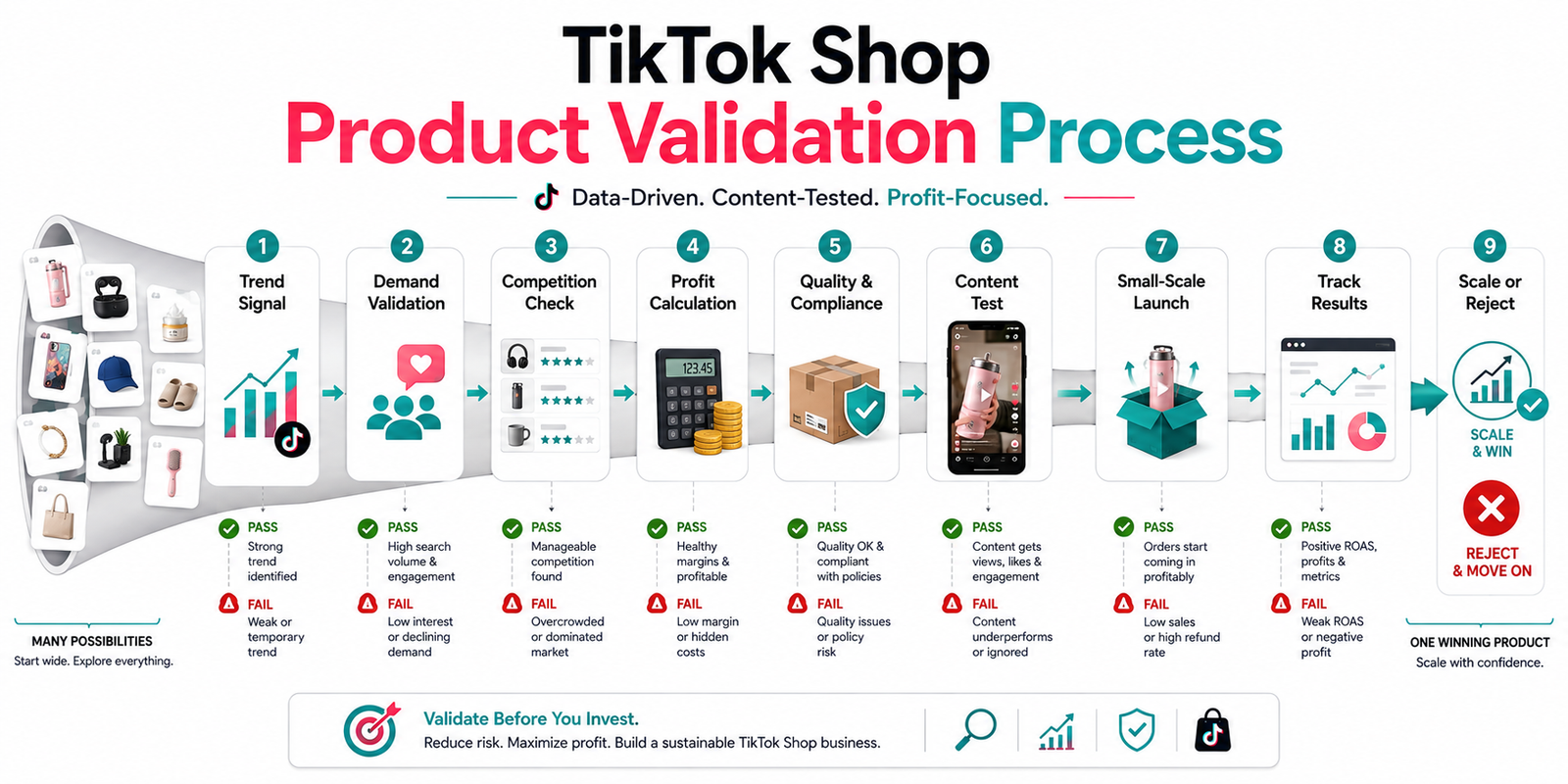
A TikTok Shop product should pass demand, competition, profitability, quality, content, and performance checks before scaling.
Quick Answer: What Makes a TikTok Shop Product Profitable?
A profitable TikTok Shop product needs more than viral attention. Look for genuine customer demand, manageable competition, enough margin after product and selling costs, reliable supply, acceptable quality, compliance with applicable policies, and multiple content angles that can attract shoppers. Test demand and profitability before scaling.
Advanced TikTok Shop Product Research Strategies
Once you have a reliable research and validation process, several more advanced strategies can help uncover opportunities before they become heavily competitive.
Identify Micro-Trends Early
Micro-trends are smaller patterns that begin growing inside particular communities before reaching wider TikTok audiences. Monitor emerging creators, niche communities, rising hashtags, repeated customer questions, and early viral content.
Look for trends showing consistent growth, rather than one isolated spike. Finding a product early can provide more room to test positioning and content before competition increases.
Research Product Trends Across Markets
Products sometimes gain traction in one country or region before becoming widely promoted elsewhere.
Monitor TikTok content and ecommerce trends across different geographic markets to identify products that may have proven demand but limited exposure in your target market.
However, always validate:
- Local demand
- Product availability
- Pricing
- Shipping
- Regulations
- Cultural relevance
A product that succeeds in one market will not automatically perform the same way everywhere.
Use Seasonal Demand to Plan Product Launches
Some products perform best around predictable events or seasons.
Review historical search behavior, social trends, and previous sales patterns for events such as:
- Holidays
- Back-to-school periods
- Summer
- Winter
- Gift-buying seasons
- Major cultural events
Create a product calendar showing when interest typically begins rising, reaches its peak, and starts declining.
Ideally, begin product and content preparation before demand reaches its highest point.
Use Creator Content as a Product Research Signal
Creators can provide valuable clues about emerging product demand.
Monitor products that creators repeatedly feature, especially when mentions appear naturally rather than only through obvious sponsored promotions.
Look at:
- Repeated product mentions
- Audience comments
- Product demonstrations
- Customer questions
- Creator engagement
- Similar products appearing across multiple accounts
Creator activity can reveal useful opportunities, but always validate those signals with additional demand and competition data.
Build a Brand Around Your Product Niche
Do not treat every winning product as an isolated opportunity.
A stronger long-term strategy is to build a recognizable brand around a specific audience, problem, lifestyle, or product category.
For example, rather than repeatedly chasing unrelated viral products, a store could build authority around:
- Home organization
- Pet accessories
- Beauty tools
- Fitness products
- Travel accessories
- Kitchen solutions
A focused niche makes it easier to create consistent content, introduce related products, and build customer trust.
Build a Community Around Your Brand
Customer communities can become valuable sources of future product ideas.
Encourage customers to:
- Leave feedback
- Share product videos
- Comment on new ideas
- Participate in branded hashtags
- Suggest products
- Create user-generated content
The stronger your relationship with customers becomes, the easier it is to understand what they may want next.
Keep Your Product Research Strategy Updated
TikTok Shop changes quickly.
New trends emerge, competition increases, customer interests shift, and TikTok continues introducing new commerce and discovery features.
Review your product research process regularly instead of assuming that the same strategy will continue working indefinitely.
Keep monitoring:
- TikTok Shop trends
- Customer behavior
- Competitor activity
- Platform features
- Content formats
- Product policies
- Marketplace performance
Continuous research gives you a better chance of recognizing opportunities before they become obvious to everyone else. For sellers deciding how much of that research and store management to handle manually, our guide on whether TikTok Shop automation is worth it breaks down the benefits, limitations, costs, and situations where automation may make sense.
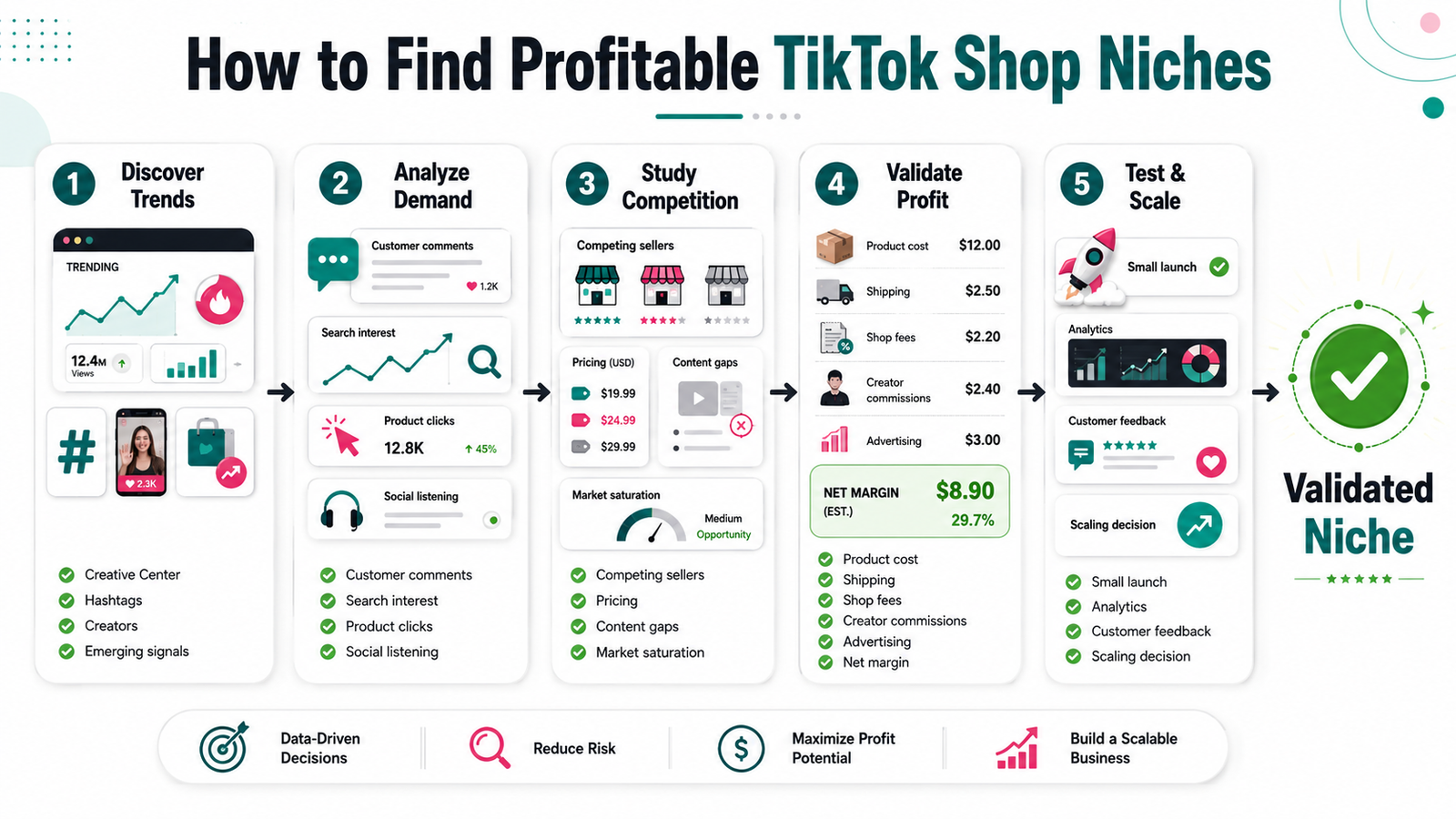
A practical research framework for finding and validating profitable TikTok Shop niches before scaling.
Key Takeaways for TikTok Shop Product Research
Finding profitable TikTok Shop niches requires more than identifying products that are currently viral. Strong product research combines trend discovery, competitor analysis, customer demand, margin calculations, product quality, content potential, and real-world testing.
Use TikTok’s native research tools alongside search data, competitor research, creator content, customer feedback, and external market signals. Look for products with genuine demand, manageable competition, reliable suppliers, healthy margins, and enough content potential to remain marketable beyond a single video.
Most importantly, treat TikTok Shop product research as an ongoing process. Trends, competitors, customer interests, and platform features continue to change. Validate opportunities before making significant investments, monitor performance after launch, and adjust your strategy using real data.
Finding the right niche is only the beginning. Sellers who want professional support with store setup, product strategy, operations, and growth can explore our TikTok Shop services.
Frequently Asked Questions
Q. How long does it take to find a profitable TikTok Shop niche?
There is no fixed timeline for finding a profitable TikTok Shop niche. The process depends on the product category, competition, available data, supplier options, and how much testing is required. Focus on validating demand, profit potential, competition, content opportunities, and supplier reliability before investing heavily.
Q. Do I need paid tools for TikTok Shop product research?
No. You can begin with free or native tools such as TikTok Creative Center, TikTok search, competitor research, customer comments, and Google Trends. Paid analytics, social listening, SEO, and competitive research platforms can provide additional data, but they are optional.
A good rule is to start with free tools first and only pay for software when you know exactly what additional data you need.
Q. Can beginners find profitable TikTok Shop niches?
Yes. Beginners can carry out effective TikTok Shop product research by studying trends, competitors, creators, customer discussions, and demand signals before committing to a product. Experience helps with interpreting the data, but a structured research process is more reliable than simply guessing which product will go viral.
Q. How do I know if a TikTok Shop niche is too saturated?
A niche may be difficult to enter when many sellers offer nearly identical products, prices are being pushed down, content looks repetitive, and there is little room to differentiate.
Competition itself is not a bad sign because it can validate demand. The more important question is whether you can offer a stronger product, better positioning, better content, a different bundle, improved customer experience, or another clear reason for shoppers to choose you.
Q. What are the biggest TikTok Shop product research mistakes?
Common mistakes include chasing viral products without validating demand, ignoring competitor research, overlooking profit margins, choosing unreliable suppliers, failing to check product quality or compliance, and selecting products that are difficult to market or fulfill.
Strong TikTok Shop product research should consider demand, competition, profitability, content potential, supplier reliability, and operational requirements together.
Q. What makes a product good for TikTok Shop?
A strong TikTok Shop product usually combines real customer demand with enough profit potential, reliable fulfillment, acceptable quality, and several natural content angles. Products that can be demonstrated clearly, solve an identifiable problem, or create engaging visual content may be easier to market through TikTok.
However, viral potential alone is not enough. The product still needs to make financial and operational sense.
Q. Should I follow viral products when choosing a TikTok Shop niche?
Viral products can be useful research signals, but they should not be the only factor in your decision. Before selling a viral product, check whether demand exists beyond a single trend, how competitive the market is, whether margins are sustainable, and whether you can continue creating useful content after the initial hype fades.
Q. How do I validate a TikTok Shop product before selling it?
Start by checking demand signals, competitor activity, customer comments, content performance, profit potential, supplier reliability, product quality, and applicable TikTok Shop policies. Then test the product on a limited scale before making a larger inventory or marketing commitment.
If you want to discuss your TikTok Shop strategy, product research, or store growth directly, contact the team to talk through your goals.


3 Comments