
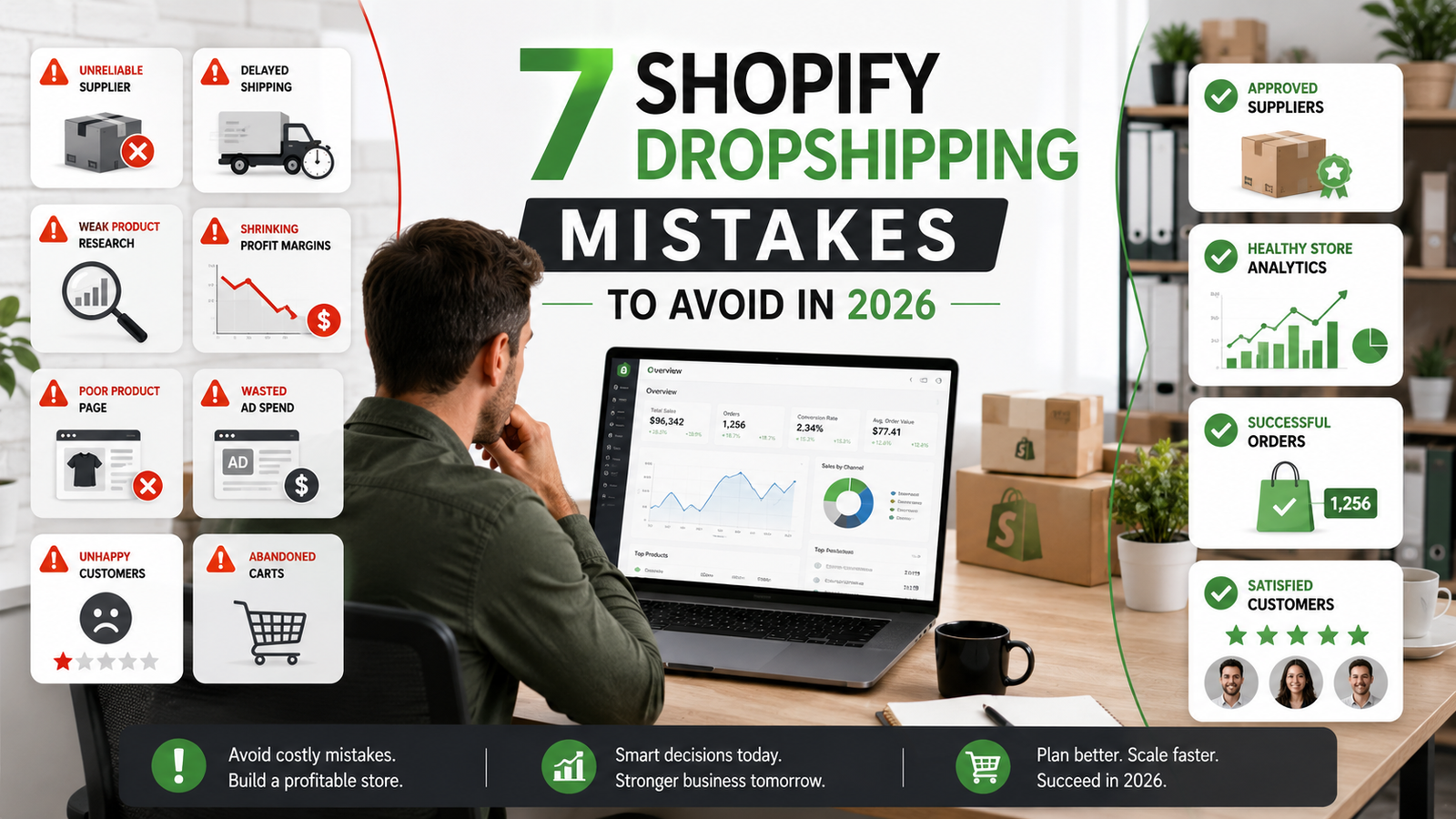
7 Shopify Dropshipping Mistakes to Avoid in 2026
Shopify dropshipping mistakes can turn a promising ecommerce store into an expensive learning experience. Dropshipping itself remains a major global business model, with Shopify citing estimates of more than $476 billion in ecommerce sales in 2026. But a growing market does not guarantee success. Choosing unreliable suppliers, miscalculating prices, selecting weak products, or wasting money on advertising can quickly reduce margins and create a poor customer experience.
Most of these problems do not destroy a store overnight. They slowly eat into profit margins, increase refunds, waste advertising budgets, and make it harder to turn first-time buyers into repeat customers.
The good news is that many common dropshipping mistakes can be avoided with better planning. This guide breaks down 7 Shopify dropshipping mistakes to avoid in 2026, why they happen, and what you should do instead to build a stronger and more profitable ecommerce business.
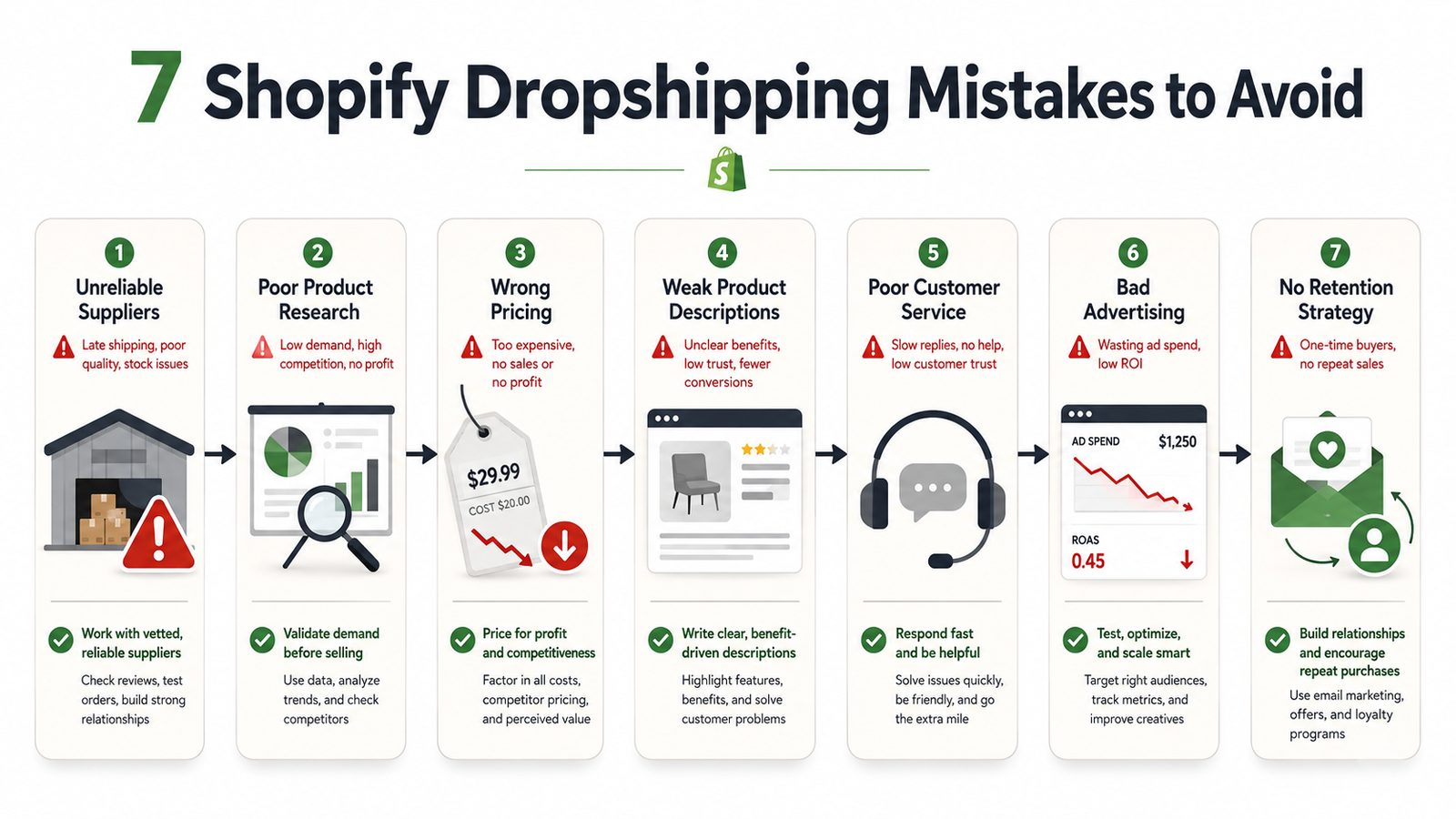
Quick Answer: What Are the Most Common Shopify Dropshipping Mistakes?
The most common Shopify dropshipping mistakes include choosing unreliable suppliers, skipping product research, pricing products without calculating true costs, using weak product descriptions, neglecting customer service, running poorly planned ads, and failing to build a customer retention strategy.
| Shopify Dropshipping Mistake | What to Do Instead |
|---|---|
| Choosing unreliable suppliers | Test product quality, shipping speed, communication, and return policies. |
| Skipping product research | Validate demand, competition, trends, and profit potential before listing. |
| Pricing without calculating true costs | Factor in product cost, shipping, fees, advertising, refunds, and returns. |
| Writing weak product descriptions | Create original, benefit-focused descriptions that answer buyer questions. |
| Ignoring customer service | Set clear expectations and communicate quickly about shipping and returns. |
| Running ads without a strategy | Test audiences, creatives, offers, and landing pages before scaling spend. |
| Ignoring customer retention | Build email, abandoned-cart, and repeat-customer campaigns early. |
Mistake 1: Choosing Unreliable Dropshipping Suppliers
Your supplier directly affects product quality, shipping speed, inventory availability, returns, and the overall customer experience. That makes choosing an unreliable supplier one of the most expensive Shopify dropshipping mistakes a new store can make.
The mistake is not necessarily working with multiple suppliers. Having backup suppliers can actually reduce inventory risk. The real problem is adding suppliers without properly checking their delivery times, product quality, return policies, inventory reliability, and communication.
Do not choose a supplier simply because it offers the lowest product cost. A cheaper supplier can quickly become expensive when slow deliveries lead to refunds, chargebacks, negative reviews, and lost customers.
Before committing, order product samples, test delivery times, review return policies, check communication speed, and confirm how inventory updates are handled. Shopify also recommends evaluating supplier delivery speed, inventory reliability, returns, and performance history when choosing a dropshipping partner.
A smarter approach is to work with dependable suppliers who consistently meet your standards. Our detailed guide on how to find reliable dropshipping suppliers explains how to evaluate potential partners, test product samples, and build long-term supplier relationships that keep your Shopify dropshipping business secure.
Action step: Reach out to at least five potential suppliers, request samples, and review their response times and overall communication before committing to any partnerships.
Mistake 2: Neglecting Product Research and Niche Selection
You cannot just upload random products and expect consistent sales. Without proper market research, your Shopify dropshipping business may end up competing in oversaturated niches with thin profit margins or in markets already dominated by established brands.
Many new dropshippers fall into the habit of chasing short-lived trends without evaluating market demand, competition strength, or long-term profit potential. A product that trends for a week can quickly fade, leaving you with ad expenses that cost more than the profit from each sale.
Effective niche selection is about finding the balance between demand, competition, and sustainable margins. This involves authentic research, analyzing competitors, studying trends, and learning from testing over time. Although it may not sound exciting, it is one of the most essential parts of building a profitable Shopify store.
Skipping proper product validation is one of the most common Shopify dropshipping mistakes because it can leave sellers promoting products with weak demand, heavy competition, or margins that are too small to support growth.
Mistake 3: Pricing Products Without a Clear Strategy
A common issue for beginners is setting prices without understanding real costs, competition, or ideal positioning. Many new store owners reduce prices to undercut competitors, only to end up earning a small profit after covering advertising and platform expenses. This approach is exhausting and cannot sustain long-term growth. The better approach is to calculate the full cost of every sale before setting a price. That includes the supplier cost, shipping, transaction fees, advertising expenses, discounts, refunds, and other operating costs. Your selling price needs to leave enough room for profit after those expenses are accounted for.
Among the most costly Shopify dropshipping mistakes, poor pricing can be especially damaging because a product may generate sales while still producing very little actual profit.
At the same time, overpricing products without offering clear value or trust can increase bounce rates. Online shoppers quickly notice when a product’s value does not justify its price, especially when price comparison is so simple across different stores.
A structured pricing approach is necessary to achieve steady profit margins. It should account for product costs, platform fees, advertising budgets, and your audience’s willingness to pay. Successful Shopify dropshipping stores use pricing as a strategic tool to balance profitability with customer satisfaction.
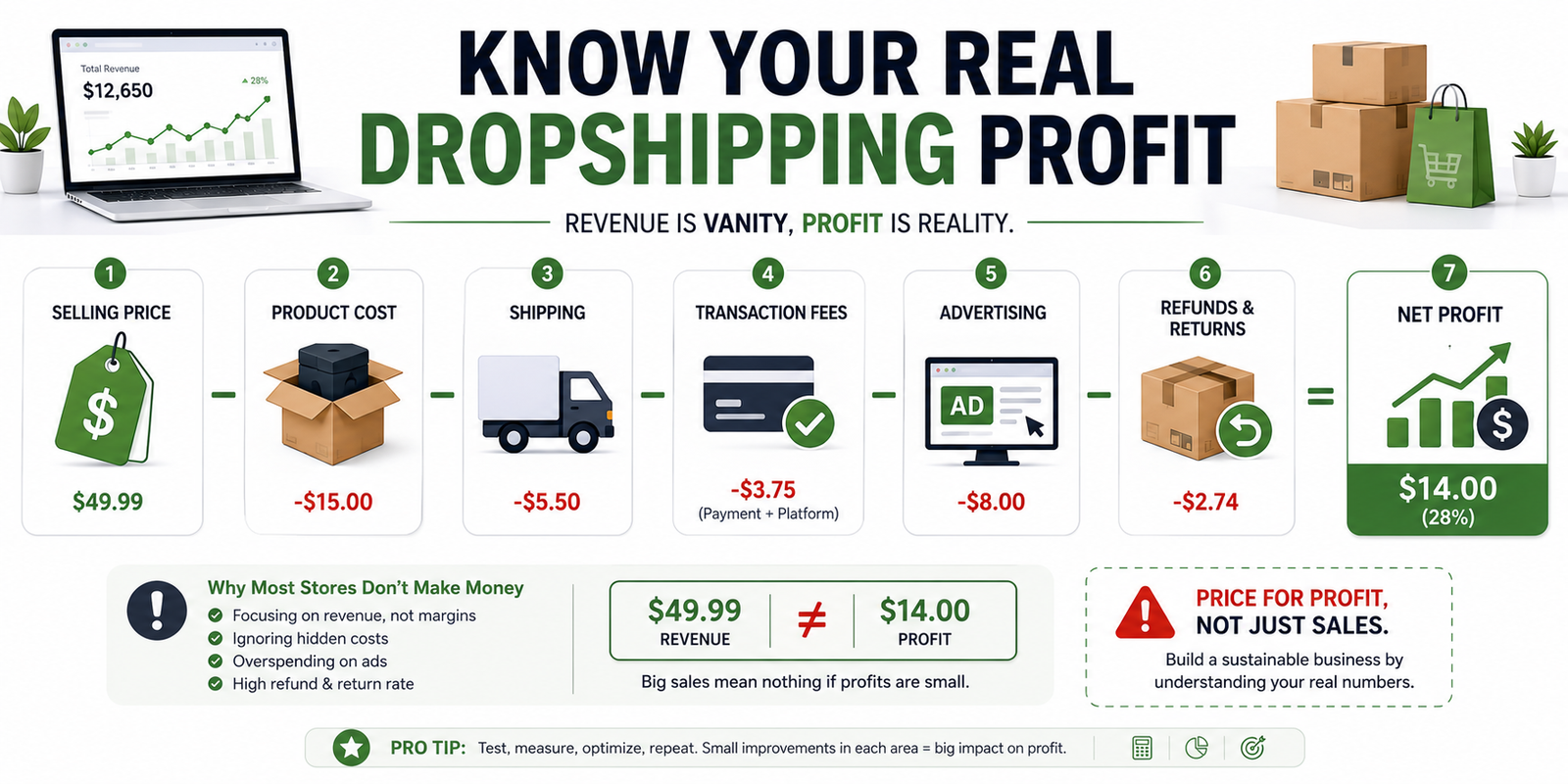
A profitable dropshipping pricing strategy should account for product cost, shipping, fees, advertising, refunds, and returns.
For a step-by-step breakdown of effective pricing frameworks, visit our resource on dropshipping pricing strategies to maximize profit. It explains how top-performing stores set sustainable pricing that grows profit instead of chasing volume.
Ready to fix your pricing strategy? Let’s talk. Contact us today, and we’ll review your current approach to help you unlock better margins.
Mistake 4: Writing Poor Product Descriptions
This is where the difference between a well-built Shopify dropshipping store and an average one becomes visible. Many sellers copy manufacturer descriptions or write short, robotic product explanations that fail to connect with potential buyers. These generic descriptions often do little to differentiate the product or give shoppers a reason to buy from your store.
A strong product description does more than list features. It highlights customer pain points, focuses on benefits, and builds trust and desire to buy. It should sound natural, clear, and human. When a visitor lands on your page, they immediately want to know whether the product fits their needs, solves a problem, and comes from a reliable seller.
Your product page should answer all three of these questions through tone, structure, and value-driven storytelling. Our complete guide on how to write product descriptions that sell shares the proven formula used by top-performing stores to turn visitors into paying customers.
Mistake 5: Ignoring Customer Service and Communication
A surprising number of dropshippers set up their stores and then disappear. They fail to respond to inquiries, don’t follow up on shipping delays, and certainly don’t handle customer complaints with grace.
This approach is catastrophic for word of mouth, reviews, and repeat business. In today’s market, exceptional customer service isn’t a nice-to-have; it’s a competitive advantage. Customers are more likely to pay a premium and remain loyal when they feel heard and valued.
The best dropshippers treat customer inquiries as opportunities to build relationships. They’re transparent about shipping times, proactive about issues, and genuinely helpful when problems arise.
Shipping communication is especially important in dropshipping because the supplier handles fulfillment while your store remains responsible for the customer experience. Set realistic delivery expectations before purchase, provide tracking information when available, and communicate quickly if an order is delayed. Clear communication, responsive support, and straightforward return policies are all important parts of a strong ecommerce customer experience.
Poor communication is another of the Shopify dropshipping mistakes that can quickly damage customer trust, especially when shipping delays or return issues are handled poorly.
Mistake 6: Poor Traffic Strategy and Paid Advertising Mistakes
A common myth: if you build it, they will come. They won’t. Without a deliberate traffic strategy, your store will sit empty.
One of the easiest Shopify dropshipping mistakes to make is spending heavily on paid advertising before testing the audience, offer, creative, and landing page.
Some dropshippers rely solely on organic traffic or hope that social media will magically send customers their way. Others jump into paid advertising without a strategy, only to burn through budgets on the wrong audiences or poorly designed ads.
Successful dropshipping requires a mix of traffic sources: organic social media, email marketing, search engine optimization, and yes, paid advertising when done thoughtfully. But paid ads require testing, data analysis, and a willingness to adjust quickly. As noted by HubSpot’s e-commerce marketing guide, successful brands balance organic growth with data-driven ad strategies for long-term stability.
Start small with paid campaigns, monitor your performance carefully, and scale the campaigns that show promising results. Don’t expect immediate profitability. Treat your initial advertising spend as a testing phase. Compare audiences, creatives, offers, and landing pages before increasing your budget, rather than assuming the first campaign will be profitable.
Mistake 7: Not Building an Email List or Customer Retention Strategy
One-time transactions are the enemy of sustainable dropshipping. Acquiring new customers can be expensive, which makes retaining customers who already know and trust your store an important part of sustainable growth.
Email lists, SMS marketing, and customer retention tactics are often overlooked by newer dropshippers who are fixated on traffic and sales volume. This is backward thinking. A smaller, engaged email list can be more valuable than a much larger audience of visitors who have little interest in buying. Email marketing can support customer relationships, repeat purchases, abandoned-cart recovery, and other stages of the customer journey.
Build an email list from day one. Offer a small incentive (a discount code, free guide, or exclusive tip), capture emails, and then maintain regular, valuable communication. This creates a repeatable revenue stream that doesn’t rely entirely on expensive paid ads.
Want help improving your retention system or automating your communication? Visit our Contact Us page to get personalized support for your store’s next stage of growth.
Quick Answer: How Do You Avoid Shopify Dropshipping Mistakes?
To avoid Shopify dropshipping mistakes, test suppliers before committing, validate product demand, calculate your full costs before setting prices, write original product descriptions, communicate shipping expectations clearly, test advertising carefully, and build email and customer retention systems early.
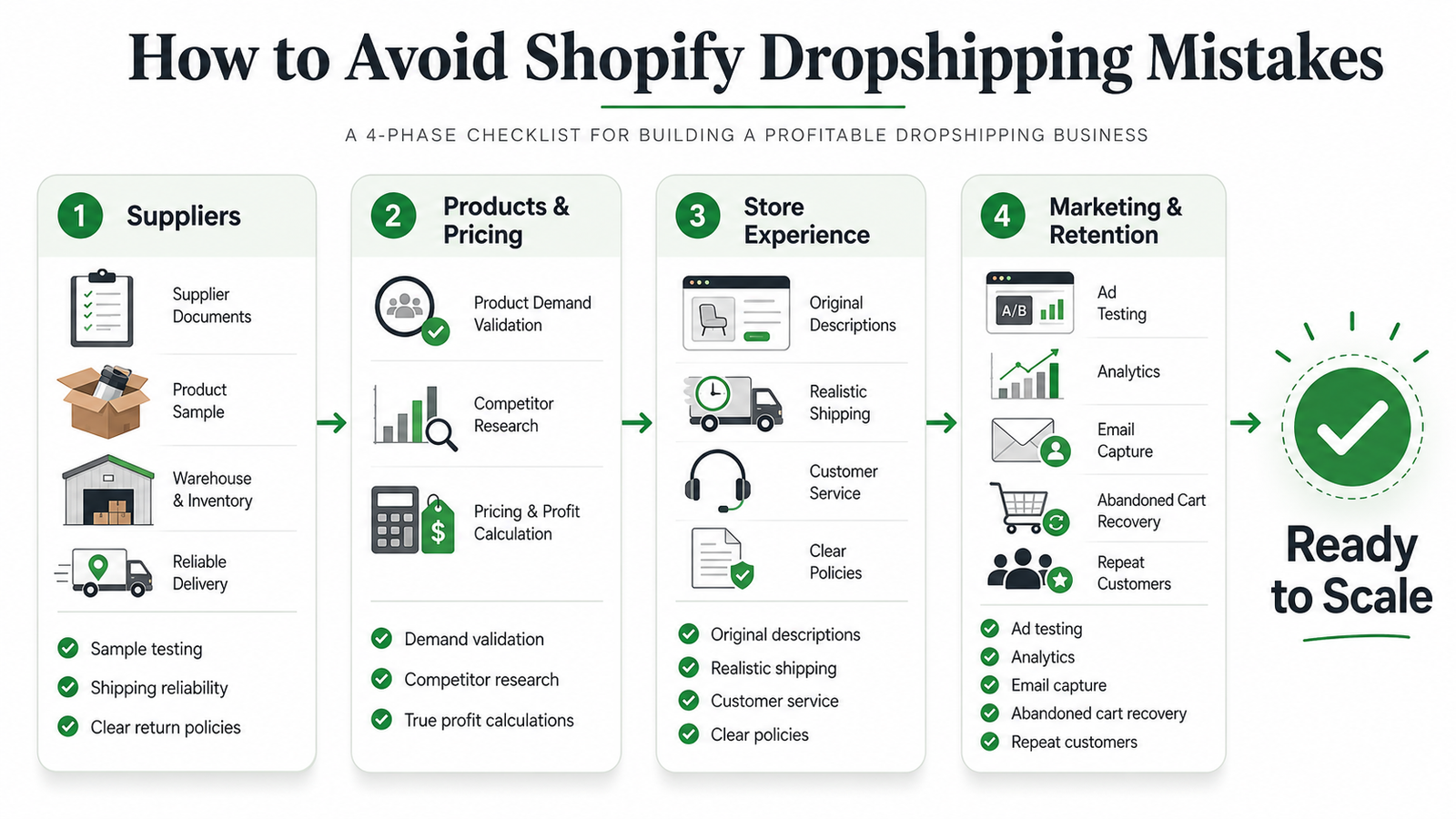
A practical checklist for avoiding common Shopify dropshipping mistakes before scaling an online store.
Conclusion: Your Roadmap to Dropshipping Success
Building a successful Shopify dropshipping store is not just about finding products and driving traffic. The decisions behind your suppliers, pricing, product research, marketing, and customer experience can have a major impact on whether the business becomes sustainable.
The good news is that many common Shopify dropshipping mistakes are preventable. Take time to test suppliers, validate demand, understand your true costs, create useful product pages, communicate clearly with customers, and measure your marketing before trying to scale.
You do not need to get everything perfect from day one. What matters is paying attention to the numbers, learning from customer behavior, and fixing weak areas before they become expensive problems.
Avoiding these Shopify dropshipping mistakes starts with reviewing each part of the customer journey, from supplier selection and pricing to fulfillment, marketing, and retention.
If you are building your first store, our guide to starting a profitable dropshipping business can help you plan your next steps.
FAQ: Common Questions About Shopify Dropshipping Mistakes
Q. How much does it cost to start a dropshipping business on Shopify in 2026?
The cost of starting a Shopify dropshipping business varies depending on your plan, domain, apps, marketing, and other tools. Shopify estimates that a lean dropshipping setup can cost around $200 to $600 per month, including the Shopify subscription, domain registration, dropshipping tools, and initial marketing expenses. Actual costs can be lower or higher depending on how you build and promote your store.
Q. How long does it take to see profit in dropshipping?
There is no fixed timeline for becoming profitable with dropshipping. Results depend on factors such as your product, pricing, traffic quality, marketing strategy, conversion rate, and operating costs. Some online sellers generate sales quickly, while others need more time to build traffic and customer trust. Focus on improving your margins and performance data rather than expecting profitability within a specific number of months. Focus on improving your margins and performance data rather than expecting profitability within a specific number of months.
Q. Can I dropship the same products as other stores?
Yes, technically you can, but selling the same products without differentiation can make competition more difficult. If you’re offering an identical product at a similar price with the same supplier images and descriptions as everyone else, customers have little reason to choose your store. Focus on differentiation through better customer service, stronger content, clearer positioning, unique bundles, branding, or a specific audience you understand well.
Q. What’s the most common reason dropshipping businesses fail?
There is no single reason every dropshipping business struggles. Common problems include unreliable suppliers, poor product research, weak profit margins, ineffective marketing, unrealistic shipping expectations, and poor customer service. In many cases, several small problems combine rather than one mistake causing the business to fail.
Q. Should I use Shopify or another platform for dropshipping?
Shopify is a popular platform for dropshipping because it supports product sourcing, order management, fulfillment integrations, and a wide range of dropshipping apps. Suppliers can ship products directly to customers while you manage the storefront and customer relationship through Shopify. Other ecommerce platforms can also support dropshipping, so the best choice ultimately depends on your budget, technical preferences, required integrations, and business model.
If you’re ready to take your dropshipping business to the next level and want expert guidance on avoiding these costly mistakes, get started with our Shopify dropshipping service. We work with store owners to optimize everything from supplier selection to customer acquisition, and we’d love to help you build something that actually works.


One Comment