
How Amazon AI Ads Are Changing Seller Marketing in 2026
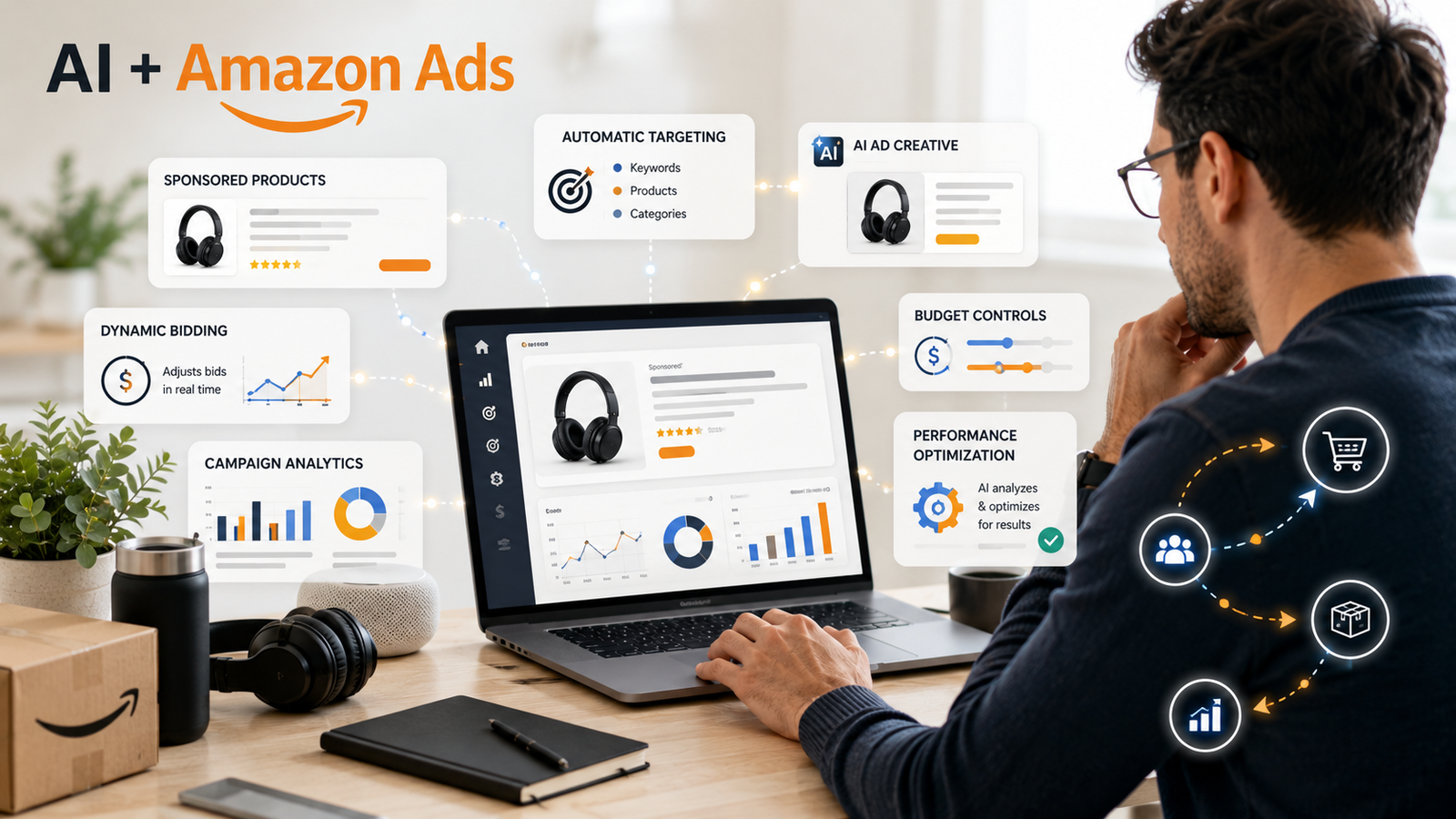
Amazon AI ads are changing how sellers plan, create, manage, and optimize advertising in 2026. Artificial intelligence now appears across more of Amazon Ads, from dynamic bidding and targeting recommendations to generative creative tools and AI assistants that can help advertisers analyze and manage campaigns.
Adoption is already moving quickly. According to Amazon Ads research on AI advertising, 74% of U.S. small and medium-sized business marketing leaders were already using or actively testing AI advertising tools, while 87% believed AI could support future growth by freeing up more time for strategic priorities. The important point is not that AI automatically guarantees stronger advertising results. It is that sellers now have more ways to reduce repetitive campaign work while keeping control of their products, budgets, and overall strategy.
For sellers who have spent years working through manual campaign optimization, product targeting, and bid adjustments, this shift can initially feel overwhelming. In practice, many of Amazon’s automation tools are designed to reduce the amount of repetitive campaign management sellers need to handle themselves. Instead of reviewing every small adjustment manually, sellers can spend more time on product strategy, profitability, inventory, and growth.
Whether you manage a small private-label brand or a larger catalog, understanding where Amazon uses AI and where human judgment still matters is becoming an important part of advertising in 2026.
Quick Answer: What Are Amazon AI Ads?
Amazon AI ads refers to Amazon advertising features that use machine learning, automation, or generative AI to help with bidding, targeting, campaign analysis, creative production, and optimization. These tools can reduce repetitive advertising work, but sellers still need to control budgets, profitability, product strategy, and final campaign decisions.
What Are Amazon AI Ads and How Do They Actually Work?
What are Amazon AI ads? Rather than being one single Amazon advertising product, the term generally refers to Amazon Ads features that use machine learning, automation, or generative AI to help advertisers manage different parts of a campaign.
Depending on the campaign and advertising product, Amazon can use shopping and advertising signals to assist with bidding, targeting, recommendations, campaign management, and creative production.
The important distinction is that not every Amazon ad campaign uses the same level or type of automation. A Sponsored Products seller using dynamic bidding has a very different setup from a larger advertiser using Amazon DSP, Amazon Marketing Cloud, or more advanced AI tools.
Instead of thinking of Amazon AI advertising as one system that runs everything automatically, it makes more sense to look at where automation appears throughout the advertising process.
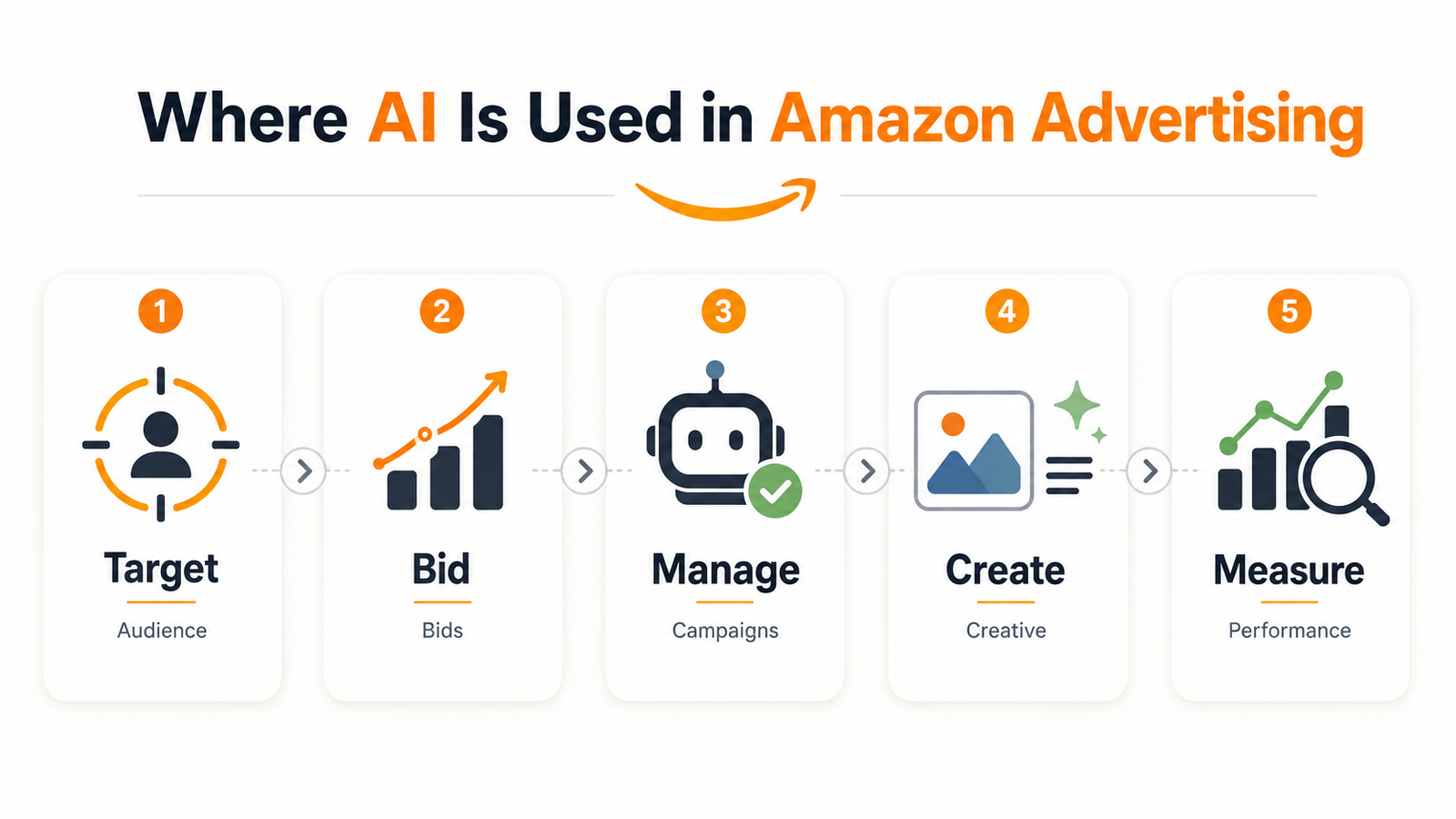
Where AI and Automation Show Up in Amazon Advertising
Dynamic Bidding: Amazon can automatically raise or lower Sponsored Products bids depending on the bidding strategy selected and the likelihood that an ad opportunity will convert.
Automatic Targeting: Sponsored Products automatic targeting can help match ads with relevant shopping queries and products without requiring sellers to manually select every target.
AI-Assisted Campaign Management: For eligible advertisers, Amazon Ads’ Ads Agent can help with campaign planning, analysis, targeting, pacing, and optimization through a conversational AI experience. Availability varies depending on account type, product access, and location.
Generative AI Creative Tools: Amazon Ads now includes tools such as Creative Agent, Image Generator, Video Generator, Audio Generator, and Creative Studio to make ad production faster.
 Amazon AI Advertising Features at a Glance
| AI Feature | What It Can Automate | Seller Still Controls |
|---|---|---|
| Dynamic Bidding | Real-time bid increases or decreases | Bidding strategy, margins, targets |
| Automatic Targeting | Matching ads with relevant searches and products | Products, budgets, exclusions, strategy |
| Ads Agent | Analysis, pacing, targeting assistance, campaign tasks | Review and approval of changes |
| AI Creative Tools | Images, videos, audio, concepts, creative drafts | Accuracy, branding, claims, final creative |
| Budget & Bid Rules | Scheduled or performance-based adjustments | Limits, profitability, campaign goals |
Five Ways AI-Powered Amazon Advertising Changes Your Marketing Strategy
1. Automated Campaign Management Reduces Daily Workload
Running Amazon ads once meant spending much more time reviewing campaigns and making manual adjustments. For sellers managing multiple products and campaigns, that can quickly become difficult to maintain.
Depending on the campaign type and settings being used, Amazon can now automate parts of bidding, targeting, pacing, recommendations, and campaign analysis.
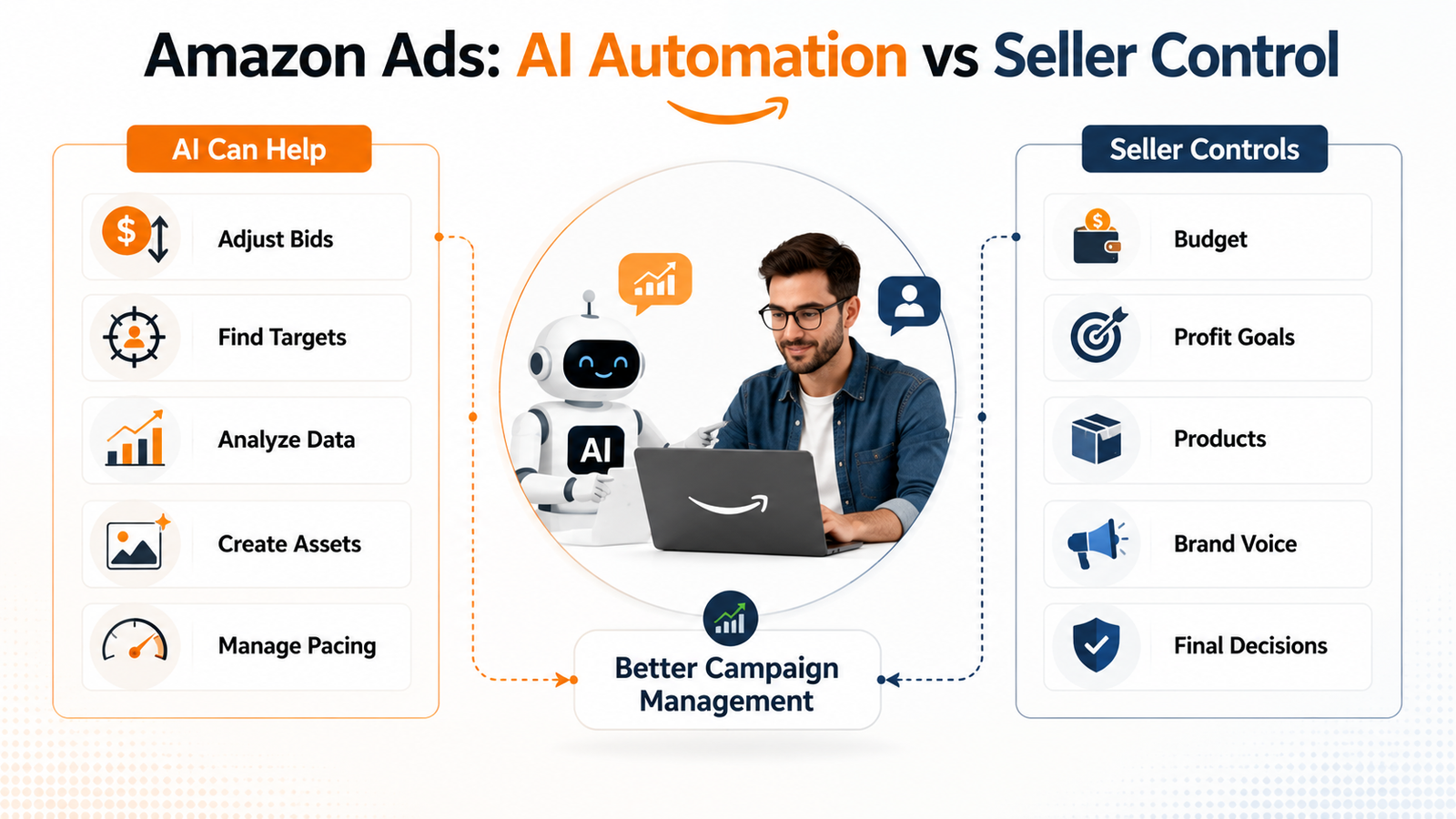
You still guide the overall strategy, set budgets, choose which products to advertise, and define what profitable performance looks like. Automation simply reduces some of the repetitive work underneath those decisions.
That can be especially useful as the number of products, campaigns, keywords, and marketplaces you manage begins to grow.
2. Dynamic Bidding Automates More of Bid Management
One of the most practical automation features available to Amazon sellers is dynamic bidding for Sponsored Products.
With dynamic bids – down only, Amazon can reduce your bid when an ad opportunity appears less likely to convert. With dynamic bids – up and down, Amazon can increase bids when an opportunity appears more likely to lead to a sale and reduce them when conversion appears less likely.
Amazon’s official Sponsored Products dynamic bidding guide explains how bids can be adjusted in real time based on conversion likelihood.
That does not mean dynamic bidding automatically produces a better ACoS or ROAS.
Product margins, conversion rates, competition, targeting, pricing, and listing quality still matter. Dynamic bidding gives Amazon more flexibility to adjust your bid within the strategy you choose, but sellers should still compare performance rather than assuming the most automated option will always be the most profitable.
3. Automated Targeting Can Reveal New Shopping Opportunities
One useful aspect of Amazon’s automatic targeting is discovery.
Instead of manually choosing every keyword or product target, automatic Sponsored Products campaigns can help match ads with relevant shopping queries and products.
That can reveal search behavior and targeting opportunities a seller may not have considered when building manual campaigns.
The data can then help you decide whether certain search terms, products, or targeting themes deserve more attention elsewhere in your advertising strategy.
More advanced advertisers using Amazon DSP or Amazon Marketing Cloud may have access to deeper audience and first-party signals, but those capabilities should not be confused with the targeting available in every seller campaign.
4. Automation Helps Sellers Prepare for Seasonal Demand
Major shopping periods such as Prime Day, Black Friday, and the holiday season can change campaign performance quickly.
Amazon provides bidding and budget automation that can make these periods easier to manage, but sellers still decide how and when those rules should be used.
Sponsored Products schedule bid rules, for example, can be set around particular times, days, date ranges, or high-traffic events. Budget rules can also automatically increase daily budgets based on schedules or campaign-performance conditions.
The advantage is not that Amazon’s AI automatically predicts every trend before your competitors.
Instead, automation gives sellers a way to prepare campaigns to respond to known high-demand periods without manually changing every bid and budget throughout the event.
5. Generative AI Makes Ad Creative Faster to Produce
Creative production is another area where Amazon has expanded its use of AI.
Amazon Ads now offers AI-assisted tools for images, video, audio, creative concepts, and campaign production. Its current AI creative solutions include Creative Agent, Image Generator, Video Generator, Audio Generator, and Creative Studio.
For Sponsored Brands and other eligible advertising formats, these tools can help advertisers turn existing product information and assets into ad-ready creative much faster than starting every variation from scratch.
Creative Agent goes further by helping with product and audience research, brainstorming, storyboards, and campaign assets. Amazon currently lists Creative Agent as being in open beta for U.S. advertisers, so access should not be assumed for every seller or marketplace.
AI-generated creative should still be reviewed carefully.
Check product details, wording, claims, branding, images, and anything that could misrepresent what the customer will actually receive.
Amazon Ads Agent Is Making Campaign Management More Conversational
Another important development is Amazon’s Ads Agent.
For eligible advertisers, Ads Agent provides a conversational interface for planning, launching, analyzing, and optimizing advertising campaigns.
Amazon says it can assist with tasks such as adjusting pacing across campaigns, creating campaign structures, identifying audience opportunities, and simplifying Amazon Marketing Cloud analysis. Importantly, Amazon also states that advertisers can review and approve proposed changes before they are made.
This represents a broader change in how advertisers may interact with complex campaign data.
Instead of manually opening multiple reports to investigate every question, more advertising tasks can begin with a natural-language request followed by AI-assisted analysis.
However, Ads Agent access varies by locale and advertising setup, so it should not be presented as a feature automatically available to every Amazon seller.
Common Challenges Sellers Face When Adopting AI Advertising
Learning Curve and Initial Setup Complexity
Many Amazon sellers hesitate to use more automated advertising because the terminology can feel technical at first.
Bidding strategies, targeting types, campaign rules, audience tools, and AI-generated creative all solve different problems. Trying to activate everything at once can make the process harder rather than easier.
The better approach is to understand what each tool is actually controlling.
Dynamic bidding changes bids. Automatic targeting helps discover relevant searches and products. Generative AI helps create assets. More advanced tools such as Ads Agent assist with campaign analysis and management for eligible advertisers.
The learning curve therefore shifts from making every adjustment manually to understanding when automation should be trusted and when intervention is needed.
Balancing Automation With Manual Oversight
Complete automation can sound appealing, but Amazon’s systems still do not understand every part of your business.
They do not know your supplier situation, exact profit margins, upcoming inventory constraints, product roadmap, or brand priorities unless those considerations are reflected in the data and settings they can access.
You do not need to watch every bid manually, but you should establish a review schedule that matches your campaign spend and how quickly performance can change.
Human oversight also matters beyond advertising. Account health, policy compliance, intellectual property issues, and seller-performance problems cannot simply be handed to an ad algorithm. If a wider account issue has already resulted in enforcement, our Amazon account suspension appeal guide explains what sellers should review before responding.
Budget Management in Automated Campaigns
Many sellers worry about losing control of spending when they increase automation.
That concern is reasonable, but it is important to understand how Amazon budgets actually work.
Sponsored ads use an average daily budget. Actual campaign spend can vary from one day to another, and Amazon provides settings that may allow campaigns to use more than the stated average daily amount on higher-opportunity days while managing the budget across the calendar month.
So the old idea that Amazon can “never exceed your daily budget” is misleading.
Before increasing automation, review your average daily budgets, campaign settings, bid rules, budget rules, and overall monthly advertising limits.
And do not assume that simply giving AI more money will improve efficiency. Additional spend only makes sense when the economics of the campaign still work.
 Practical Steps to Implement AI Advertising in Your Amazon Business
Step 1: Audit Your Current Campaign Performance
Before changing how your advertising is managed, establish a baseline.
Document the metrics that matter for your current campaigns, such as:
- ACoS
- ROAS
- Ad spend
- Ad-attributed sales
- Conversion rate
- CPC
- CTR
- Total sales
Without a baseline, it becomes difficult to know whether automation genuinely improved the business or simply changed the numbers.
If you are advertising a new product, make sure the wider launch is ready too. Our Amazon product launch checklist covers the listing, inventory, pricing, reviews, and operational factors worth checking before aggressively scaling traffic.
Step 2: Start With One Campaign Type
Rather than changing your entire advertising structure at once, begin with one campaign or one clear use case.
Sponsored Products with automatic targeting or dynamic bidding can be a practical starting point because you can compare the automated approach with the campaign structures you already understand.
Run the test long enough to collect useful data.
There is no universal three-week period that applies to every product. A high-volume listing can collect meaningful information much faster than a niche product with limited traffic.
Step 3: Set Clear Performance Goals
Automation works better when you know what you want it to achieve.
Possible goals include:
- Maintaining ACoS within a profitable range
- Growing ad-attributed sales
- Reaching more new-to-brand customers where that metric is available
- Supporting a product launch
- Improving campaign efficiency
- Increasing profitable market reach
Avoid setting arbitrary targets simply because another seller uses them.
A profitable ACoS for one product can be unsustainable for another because margins, pricing, fees, repeat purchase behavior, and business goals differ.
Step 4: Give Automated Campaigns Enough Data
Automated systems need campaign data to make useful decisions.
How quickly that happens depends on factors such as traffic, spend, clicks, conversions, targeting, category, and product demand.
There is no universal Amazon Ads learning period of exactly seven, fourteen, or twenty-eight days that applies to every AI advertising feature.
Monitor campaigns closely enough to catch genuine problems, but avoid changing settings simply because performance moves for a short period.
Make strategic adjustments when the data gives you a clear reason.
Step 5: Scale Gradually Based on Results
Once an automated campaign is producing results that fit your profitability goals, you can consider increasing investment.
There is no universal rule that budgets should rise by twenty or thirty percent every week.
Scale at a pace that lets you monitor whether additional spend continues to produce acceptable returns.
Many sellers may also find that a hybrid strategy works well. Automation can handle discovery and repetitive adjustments while manual campaigns remain useful for targets where tighter control matters.
How AI Advertising Integrates With Your Broader E-Commerce Strategy
Amazon AI ads do not operate in isolation. Better campaign automation cannot compensate for weaknesses elsewhere in the business.
Listing Optimization: Advertising can bring shoppers to a product detail page, but the listing still needs to convert them. Product images, titles, bullets, pricing, reviews, and the overall offer all influence what happens after someone clicks.
If advertising traffic remains healthy but organic visibility changes unexpectedly, our guide on why Amazon listings lose rankings covers other factors sellers should investigate instead of assuming advertising is the only cause.
Inventory Management: Strong advertising can increase sales velocity. That becomes a problem if the campaign creates demand for inventory you cannot keep in stock. Coordinate advertising decisions with replenishment and fulfillment planning.
Pricing Strategy: AI can optimize parts of ad delivery, but it cannot make an uncompetitive product offer convert efficiently. Advertising decisions should always be viewed alongside pricing and contribution margin.
Customer Experience: Advertising can bring more buyers to a product, but reviews, repeat purchases, and long-term brand trust depend on what happens after the click. Accurate listings, reliable fulfillment, product quality, and responsive customer service still matter.
What Is Changing in Amazon AI Advertising in 2026?
Amazon is moving beyond individual automation features toward a broader AI-assisted advertising workflow.
Ads Agent can help eligible advertisers work through campaign planning, analysis, targeting, and optimization using natural-language interactions. Creative Agent adds AI assistance to campaign concepts and asset creation.
Amazon is also bringing AI into the shopper-facing ad experience. Sponsored Products prompts and Sponsored Brands prompts moved to general availability in the U.S. in March 2026. These prompts can surface relevant product information in shopping results and product detail pages and may open an interaction through Rufus.
Sponsored Brands has become more automated as well. In May 2026, Amazon introduced AI-powered Sponsored Brands collections that can automatically select relevant groups of products from an advertiser’s catalog based on campaign targets and shopping signals. Advertisers can still use manual product selection when they want greater control.
For more advanced advertisers, Amazon also expanded Brand+ and Performance+ in July 2026 with additional AI-powered optimization capabilities and more advertiser controls.
The direction is clear: AI is spreading across targeting, campaign management, creative production, product selection, analysis, and the shopping experience.
The seller’s job is increasingly shifting from making every tactical adjustment manually to setting the right goals, checking profitability, reviewing recommendations, and deciding where automation should have control.
 Measuring Success: Key Performance Indicators for AI Advertising
To know whether automation is helping, look beyond total sales.
ACoS Trend Over Time
Advertising Cost of Sales shows how much ad spend is required to generate ad-attributed sales.
Instead of reacting to one unusually good or bad day, look for patterns over a meaningful period and compare ACoS with the margin your product can actually support.
New-to-Brand Metrics
For eligible campaign types, new-to-brand reporting can help advertisers understand whether advertising is reaching customers who are new to the brand according to Amazon’s defined measurement window.
This can be useful when the goal is customer acquisition rather than simply generating another purchase from an existing buyer.
Impression Share
Where available, impression-share reporting can provide context around how often your advertising appears relative to eligible opportunities.
Use it alongside other metrics rather than treating a high impression share as success on its own.
Return on Ad Spend
ROAS looks at advertising performance from the opposite direction of ACoS.
If a campaign spends $1 and generates $5 in attributed sales, the ROAS is 5x.
But revenue alone is not profit. A campaign can show a strong ROAS and still underperform financially if margins are thin.
Total Sales and Ad-Attributed Sales
Do not assume that paid advertising automatically improves organic rankings.
Instead, compare ad-attributed sales with total sales, profitability, and overall product performance.
The goal is to understand whether advertising is producing valuable incremental demand and supporting the wider business, not simply generating attractive advertising metrics.
Real World Application: Making AI Advertising Work for Your Business
The best level of automation depends less on how many years you have been selling and more on how much data and campaign complexity you are managing.
New or Low-Data Campaigns
If a product does not yet have much advertising history, automatic targeting can help uncover relevant search and product opportunities.
Use the early data to understand buyer behavior before making major assumptions about which keywords or targets deserve more budget.
Established Campaigns With Reliable Data
If you already have campaigns producing consistent results, introduce automation where it solves a clear problem.
Compare dynamic bidding, automatic targeting, rules, or other automated features against the approaches you already use.
There is no need to turn off a profitable manual campaign simply because a newer automated option exists.
Large or Complex Advertising Accounts
As the number of products, campaigns, targets, and marketplaces increases, automation becomes increasingly useful.
AI-assisted campaign management can reduce repetitive work at scale, while your team focuses on profitability, product strategy, inventory, creative direction, and major budget decisions.
The goal at every stage is the same: use automation where it improves efficiency without losing sight of the economics behind the campaign.
Conclusion: Taking the Next Step in Your Amazon Advertising Journey
Amazon AI ads in 2026 are best viewed as a growing set of advertising tools rather than a completely hands-off marketing system.
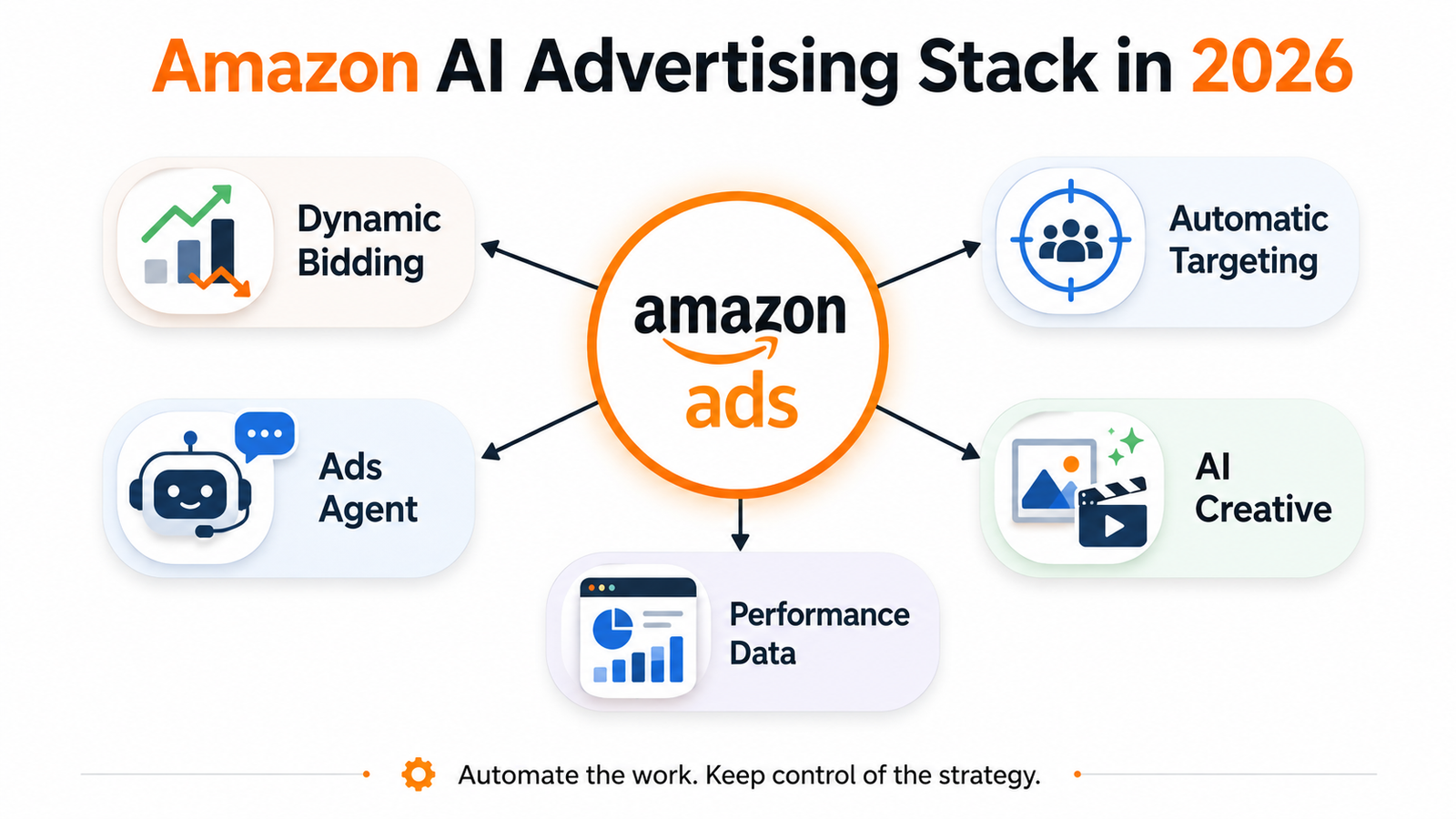
Dynamic bidding, automatic targeting, Ads Agent, generative AI creative tools, automated rules, and newer AI-powered ad experiences can reduce manual work and help advertisers make sense of more data.
But automation does not remove the fundamentals.
Sellers still need to understand margins, choose the right products, control budgets, maintain strong listings, manage inventory, review creative, and decide what successful performance actually looks like.
AI can make Amazon advertising easier to manage at scale. It cannot make a weak product, poor offer, or unprofitable campaign successful on its own.
If you want support building a larger Amazon operation around advertising, inventory, sourcing, and fulfillment, explore our Amazon Wholesale FBA services.
Frequently Asked Questions About Amazon AI Advertising
Q. How much does it cost to use Amazon’s AI advertising features?
Costs depend on the advertising product and feature being used.
Many automation features within sponsored ads work as part of the normal advertising campaign rather than requiring a separate AI subscription. You still pay the normal advertising costs associated with the campaign.
Some individual AI tools also have their own availability conditions. For example, Amazon currently lists Ads Agent as available at no cost to eligible advertisers, although access varies by advertising setup and locale.
Q. Can small sellers compete with big brands using AI advertising?
Small sellers can access useful automation features such as Sponsored Products automatic targeting, dynamic bidding, and certain AI-assisted creative tools.
That does not guarantee they will outperform larger brands.
Results still depend on product demand, pricing, margins, listing quality, competition, reviews, inventory, budget, and campaign strategy.
Q. How long does it take to see results from AI-powered campaigns?
There is no universal timeframe.
Automated campaigns need enough impressions, clicks, conversions, and other campaign data to provide useful performance information. How long that takes depends on the product, category, budget, traffic, targeting, and campaign type.
Avoid judging an automated campaign by an arbitrary one-week or four-week rule.
Q. Should I turn off manual campaigns when I start using AI advertising?
Not necessarily.
If a manual campaign is already profitable and gives you the control you need, there is no reason to shut it down simply because automation is available.
Test automated features where they solve a clear problem and compare performance using enough data to make a useful decision. Many advertisers may benefit from using manual and automated approaches together.
Q. Does AI advertising work equally well for every Amazon product category?
No advertising approach performs equally across every category.
Automation can be useful across many products, but results depend on search demand, competition, conversion rate, price, margins, listing quality, available campaign data, and the strength of the offer.
A category with more data may give automation more information to work with, but that does not guarantee better profitability.
Not sure which parts of your Amazon business should be optimized first? Contact the HiSellIt team to discuss your current setup and growth goals.