
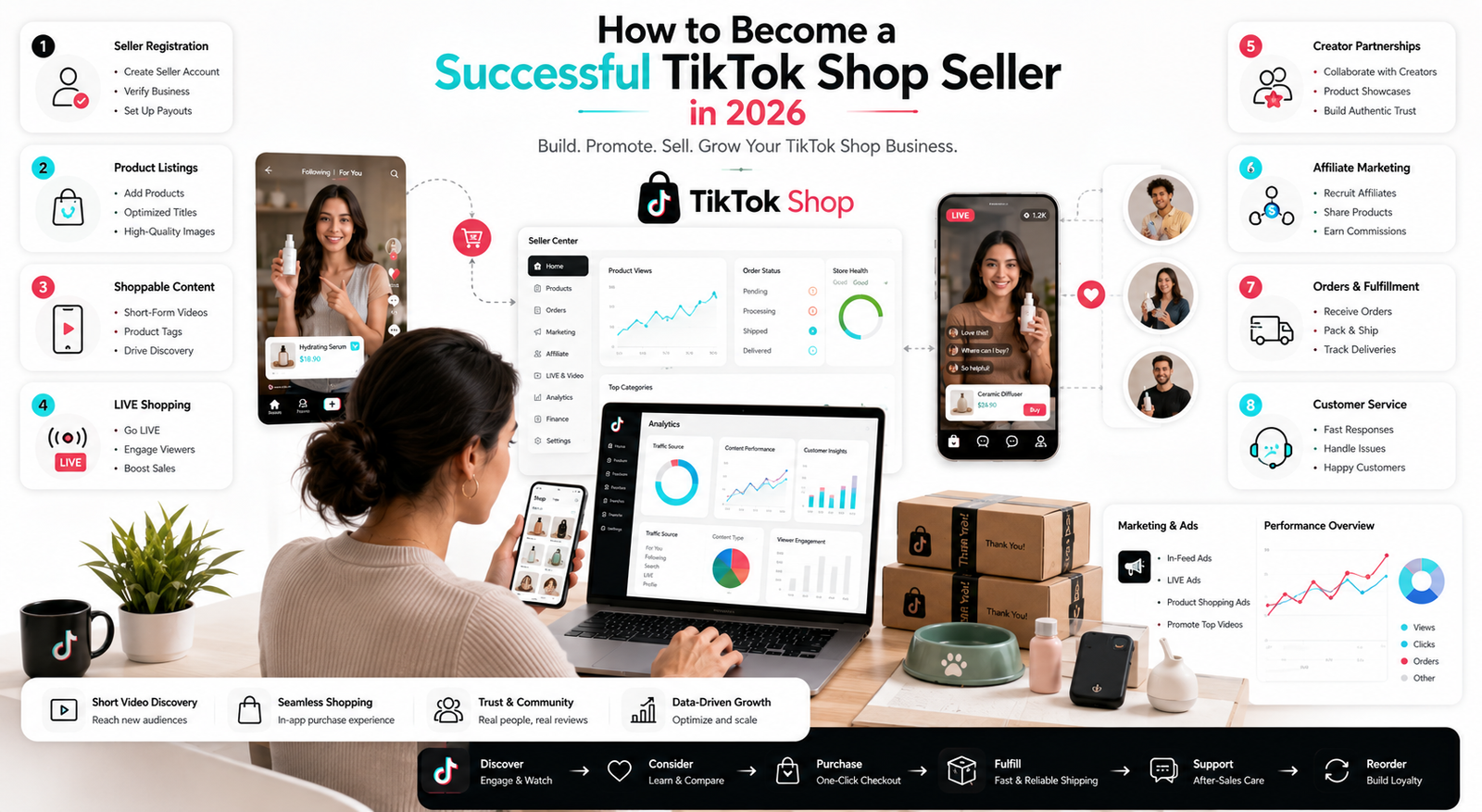
How to Become a Successful TikTok Shop Seller in 2026
Learning how to become a TikTok Shop seller in 2026 means understanding a commerce environment where content, search, creators, LIVE shopping, product discovery, and in-app purchasing work together. TikTok Shop has moved far beyond being a social-commerce experiment. In the U.S., TikTok reported that Shop sales increased 120% year over year during the first part of 2025, while sales exceeded $500 million during the four-day Black Friday and Cyber Monday period in 2025. These figures show the platform’s scale, although they do not guarantee results for an individual merchant.
The opportunity for retailers is significant, but being successful on TikTok Shop requires more than simply listing products. Sellers need to understand content creation, search behavior, creators, customer service, product compliance, fulfillment, advertising, and account health.
TikTok Shop combines entertainment-led discovery with increasingly important search and commerce behavior. Customers can encounter products through shoppable videos, LIVE streams, creators, Shop recommendations, product cards, and searches. Success therefore requires a balance between strong ecommerce operations and content that naturally fits the TikTok environment.
Quick Answer: How Do You Become a TikTok Shop Seller in 2026?
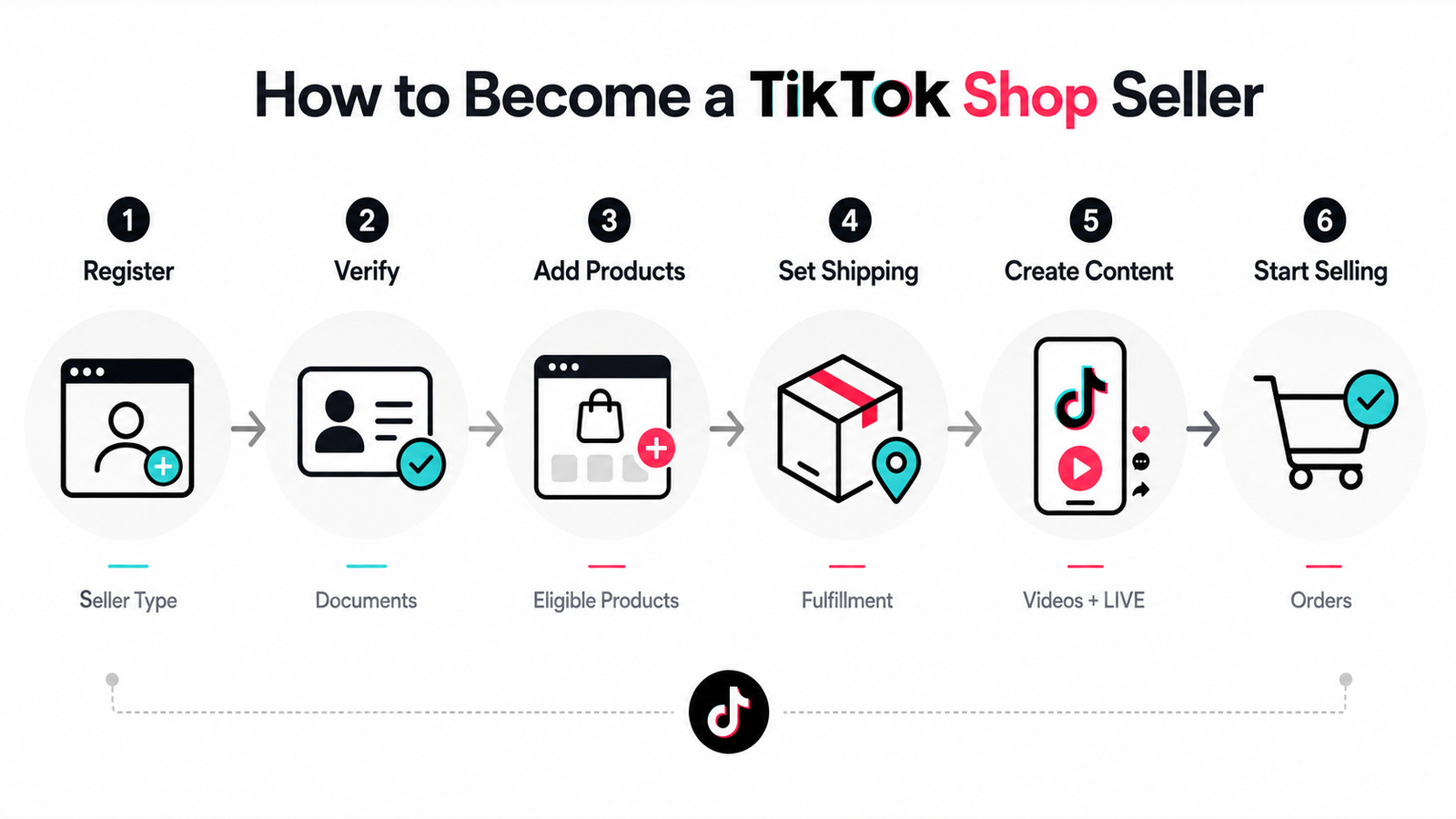
To become a TikTok Shop seller, choose the correct seller type, complete identity or business verification, connect your tax and bank information, list eligible products, configure shipping and returns, and begin promoting products through shoppable content, LIVE, creators, TikTok Shop Affiliate, and eligible Shop advertising. Long-term success also depends on product quality, fulfillment, customer service, Shop Performance Score, Account Health Rating, and careful use of Seller Center analytics.
Understanding the TikTok Shop Environment
Before getting into the specifics of becoming a TikTok Shop merchant, it is important to understand how the platform differs from a conventional ecommerce store.
Three ideas remain central to how TikTok Shop operates.
Entertainment-First Commerce
People often open TikTok primarily to consume content, and products can become part of that experience through demonstrations, creator recommendations, LIVE sessions, tutorials, storytelling, and problem-solving videos.
That does not mean every shopper is passively discovering products. Search now plays an increasingly important role as well. A customer might first encounter a product in a video, search for comparisons, visit a product card, watch a LIVE demonstration, and then purchase.
Successful merchants therefore need products that can be communicated clearly through content while also maintaining accurate, searchable product listings.
Algorithmic Discovery
TikTok’s recommendation systems help distribute content according to signals such as user interests and interactions. However, organic recommendation and advertising should not be confused.
A seller can generate visibility through organic videos, creators, LIVE, product cards, search, and paid advertising. Advertising spend can play an important role when merchants choose to use TikTok Shop Ads.
Since July 2025, GMV Max has become the default and only supported campaign type for new TikTok Shop Ads using the Sales objective with TikTok Shop as the destination, subject to TikTok’s stated exceptions for certain existing campaign formats.
Community-Driven Sales
Creators, reviews, customer conversations, demonstrations, and community participation can all influence purchase decisions.
This is one reason TikTok Shop sellers need to think beyond individual product listings. Content quality, creator partnerships, fulfillment, customer satisfaction, and shop health all affect the broader business.
 Phase 1: Setting Up the Foundation and Creating an Account
Step 1: Do Market Research and Find Your TikTok Shop Niche
Start by researching the customer problem or interest your products serve rather than assuming that TikTok Shop is only for one age group.
Broad statements such as “TikTok is mainly Gen Z” are not enough to choose a niche in 2026. Your own customer data, TikTok Shop search behavior, competitor activity, creator audiences, product economics, and category demand are more useful.
Look at products and categories gaining attention, but also investigate whether there is room to differentiate. Read comments carefully because they can reveal customer questions, objections, frustrations, and desired features.
Study TikTok Shop sellers in similar niches. Look at:
- Their product assortment
- How they demonstrate products
- Their shoppable videos and LIVE strategy
- Creator partnerships
- Pricing and promotions
- Customer feedback
- Product reviews
- Shipping promises
- How consistently they publish
Competitor research should generate ideas, not encourage copying.
For a deeper product-research process, use our guide on how to find profitable TikTok Shop niches.
Step 2: What Documents Do You Need to Register on TikTok Shop?
One important correction for sellers is that TikTok Shop does not require every U.S. seller to form a corporation before applying.
Current U.S. TikTok Shop registration supports different business types, including Individual Sellers, Sole Proprietorships, Corporations, and Partnerships. Documentation varies according to the seller type. TikTok’s current seller registration guidance explains the onboarding and tax-information process.
TikTok Shop Seller Registration Types
| Seller Type | Typical Information Required |
|---|---|
| Individual Seller | Identity verification, U.S. address/residency information, tax information, and bank details |
| Sole Proprietorship | Owner identity, applicable business information, tax documentation, and bank details |
| Corporation / Partnership | Legal business information, representative or ownership information, tax details, bank information, and supporting documents |
TikTok’s current U.S. guidance states that Individual Seller applicants must meet identity and residency requirements and submit matching information. Requirements can change, so always review the latest Individual Seller requirements before applying.
The original idea that products fall into only two categories, “white label” or “private label,” should also be avoided. Those terms describe branding or manufacturing arrangements, not TikTok Shop’s legal product-permission system.
Instead, make sure that you:
- Have the right to sell the product
- Do not use counterfeit or unauthorized branded goods
- Have appropriate brand authorization where required
- Check intellectual-property requirements
- Confirm that the item is allowed on TikTok Shop
- Obtain any required category or product qualification
TikTok Shop distinguishes between prohibited products and restricted products. Restricted categories may require category-level, product-level, or invite-only qualification depending on the item and market. Review the current TikTok Shop Restricted Products Policy before sourcing inventory.
Categories such as beauty, electronics, baby products, health-related items, food, automotive products, and others may have additional documentation or eligibility requirements.
You should also establish accounting and inventory systems from the start. Viral demand can create sudden changes in order volume, so inventory visibility and reliable financial records matter even for relatively small shops.
Step 3: How to Create a TikTok Shop Seller Account
Head to TikTok Shop Seller Center and begin the registration process using the seller type that accurately represents your situation.
You may need to provide identity or business information, tax details, banking information, and supporting documents. TikTok Shop does not provide one universal seller-approval timeline. Verification time depends on seller type, document accuracy, identity or business checks, and whether additional information is requested.
Pay careful attention when creating your shop identity. Your shop name, description, logo, product catalog, and content presence should feel consistent.
You will also need to configure your fulfillment and returns workflow.
TikTok Shop Fulfillment Options
| Option | How It Works |
|---|---|
| Seller Shipping | Eligible sellers manage shipping using supported logistics services |
| TikTok Shipping | Shipping services and logistics options are provided through TikTok Shop |
| Fulfilled by TikTok | TikTok stores, picks, packs, and ships eligible inventory |
TikTok’s current customer order shipping requirements explain responsibilities across Seller Shipping, TikTok Shipping, and Fulfilled by TikTok.
Choose the option that fits your product, order volume, margins, delivery needs, and operational capabilities. Do not promise delivery speeds you or your fulfillment provider cannot consistently meet.
Phase 2: Product Strategy and Catalog Development
Step 4: How to Choose the Best Products and Find Suppliers
Select products that align with TikTok Shop policies and can be communicated naturally through content.
Products that are visually demonstrable, solve recognizable problems, have interesting use cases, or can be explained quickly may provide more content opportunities. However, no product type is guaranteed to perform simply because it looks good on video.
The informal idea of a “TikTok-able” product can still be useful. In practical terms, it means a product that can be demonstrated, explained, compared, styled, tested, or incorporated naturally into short-form videos or LIVE content.
Supplier reliability is equally important.
Evaluate:
- Product quality
- Stock consistency
- Delivery speed
- Tracking quality
- Packaging
- Communication
- Returns procedures
- Documentation
- Capacity to handle changes in demand
Reviews can influence buyer confidence, but avoid claiming that a positive review automatically causes the algorithm to boost a listing.
TikTok Shop currently uses Negative Review Rate as part of its broader seller-performance framework. Product satisfaction, fulfillment, and customer-service performance contribute to the Shop Performance Score.
Step 5: How to Optimize TikTok Shop Product Listings
Create listings that are useful to customers and easy for TikTok Shop’s search and recommendation systems to understand. Use accurate titles, relevant product information, correct categories, clear images, accurate attributes, and natural keywords.
Product descriptions should answer common questions such as:
- Size
- Materials
- Compatibility
- Usage
- Care
- What’s included
- Delivery expectations
- Safety or compliance information where applicable
Avoid keyword stuffing or exaggerated claims. Your listing media should also serve a different purpose from your organic content. Listing photography should help shoppers evaluate the product clearly, while TikTok videos can provide demonstrations, storytelling, comparisons, tutorials, or lifestyle context.
Step 6: How Should You Price Products on TikTok Shop?
Competitor pricing can provide context, but your own unit economics should determine whether a product is sustainable. Do not compete solely by undercutting other TikTok Shop sellers.
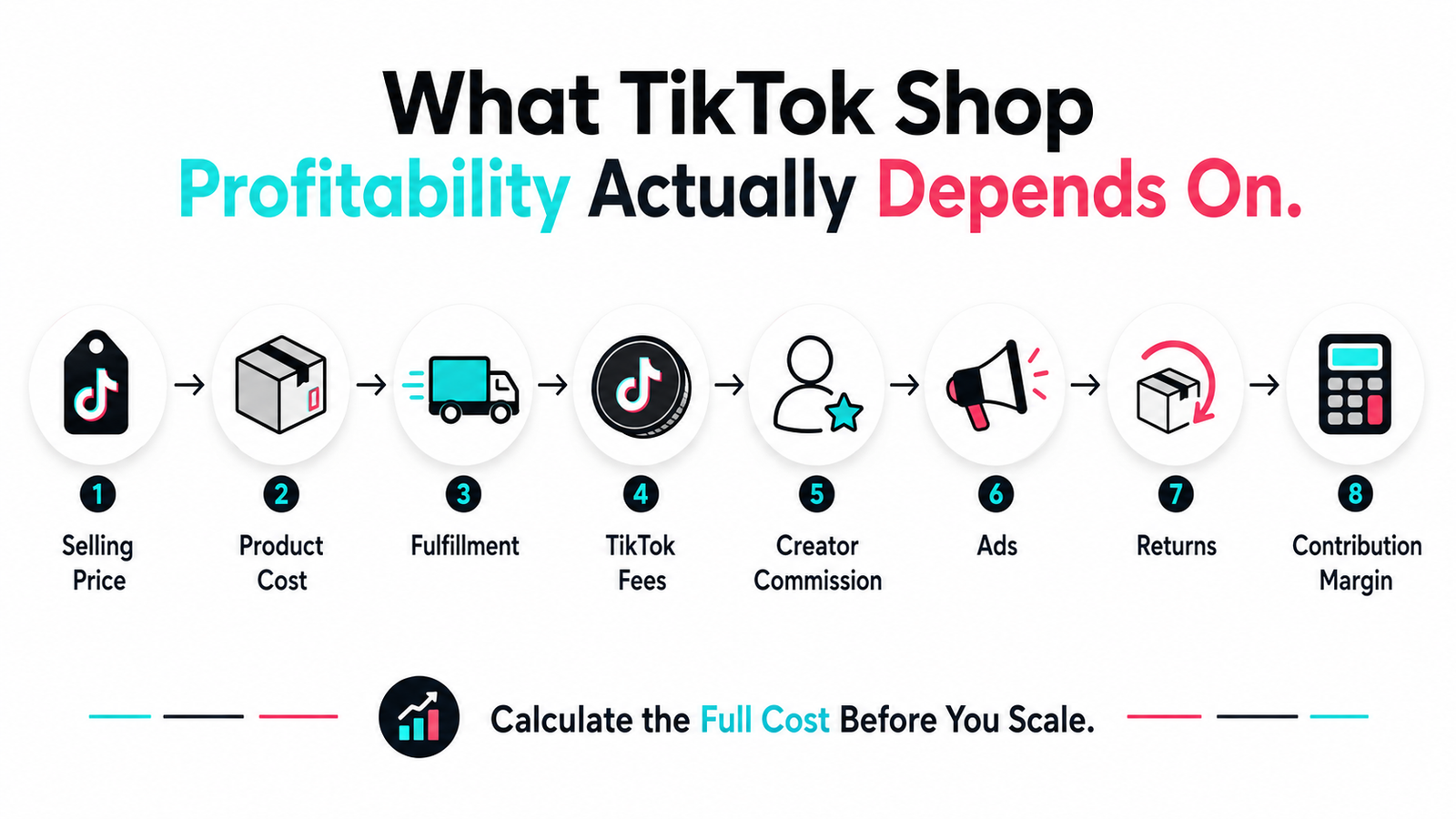
A useful TikTok Shop pricing calculation is:
Selling Price
− Product Cost
− Shipping / Fulfillment
− TikTok Shop Referral Fee
− Creator / Affiliate Commission
− Advertising
− Seller-Funded Discounts
− Returns / Refunds
− Packaging and Operating Costs
= Contribution Margin
TikTok Shop referral fees vary by category. Current U.S. documentation shows many categories at 6%, while certain categories have different rates, so merchants should check the latest TikTok Shop referral-fee schedule rather than assuming one universal percentage.
Leave enough room in your economics for creator commissions, advertising, promotions, returns, and fulfillment instead of calculating profit from product cost alone.
Quick Check: Is a TikTok Shop Product Financially Viable?
Do not judge a TikTok Shop product only by its selling price or supplier cost. Calculate contribution margin after product cost, shipping, TikTok Shop fees, creator commissions, advertising, seller-funded discounts, refunds, returns, packaging, and other operating expenses. A product can generate strong sales and still be unprofitable if these costs are ignored.
 Phase 3: Marketing Strategy and Content Development
Step 7: How to Develop a Content Strategy for TikTok Shop
Develop a content strategy that presents your products through demonstrations, education, entertainment, lifestyle use, problem-solving, or storytelling rather than relying entirely on direct sales messages.
Examine popular TikTok content in your niche to understand pacing, hooks, demonstrations, storytelling methods, and customer questions.
There is no official 70/30 rule requiring 70% educational content and 30% advertising.
Instead, test a mix of:
- Product demonstrations
- Educational videos
- Problem-and-solution content
- Before-and-after demonstrations where accurate and permitted
- Customer use cases
- Creator videos
- Behind-the-scenes content
- Product-focused sales videos
- LIVE shopping
Judge the mix using actual performance.
Strong TikTok content also does not require an expensive production team. Depending on your brand, creator-style phone footage may work alongside more polished product media.
For more current content and conversion ideas, see our TikTok Shop marketing strategies guide.
Step 8: What Is Organic Content Creation?
Invest time in learning how to demonstrate products clearly.
A strong product video might lead with:
- The customer problem
- A surprising product function
- A demonstration
- A question
- A comparison
- A use case
- A customer objection
Develop a consistent brand presence where appropriate, whether that means the founder, employees, creators, or other recurring representatives.
Relevant sounds, hashtags, and trends can also be incorporated when they genuinely suit the product. Avoid forcing unrelated trends simply because they are popular.
Authenticity should mean accurate, believable communication, not deliberately making every video look unpolished.
Step 9: What Creator Partnership Strategy Works for TikTok Shop?
TikTok Shop now has a formal Affiliate ecosystem, so creator partnerships should not be treated only as generic influencer marketing.
Through TikTok Shop Affiliate, sellers can use two important collaboration models:
Open Collaboration: Eligible products can be made available more broadly to Affiliate creators.
Target Collaboration: Sellers can invite specific creators to promote selected products.
TikTok’s current Affiliate collaboration guide explains both Open and Target Collaboration, creator commissions, samples, and performance management.
Evaluate creators according to:
- Audience relevance
- Content quality
- Product fit
- Views
- Orders
- GMV
- Commission costs
- Return or refund patterns
- Reliability
- Repeat performance
Do not assume that micro-influencers automatically deliver better ROI than larger creators.
Set clear standards for partnerships while allowing creators enough creative freedom to communicate naturally with their audience.
Phase 4: Customer Engagement and Community Development
Step 10: How to Create a Community Engagement Strategy
Respond to useful questions and comments in a timely, professional way, but do not promise that replying to comments automatically causes TikTok’s algorithm to promote your content.
Community engagement is valuable because it can:
- Answer purchase objections
- Reveal customer questions
- Generate content ideas
- Build trust
- Help identify product issues
- Strengthen creator and customer relationships
Encourage genuine user-generated content when appropriate, but make sure any contests, incentives, or promotions follow TikTok Shop’s policies.
It can also be useful to build owned audiences through compliant channels such as your website or email program. However, do not assume that TikTok Shop customer information can be freely exported or used for external marketing without considering platform rules, privacy requirements, and consent.
Step 11: How to Develop Excellent Customer Service
Create standard operating procedures suitable for a fast-moving ecommerce environment.
Routine questions can be supported with automated responses or customer-service tools, while complaints, refunds, complex product questions, delivery failures, and other sensitive cases should receive human attention.
As your shop grows, customer-service quality becomes especially important because TikTok Shop evaluates seller performance across multiple customer-experience metrics.
Step 12: Review and Reputation Management on TikTok Shop
Reviews matter, but merchants need to follow TikTok Shop’s current review policy.
Do not offer money, free products, gift cards, refunds, rebates, discounts, or other rewards simply to persuade customers to leave positive reviews, change negative reviews, or remove criticism.
TikTok’s current Review Policy specifically restricts review manipulation and unauthorized incentives. TikTok also provides certain official platform-controlled review incentive features where applicable, which are different from sellers privately rewarding customers for positive reviews.
Instead:
- Deliver accurate products
- Ship reliably
- Resolve genuine problems
- Monitor recurring complaints
- Respond professionally where functionality allows
- Use negative feedback to identify supplier, listing, or fulfillment problems
Negative Review Rate is one of the metrics TikTok Shop uses when evaluating seller performance.
TikTok Shop Seller Health: SPS and Account Health Rating
Two important concepts missing from many older TikTok Shop seller guides are Shop Performance Score and Account Health Rating.
Shop Performance Score
TikTok Shop’s Shop Performance Score (SPS) ranges from 0 to 5 and evaluates areas such as product satisfaction, fulfillment/logistics, and customer service. TikTok’s current guidance says an SPS becomes available after the shop reaches the required delivered-order history, and the score can influence access to seller benefits.
Examples of performance areas include:
- Negative Review Rate
- Non-Buyer Fault Return Rate
- Seller-Fault Cancellation Rate
- On-Time Delivery
- Customer-service satisfaction
- After-sales handling
Account Health Rating
Account Health Rating relates more closely to policy compliance and enforcement.
Merchants should regularly monitor Seller Center for violations, appeals, policy updates, and account-health issues rather than waiting for restrictions to occur. TikTok’s current Seller Enforcement Policy explains how violations and enforcement actions can affect sellers.
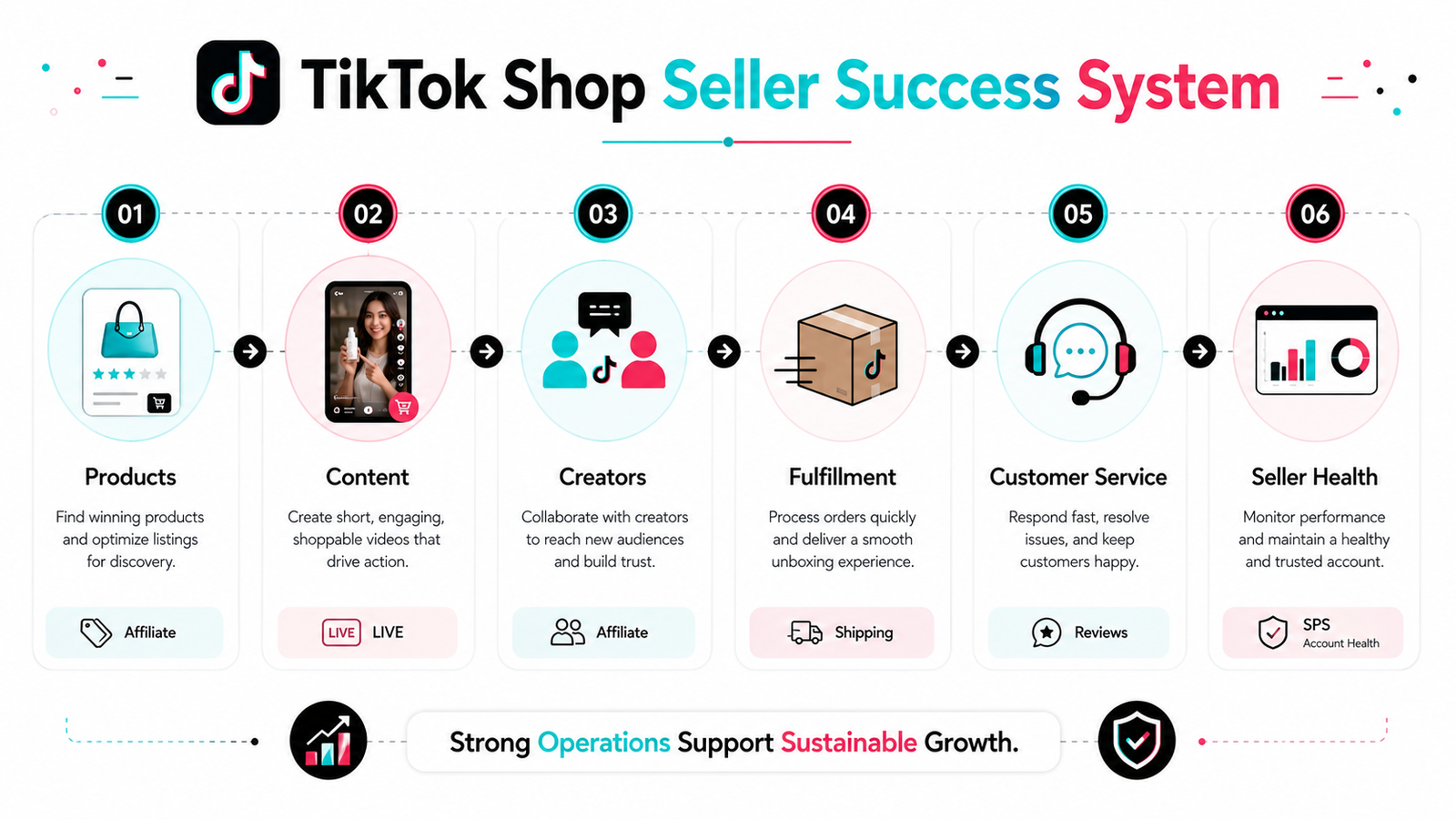
TikTok Shop Seller Success Dashboard
| Area | What a TikTok Shop Seller Should Manage |
|---|---|
| Registration | Identity/business verification, tax information and banking |
| Products | Eligibility, quality, pricing and accurate listings |
| Compliance | Restricted/prohibited products and qualifications |
| Fulfillment | Inventory, shipping, tracking, returns and cancellations |
| Content | Shoppable videos, LIVE and product storytelling |
| Creators | Open and Target Affiliate collaborations |
| Advertising | GMV Max where appropriate |
| Customer Service | Messages, complaints and after-sales support |
| Seller Health | Shop Performance Score and Account Health Rating |
| Analytics | GMV, SKU orders, traffic and content performance |
 Phase 5: How to Optimize Growth and Scaling
Step 13: How Can You Use TikTok Shop Analytics to Improve Sales?
Use TikTok Shop Seller Center analytics to determine which products, content types, creators, and commerce channels contribute to results.
The analytics environment has changed significantly. Current Shop Analytics provides real-time and revenue-focused metrics such as GMV, SKU orders, content-type performance, and shop-level performance. Product-level traffic analysis is available through Product Analytics → Product Traffic Analysis.
Useful metrics can include:
- GMV
- SKU orders
- Product views and clicks
- Conversion performance
- Video performance
- LIVE performance
- Product-card performance
- Affiliate performance
- Refund and return patterns
- Customer-service performance
Engagement metrics such as views and video completion can still matter for content analysis, but they should not replace commerce metrics. A video with strong engagement but few product clicks or orders should not automatically be considered commercially successful.
Step 14: How Can You Use TikTok Ads to Boost TikTok Shop Sales?
Paid advertising can support TikTok Shop growth when the product economics justify it.
The major 2026 update is GMV Max.
For new TikTok Shop Ads campaigns using the Sales objective with TikTok Shop as the destination, TikTok has shifted the advertising system toward GMV Max. The two main Shop-focused formats to understand are:
Product GMV Max for product-focused commerce campaigns.
LIVE GMV Max for supported LIVE commerce advertising.
GMV Max automates significant parts of campaign delivery, so merchants should understand target ROI, budgets, creative availability, product economics, and attribution rather than simply “boosting” videos without a plan. Advertising should complement your organic content, creator partnerships, product cards, and LIVE efforts rather than replace them.
You can also promote the broader business through appropriate channels such as Instagram, YouTube, Google Ads, organic search, creators, email, and other platforms. However, cross-platform activity should be judged by whether it brings profitable customers.
If you need specialist help with TikTok Shop strategy, advertising, content, and operations, explore HiSellIt’s TikTok services.
Step 15: How Can Merchants Scale Inventory and Fulfillment?
As demand increases, strengthen supplier and fulfillment relationships. Relying on a single supplier can create risk if that supplier experiences stock shortages, quality problems, or delivery disruptions. Depending on the product and business model, alternative or backup supply arrangements may improve resilience.
Use inventory-management systems that provide clear stock visibility. Running out of inventory during a period of strong demand can result in:
- Lost orders
- Interrupted advertising
- Creator frustration
- Customer dissatisfaction
- Missed promotional opportunities
Do not describe a stockout as an automatic “algorithm penalty” unless TikTok specifically documents one. As volume grows, evaluate whether Seller Shipping, TikTok Shipping, or Fulfilled by TikTok best fits your operational needs. Current TikTok Shop fulfillment guidance explains the responsibilities attached to each shipping method.
Phase 6: Long-Term Success and Advanced TikTok Shop Strategies
Step 16: How to Use Engagement Data to Improve Products
Use reviews, comments, returns, product questions, search behavior, and sales information to understand customer preferences. Comments can reveal useful product-development ideas, but engagement alone is not market proof. Validate an opportunity through actual search behavior, sales, repeat customer data, and product economics before investing heavily.
You may also consider developing exclusive products or bundles where appropriate, but exclusivity does not automatically create demand. Keep watching the wider TikTok content landscape for emerging customer interests while balancing trends against operational sustainability.
Step 17: Why Brand Storytelling Matters
Develop a recognizable brand voice and visual identity that remains consistent across your product listings and content. Produce content that goes beyond repetitive product promotion. Useful storytelling can include:
- Founder stories
- Product development
- Behind-the-scenes processes
- Customer education
- Product demonstrations
- Brand values
- Supplier or manufacturing information where accurate
The objective is not to copy an idea of “what TikTok audiences like,” but to create a recognizable and credible business.
Step 18: Diversification and Risk Management
Create contingency plans for supply disruptions, policy changes, rising competition, fulfillment failures, and changes in customer demand. Diversifying revenue can make sense where it supports the same customers and business model, but avoid expanding simply for the sake of having more revenue streams.
Selling through other ecommerce channels can reduce dependence on one platform, although every additional marketplace adds its own operational and policy requirements.
Stay current with TikTok Shop policy changes. Merchant eligibility, fulfillment rules, restricted-product policies, advertising systems, and Seller Center features continue to change.
How Do You Evaluate Ongoing Development?
Success on TikTok Shop requires continued analysis and adaptation. Review your data regularly and evaluate more than gross sales.
Useful business metrics can include:
- Revenue
- GMV
- Contribution margin
- SKU orders
- Returns and refunds
- Seller-fault cancellations
- On-time delivery
- Negative reviews
- Affiliate performance
- Advertising efficiency
- Repeat customer behavior
- Product traffic
- Shop Performance Score
- Account Health Rating
The goal is to understand whether the business is improving operationally as well as growing in sales.
Typical TikTok Shop Mistakes and How to Prevent Them
Excessive Advertising and Inauthenticity
Treating every TikTok post as a conventional product advertisement can limit your creative options. Instead, build content around useful demonstrations, education, customer problems, comparisons, storytelling, and genuine use cases. This does not mean ads or direct offers are bad. It means merchants should give viewers a reason to care about the product before repeating sales messages.
Disregarding Platform Trends and Culture
TikTok has its own content formats and audience behaviors. Spend time studying relevant content, but do not copy trends blindly. A trend that works for one category or creator may have little connection to your product. Use trends when they support the message, not simply because they are popular.
Optional Revenue Diversification
The original strategy of immediately adding subscriptions, courses, affiliate income, and multiple unrelated revenue streams can distract new merchants from building a strong TikTok Shop operation.
Focus first on:
- Reliable products
- Consistent fulfillment
- Strong content
- Creator relationships
- Healthy margins
- Customer satisfaction
- Seller health
Additional revenue models should only be considered when they genuinely fit the business and comply with TikTok Shop rules.
Automation and Technology Integration
As your TikTok Shop business expands, technology can reduce repetitive work while preserving operational control.
For a deeper breakdown of available systems, see our TikTok Shop automation tools guide.
CRM and Customer Management
Customer-management systems can help organize permitted customer interactions and business data, but merchants need to respect privacy requirements and TikTok Shop rules. Do not assume TikTok Shop buyer data can automatically be moved into third-party promotional systems. Use customer information only when you have the appropriate permission and lawful basis to do so.
Inventory Management Automation
Automated inventory systems can provide stock visibility, supplier synchronization, reorder alerts, and other workflow assistance. However, automation does not eliminate the need to monitor:
- Supplier accuracy
- Quality problems
- Returns
- Stock discrepancies
- Fulfillment exceptions
Content Creation and Scheduling Tools
Content tools can assist with editing, production workflows, asset management, scheduling, and analytics. Automation should support human creativity rather than replace strategic judgment. AI can help with drafts, concepts, captions, analysis, or workflows, but product claims, compliance, messaging, and final creative should still be reviewed carefully.
Considerations for International Expansion
TikTok Shop’s availability and seller requirements differ by country. A product being eligible in the U.S. does not automatically mean it can be sold under the same requirements in another TikTok Shop market. Before expanding, research:
- Market availability
- Seller eligibility
- Product restrictions
- Local demand
- Tax obligations
- Customs
- Shipping
- Returns
- Labeling
- Certifications
- Payment requirements
- Cultural and language differences
International growth can open new opportunities, but it also increases operational complexity.
Conclusion: Becoming a Successful TikTok Shop Seller in 2026
Learning how to become a TikTok Shop seller is only the first part of building a successful operation.
Registration gets your shop onto the platform. Sustainable growth depends on what happens afterward: selecting eligible products, building reliable supplier relationships, creating useful content, optimizing listings, collaborating with creators, fulfilling orders on time, managing customer problems, and protecting your account health.
TikTok Shop in 2026 is not simply an entertainment platform with a checkout button. Search, shoppable video, LIVE, creators, Affiliate Center, Seller Center analytics, product cards, GMV Max, Shop Performance Score, and Account Health Rating all form part of the merchant ecosystem.
The strongest merchants will not rely solely on viral content. They will combine creative product discovery with disciplined ecommerce operations.
If managing all of these areas becomes too time-consuming, HiSellit’s TikTok services can support areas such as TikTok Shop operations, content strategy, and growth. For a strategy tailored to your shop, you can also contact the HiSellIt team.
Frequently Asked Questions
Q. Can Someone Manage My TikTok Shop on My Behalf?
Yes. Sellers can work with third-party ecommerce specialists to support areas such as account setup, product operations, content, creator partnerships, advertising, and shop management.
However, the seller remains responsible for ensuring the business and products comply with TikTok Shop policies.
If you want support managing your operation, explore HiSellit’s TikTok services or contact the team.
Q. How Long Does TikTok Shop Seller Approval Take?
TikTok Shop does not provide one universal seller-approval timeline.
Verification depends on the type of seller, accuracy of the documentation, identity or business checks, and whether TikTok Shop requests additional information. Review the latest TikTok Shop registration requirements before submitting your application.
Q. Do I Need Special Certifications to Sell on TikTok Shop?
Not every product requires additional certification.
Some restricted products and categories require category-level, product-level, or invite-only qualification. Requirements depend on what you sell, so sellers should check the latest Restricted Products Policy and Seller Center qualification requirements before listing.
Q. How Do I Find the Right Suppliers for TikTok Shop Products?
Evaluate suppliers based on product quality, stock reliability, delivery times, tracking, packaging, communication, returns, compliance documentation, and their ability to handle changes in order volume.
The cheapest supplier is not necessarily the most economical once refunds, delays, defects, and poor customer experiences are considered.
Q. What Makes a Product “TikTok-Able”?
“TikTok-able” is an informal term rather than an official TikTok Shop metric.
It generally describes a product that can be demonstrated, explained, styled, tested, compared, or incorporated naturally into short-form content or LIVE.
Products should still be validated for demand, margins, supplier reliability, return risk, and compliance before being selected.
For more product research, see our guide to finding profitable TikTok Shop niches.
Q. How Should I Price Products on TikTok Shop?
Start with customer expectations and competitor pricing, then calculate your full unit economics.
Account for product cost, fulfillment, referral fees, affiliate commissions, advertising, promotions, returns, refunds, packaging, and other operating expenses.
Do not compete solely by having the lowest price.
Q. What’s the Difference Between Micro-Influencers and Mega-Influencers for TikTok Shop?
Follower count alone does not determine ROI.
A smaller creator may have a highly relevant audience, while a larger creator may provide much more reach. Compare audience-product fit, content quality, commissions, views, clicks, orders, GMV, returns, and repeat performance.
TikTok Shop Affiliate also allows sellers to use Open and Target Collaboration rather than relying exclusively on traditional influencer outreach.
Q. How Do I Handle Negative Reviews on TikTok Shop?
Respond professionally where appropriate, investigate the complaint, resolve legitimate fulfillment or product problems, and look for repeated patterns.
Do not offer customers private incentives to change, delete, or leave positive reviews. TikTok Shop’s review rules prohibit several forms of review manipulation.
Q. How Important Is Cross-Platform Marketing for TikTok Shop Success?
Cross-platform marketing can reduce dependence on one acquisition source, but it is not mandatory for every seller.
Instagram, YouTube, Google Ads, organic search, email, creators, and other channels may be useful when they match your customers and generate worthwhile business results.
Focus on the channels you can manage effectively rather than trying to appear everywhere at once.