
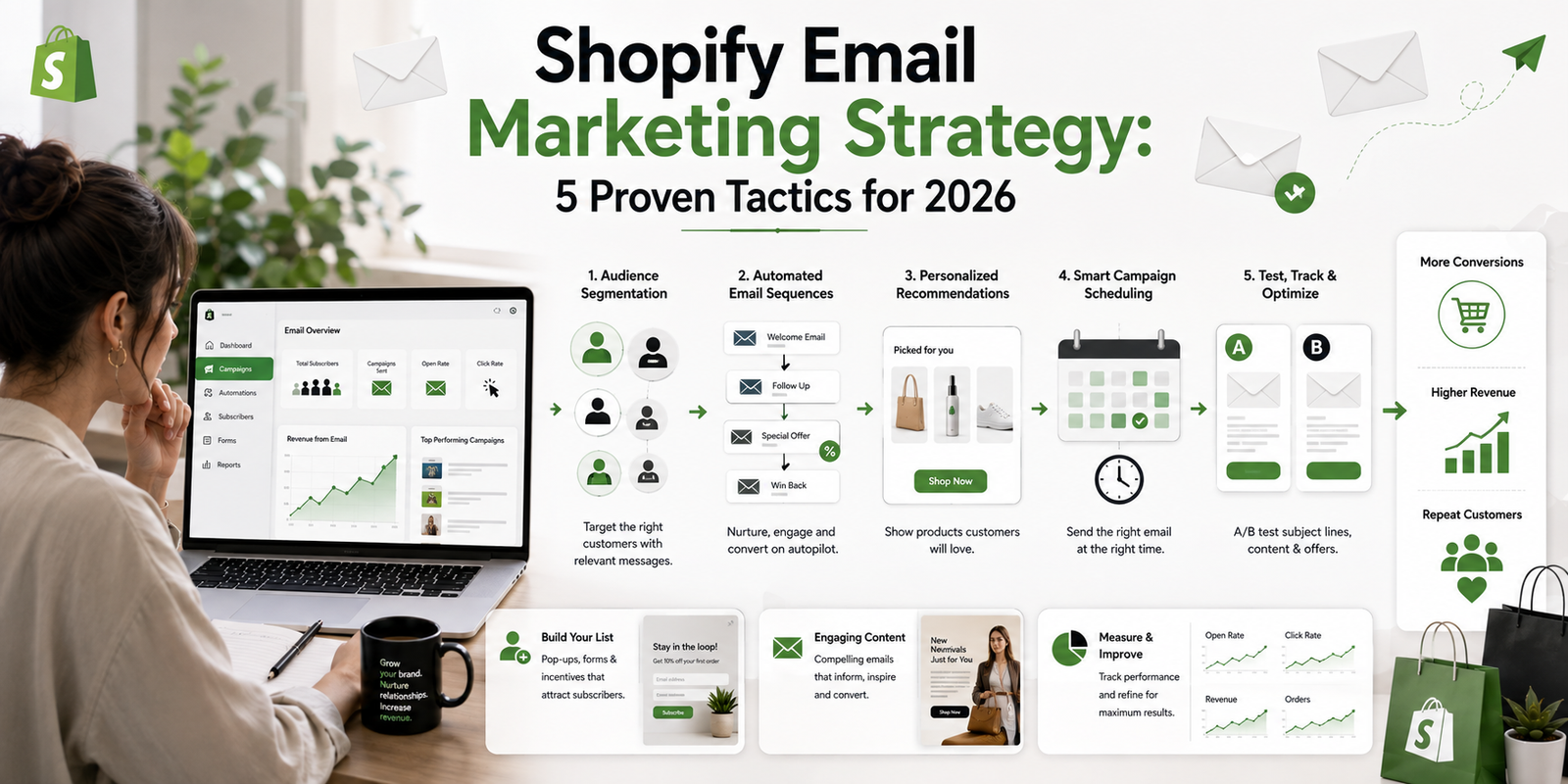
Shopify Email Marketing Strategy: 5 Proven Tactics for 2026
A well-planned Shopify email marketing strategy in 2026 can help ecommerce stores turn customer data into more relevant campaigns, automated follow-ups, repeat purchases, and stronger customer relationships.
Email marketing on Shopify has also become more sophisticated. Shopify Messaging now supports email and SMS campaigns, customer segmentation, marketing automations, campaign tracking, and tools designed to help merchants communicate with customers at different stages of the buying journey.
The real opportunity is not simply sending more emails. It is sending the right message to the right customer at the right time. This guide covers five practical Shopify email marketing tactics for 2026: segmentation, automation, personalization, consistent campaign planning, and ongoing testing.
For store owners who want to expand beyond email and strengthen their overall digital performance, explore our Shopify growth resources to discover how data-backed strategies can help your business reach its full potential.
Email works best when it supports a broader acquisition strategy. If you are also trying to increase organic traffic, our Shopify SEO guide for beginners explains how to improve your store’s visibility in search.
Quick Answer: What Is a Shopify Email Marketing Strategy?
A Shopify email marketing strategy is a structured plan for using customer data, segmentation, automation, personalization, campaign scheduling, and performance tracking to send more relevant emails and encourage sales, repeat purchases, and customer retention.
5 Shopify Email Marketing Tactics and What They Improve
| Email Marketing Tactic | Main Goal | What to Focus On |
|---|---|---|
| Segmentation | Improve message relevance | Purchase behavior, engagement, lifecycle stage, and customer value |
| Automation | Reach customers at key moments | Welcome, abandoned-cart, post-purchase, and win-back sequences |
| Personalization | Make emails more relevant | Recommendations, customer behavior, preferences, and dynamic content |
| Campaign Planning | Maintain consistent communication | Content calendar, promotions, seasonal campaigns, and customer expectations |
| Testing & Measurement | Improve campaign performance | Subject lines, CTAs, timing, clicks, conversions, and revenue |
What Makes an Effective Shopify Email Marketing Strategy?
A strong Shopify email marketing strategy is not about how many emails you send, but how relevant, well-timed, and valuable each one feels to your audience. Shopify stores can use customer and commerce data such as purchase history, engagement, customer segments, and relevant shopping behavior to create more targeted marketing campaigns. The real question is whether that data is being used strategically to create meaningful customer experiences that lead to conversions.
An effective Shopify email marketing plan brings together three essential components. First, it uses segmentation so each subscriber receives messages tailored to their behavior and interests. Second, it automates key campaigns so you do not have to send every message manually. Third, it constantly measures and improves results by tracking important metrics such as open rates, click-through rates, and revenue per email sent. Resources like Campaign Monitor’s email segmentation guide provide excellent insight into how segmentation drives higher engagement and conversion rates.
When you combine these three elements, your Shopify email marketing evolves from guesswork into a precise, data-driven system. You move beyond hope-based marketing and start making decisions grounded in actual performance data. Over time, your email list becomes a reliable, revenue-generating asset for your e-commerce business.
1. Segment Your Audience for Better Open Rates and Conversions
Sending the same campaign to every subscriber makes it harder to keep emails relevant. Segmentation lets you group customers by factors such as purchase behavior, lifecycle stage, engagement, product interests, VIP status, or churn risk, then tailor campaigns to each group. Shopify’s current segmentation guidance specifically recommends starting with practical segments tied to customer behavior and revenue opportunities.
The most effective segments usually focus on purchase history, customer lifetime value, engagement level, and browsing activity. Studies from HubSpot confirm that segmented campaigns generate substantially higher engagement and conversions compared to one-size-fits-all messages.
For instance, a customer who made a purchase six months ago but has not opened an email since requires a very different approach than someone who ordered yesterday. The six-month customer needs a win-back email or exclusive content that re-engages them, while the recent buyer deserves a thank-you message followed by tailored product recommendations based on their purchase.
Personalization is even more effective when every email feels consistent with the store customers already recognize. Our Shopify branding guide explains how to build a stronger visual identity, brand voice, and customer experience across your Shopify store.
A practical segmentation strategy for Shopify stores includes four key groups:
- New customers
- Repeat customers
- At-risk or lapsed customers
- Inactive subscribers
The time you spend on segmentation can pay off by helping you match each message to a more relevant audience. This is the foundation of an effective Shopify email marketing strategy and one of the clearest paths to stronger engagement, higher conversions, and predictable growth.
2. Automate Your Customer Journey with Triggered Email Sequences
Automation is where most Shopify stores fail to capitalize on the opportunity. Many use basic welcome sequences but abandon advanced automation right after that. Consider what actually happens in real shopping behavior. A customer lands on your store, views a product, and then leaves without purchasing. That is an abandoned browse. Or they add products to their cart but never finish checking out. That is an abandoned cart. These are key moments where a well-timed email can recover a sale, but only if you act quickly and with the right message.
Timing matters for recovery emails, but there is no single schedule that works for every store. Timing matters for recovery emails, but there is no single schedule that works for every store. Shopify’s 2026 guidance suggests sending abandoned-cart reminders around four hours after abandonment, while welcome emails are generally most useful when sent immediately after signup. Test timing against your own audience data rather than treating any schedule as universal.
Shopify Messaging includes prebuilt workflows for automated emails, including abandoned-cart campaigns, while Shopify Flow can support more customized automation logic.
Beyond recovery, post-purchase automation also drives lasting loyalty. A simple three-email sequence can encourage reviews, share product care tips, and offer early access to upcoming promotions. Over time, these small actions build stronger customer relationships.
Email automation can recover missed opportunities, but it cannot fix problems elsewhere in the customer experience. If you run a dropshipping store, our guide to Shopify dropshipping mistakes to avoid covers supplier, pricing, fulfillment, advertising, and retention issues that can affect overall performance.
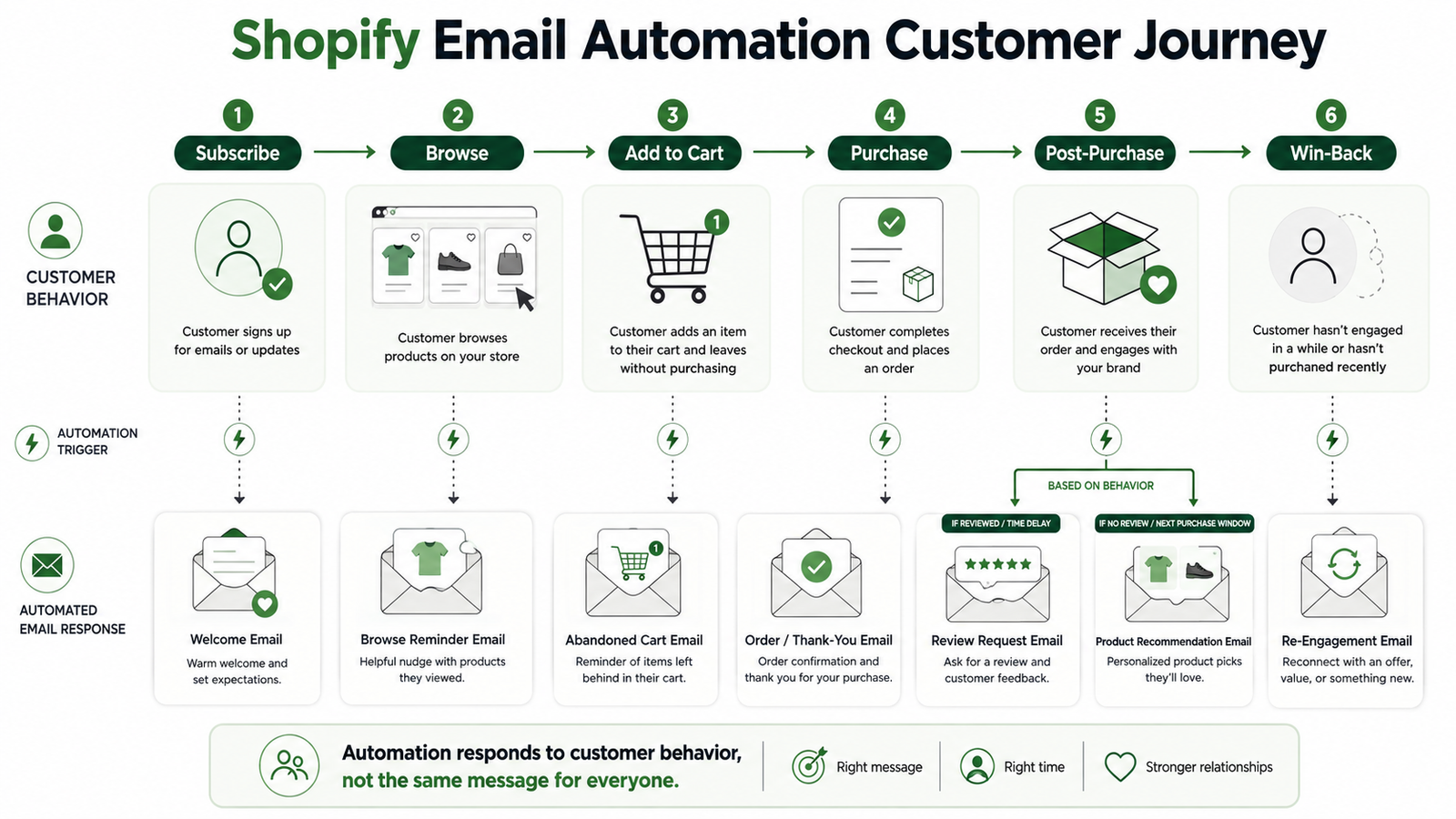
Automated Shopify email sequences can respond to customer actions throughout the buying journey.
3. Personalization Goes Beyond First Names
Many Shopify store owners believe personalization means adding a customer’s first name to an email subject line. That helps, but it barely scratches the surface. True personalization is about making every message feel relevant to each individual shopper. It means recommending products based on what they actually purchased, sending birthday or anniversary rewards, and adjusting how often they receive emails based on engagement.
Shopify Messaging and compatible platforms such as Klaviyo and Omnisend make this easier than ever. These systems allow you to use purchase history, browsing behavior, and customer attributes to build dynamic content blocks that adapt automatically for each person.
For example, a customer who recently bought running shoes might see suggestions for athletic socks or shoe care products. Someone who purchased a winter coat could see matching gloves or scarves. It is the same email template, but each subscriber sees something completely tailored. This level of relevance increases both clicks and conversions.
Send-time optimization can also be part of personalization. Shopify’s current guidance recommends testing timing based on your own audience behavior rather than relying entirely on universal benchmarks, and Shopify Messaging includes tools for recommended send times.
Shopify Messaging can also suggest a campaign send time, giving merchants another data point to test alongside their own audience engagement patterns.
4. Create a Content Calendar and Stick to a Sustainable Cadence
Consistency is one of the most overlooked parts of Shopify email marketing. When customers hear from you regularly and predictably, it builds familiarity and trust. If weeks or months go by without a single email, that connection fades and engagement drops.
A practical email program combines scheduled campaigns with automated messages such as welcome, abandoned-cart, and post-purchase emails. The exact frequency of scheduled campaigns should depend on your audience, products, seasonality, and engagement rather than a fixed weekly formula.
There is no single email frequency that works for every Shopify store. The right cadence depends on your audience, products, campaign type, season, and subscriber engagement. Start with a manageable schedule, then monitor clicks, conversions, unsubscribes, and revenue to determine whether you should send more or less frequently.
The simplest way to maintain rhythm is by planning. Create a content calendar each quarter and schedule seasonal sales, product highlights, and loyalty campaigns in advance. This not only saves time but also ensures every email aligns with your goals.
Need help structuring your email calendar? Contact our team to discuss a custom Shopify email marketing strategy.
5. Test, Measure, and Iterate Like Your Revenue Depends on It
The Shopify stores succeeding with email marketing rarely get it perfect the first time. They test, track, and adjust continuously. This is where experimentation transforms good campaigns into great ones.
A/B testing helps uncover what really resonates. You can test subject lines to find which earns more opens, test send times to identify when your audience is most active, or experiment with CTAs and landing pages to maximize conversions.
Start small. Test one variable per campaign and measure results. If a change performs better, make it your new standard. If not, try something else next time. This ongoing cycle of testing and refining leads to measurable gains over time.
Focus on metrics that actually reflect growth. Track open rate, click-through rate, conversion or placed-order rate, unsubscribes, and revenue generated by each campaign. For ecommerce stores, revenue per recipient can be especially useful because it connects email performance directly to sales. Shopify also recommends comparing results against your own historical performance rather than relying only on industry benchmarks.
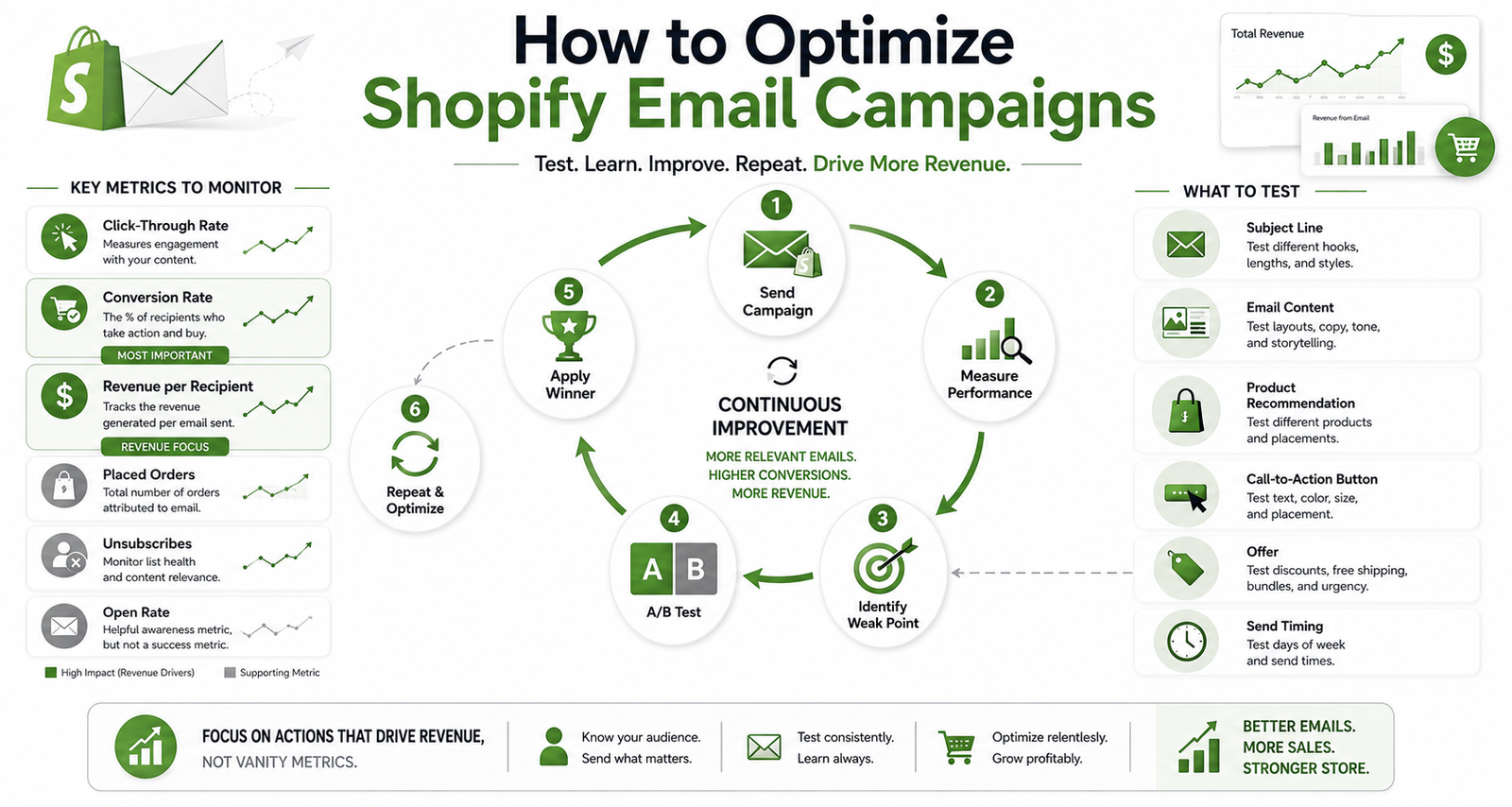
Shopify email performance improves through ongoing measurement, A/B testing, and decisions based on conversions and revenue.
The Bottom Line: Your Shopify Email Strategy Is Your Competitive Edge
A strong Shopify email marketing strategy works best as a system rather than a collection of occasional promotions. Segmentation improves relevance, automation keeps important customer journeys running consistently, personalization makes messages more useful, and testing shows what actually drives results.
The most important step is to use your own customer and revenue data to improve the program over time. Industry benchmarks can provide context, but your clicks, conversions, placed orders, unsubscribes, and revenue per recipient will tell you far more about what works for your store.
Shopify’s current marketing tools support customer segmentation, email automation, campaign tracking, and triggered workflows directly within the platform, giving merchants a strong foundation to build on.
Quick Answer: What Are the Best Shopify Email Marketing Tactics?
The most effective Shopify email marketing tactics include segmenting subscribers, automating key customer journeys, personalizing messages using customer behavior, maintaining a consistent campaign schedule, and testing subject lines, content, timing, and calls to action using real performance data.
To explore how structured marketing systems can multiply your store’s performance, visit Hisellit or contact our team through our support page.
FAQ: Shopify Email Marketing Strategy Common Questions
- How much does it cost to implement a Shopify email marketing strategy?
Shopify Messaging includes the first 10,000 email sends per month at no additional charge for eligible Shopify plans. After that, email pricing is based on monthly sending volume. Third-party email platforms use their own pricing models, which may depend on contacts, profiles, sends, or features. Check current pricing before choosing a platform.
- How often should I email my Shopify subscribers?
There is no universal sending frequency for every Shopify store. Your ideal cadence depends on customer expectations, product type, campaign purpose, seasonality, and engagement. Start with a consistent schedule and monitor clicks, conversions, revenue, and unsubscribe behavior. If engagement falls as frequency rises, test sending less often or segmenting your audience more carefully.
- What’s a good email open rate for a Shopify store?
Email benchmarks vary by industry, audience, list quality, and campaign type. Shopify’s 2026 guidance cites an ecommerce average of about 29.8%, based on Mailchimp data, but also notes that Apple Mail Privacy Protection can inflate open-rate reporting. Use benchmarks for context, but pay closer attention to your own trend over time and metrics such as clicks, conversions, and revenue per recipient.
- Should I use Shopify Messaging or a third-party email platform?
Shopify Messaging can be a strong starting point for merchants who want email campaigns, segmentation, and marketing automations integrated directly into Shopify. Third-party platforms may make sense when you need more specialized automation, reporting, data integrations, or advanced workflow features. Choose based on the capabilities your store actually needs rather than a specific subscriber-count threshold.
- How long does it take to see results from Shopify email marketing?
There is no fixed timeline. Automated campaigns such as welcome, abandoned-cart, and post-purchase emails can begin generating performance data as soon as customers trigger them, while broader improvements from segmentation, testing, and retention campaigns require enough sends and conversions to evaluate reliably. Focus on building a baseline and improving performance over time instead of expecting results within a fixed number of days.
Ready to build an email system that actually drives growth? Learn more about our Shopify email marketing and automation services to see how we help e-commerce brands optimize every touchpoint in their customer journey.