
Amazon Brand Registry Explained: Benefits, Requirements & Process
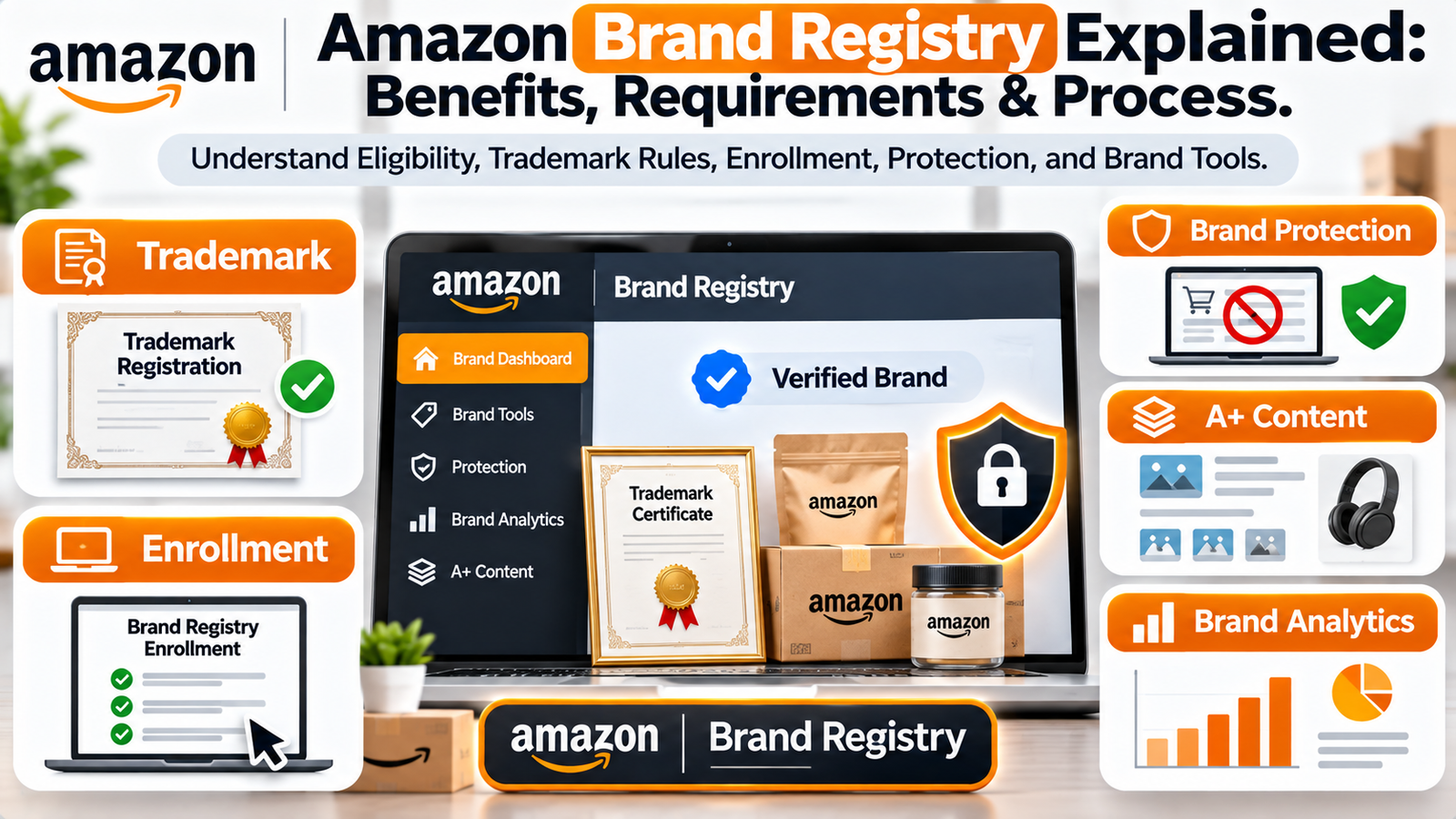
Amazon Brand Registry is a free Amazon program for eligible brand owners who want stronger brand verification, protection tools, and access to additional brand-building features.
The central Amazon Brand Registry requirements start with an eligible trademark and clear evidence that the brand appears on the product or packaging. Importantly, eligible pending trademark applications can now qualify in some cases, so older advice saying brands must always wait for full registration is no longer accurate.
Amazon Brand Registry enrollment can also unlock much more than counterfeit reporting. Depending on your role and selling status, Amazon Brand Registry benefits can include A+ Content, Brand Stores, Vine, Brand Analytics, advertising tools, automated protections, and Report a Violation.
The program itself is free, although trademark filing, legal services, selling accounts, and some separate programs can involve costs.
What Is Amazon Brand Registry?
Amazon Brand Registry is a free program for eligible brands that uses trademark and brand information to verify rights owners. Once enrolled, eligible users can access additional tools for intellectual-property protection, product content, analytics, advertising, storefronts, reviews, and brand management.
Amazon Brand Registry Requirements
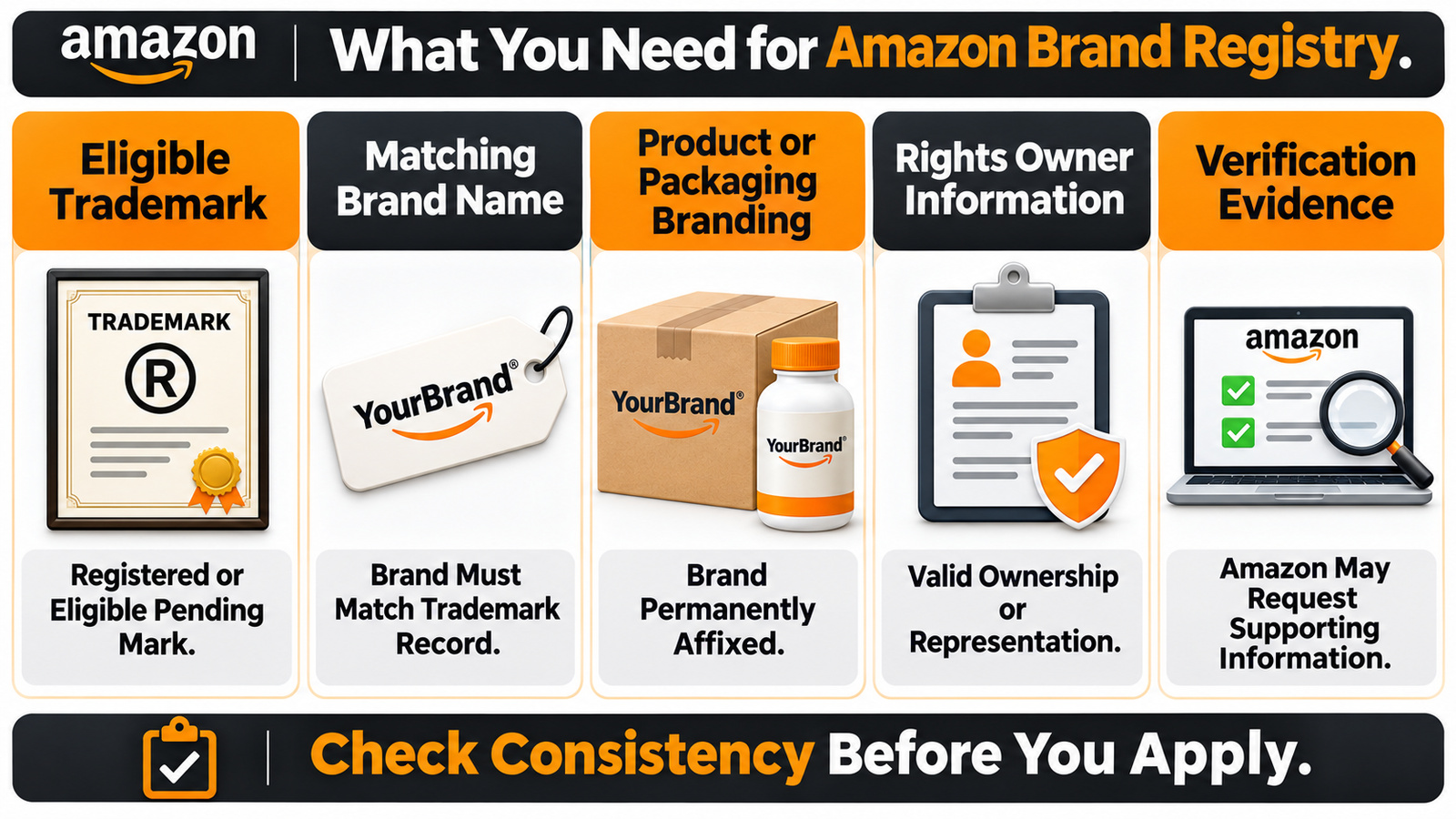 Amazon Brand Registry requirements are designed to connect a real brand with valid intellectual-property rights and a verified rights owner.
At a practical level, Brand Registry eligibility requirements currently include:
- an eligible pending or registered trademark
- a brand name that matches the trademark record
- an accepted text or design mark
- a logo that includes the brand name
- branding permanently affixed to the product or packaging
- the trademark registration or application number
- relevant product categories
- valid rights-owner information
- supporting verification information when requested
Amazon currently accepts text-based marks and image-based marks containing words, letters, or numbers from designated government trademark offices.
The requirements for Amazon Brand Registry also make consistency important.
If the trademark says “North River,” but the application says “NorthRiver,” that mismatch can cause problems. Amazon specifically advises applicants to enter the brand name in the same format as the trademark record, although capitalization differences can be accepted.
For Amazon Brand Registry for beginners, the safest approach is to compare the trademark record, brand name, logo, and product images before starting the application.
Do You Need a Trademark for Amazon Brand Registry?
Yes. An eligible trademark is central to the Amazon Brand Registry trademark requirement.
Amazon currently allows qualifying brands to enroll with either an active registered trademark or, in supported circumstances, an eligible pending trademark application.
The trademark for Amazon Brand Registry must generally be either:
- a text-based or word mark, or
- a design mark containing words, letters, or numbers
The Amazon trademark requirements also depend on the trademark office that issued or is processing the mark.
An Amazon Brand Registry registered trademark therefore remains a standard route, but it is no longer the only route available to every eligible applicant.
Can You Join Brand Registry With a Pending Trademark?
Yes, where Amazon’s current eligibility rules and supported trademark offices allow it.
An Amazon Brand Registry pending trademark can qualify before final registration. This is one of the biggest differences between current guidance and many older articles.
Brand Registry with pending trademark status is not automatic, however. Amazon still checks the trademark office, mark type, brand information, ownership, and other enrollment requirements.
So can you use a pending trademark for Brand Registry? Yes, potentially, but the pending application must meet Amazon’s eligibility rules.
Amazon also highlights IP Accelerator as another route for brands that have not yet completed trademark registration.
Does the Brand Name Need to Appear on the Product?
Yes. Amazon currently requires the brand name or logo to be permanently affixed to the product or packaging.
Amazon branded packaging requirements are stricter than simply placing a removable sticker on a box for the application photo.
Amazon says permanent branding is typically applied during production through methods such as printing, sewing, engraving, or laser etching. Easily removable stickers, tags, labels, stamps, digitally altered images, stock images, and computer-generated mock-ups are not accepted as evidence of permanent branding.
The Amazon Brand Registry brand name should also match the trademark record.
For an image-based trademark, the Amazon Brand Registry logo submitted should match the image in the official trademark record.
This Amazon trademark brand name match is one of the areas worth checking before submission.
Do You Need to Sell on Amazon to Join Brand Registry?
No.
Amazon Brand Registry without seller account access is possible for eligible rights owners.
Amazon explicitly states that a brand can enroll even if it does not sell directly in the Amazon store. In that situation, protection tools such as Report a Violation can still be available.
However, selling-specific tools are different.
A seller account required for Brand Registry is not a universal enrollment rule, but features such as A+ Content, Brand Stores, and some analytics or advertising tools can require an appropriate Seller Central relationship, selling plan, or assigned role.
For readers who are still deciding which Amazon selling setup they need, the Amazon Seller Account Types guide explains the Individual and Professional account distinction separately.
Is Amazon Brand Registry Free?
Yes. Brand Registry itself is currently free for eligible brands.
That answers is Amazon Brand Registry free at the program level.
But the Amazon Brand Registry cost should not be confused with other expenses around the process.
Possible separate costs can include:
- trademark filing fees
- trademark attorney or legal-service fees
- a Professional selling account
- Amazon Vine fees for some enrollment levels or products
- Transparency serialization costs
- advertising spend
There is no standard monthly Amazon Brand Registry fee simply for enrolling an eligible brand.
How to Enroll in Amazon Brand Registry
 The Amazon Brand Registry process can be understood in five basic stages.
Step 1: Access or Create Your Brand Registry Account
Use the same credentials as Seller Central or Vendor Central if you already have one. Amazon recommends this because it helps connect the accounts and associated tools.
Step 2: Enter Trademark and Brand Details
The Amazon Brand Registry application asks for information such as:
- brand name
- trademark details
- trademark number
- mark type
- product categories
- logo
This stage of Amazon brand enrollment should match the trademark record closely.
Step 3: Upload Product or Packaging Images
Amazon asks for images showing the brand permanently affixed to the product or packaging.
This is a core part of the Amazon Brand Registry registration process.
Step 4: Provide Verification Information
Amazon may request additional manufacturing, distribution, ownership, or identity information.
Amazon Brand Registry verification can therefore vary from one application to another.
Step 5: Review and Submit
Check the information carefully before submitting.
After submission, Amazon may contact the trademark correspondent or public contact associated with the mark to verify brand ownership. Amazon’s current guidance says that contact may need to complete the confirmation within seven days.
For sellers who need a broader explanation of where brand tools connect with the selling account, see Amazon Seller Central Explained.
What Documents Does Amazon Brand Registry Require?
There is no single universal Amazon Brand Registry documents checklist for every applicant.
Amazon may ask for:
- trademark information
- trademark documentation
- logo evidence
- product or packaging images
- manufacturing information
- distribution information
- rights-owner details
- additional verification material
Brand Registry verification documents can vary based on the trademark, application, country, business structure, and Amazon’s review.
Amazon brand ownership verification is particularly important because the initial enrollment application must be submitted by the trademark owner. An authorized agent can be added later after the brand is enrolled.
What Are the Benefits of Amazon Brand Registry?
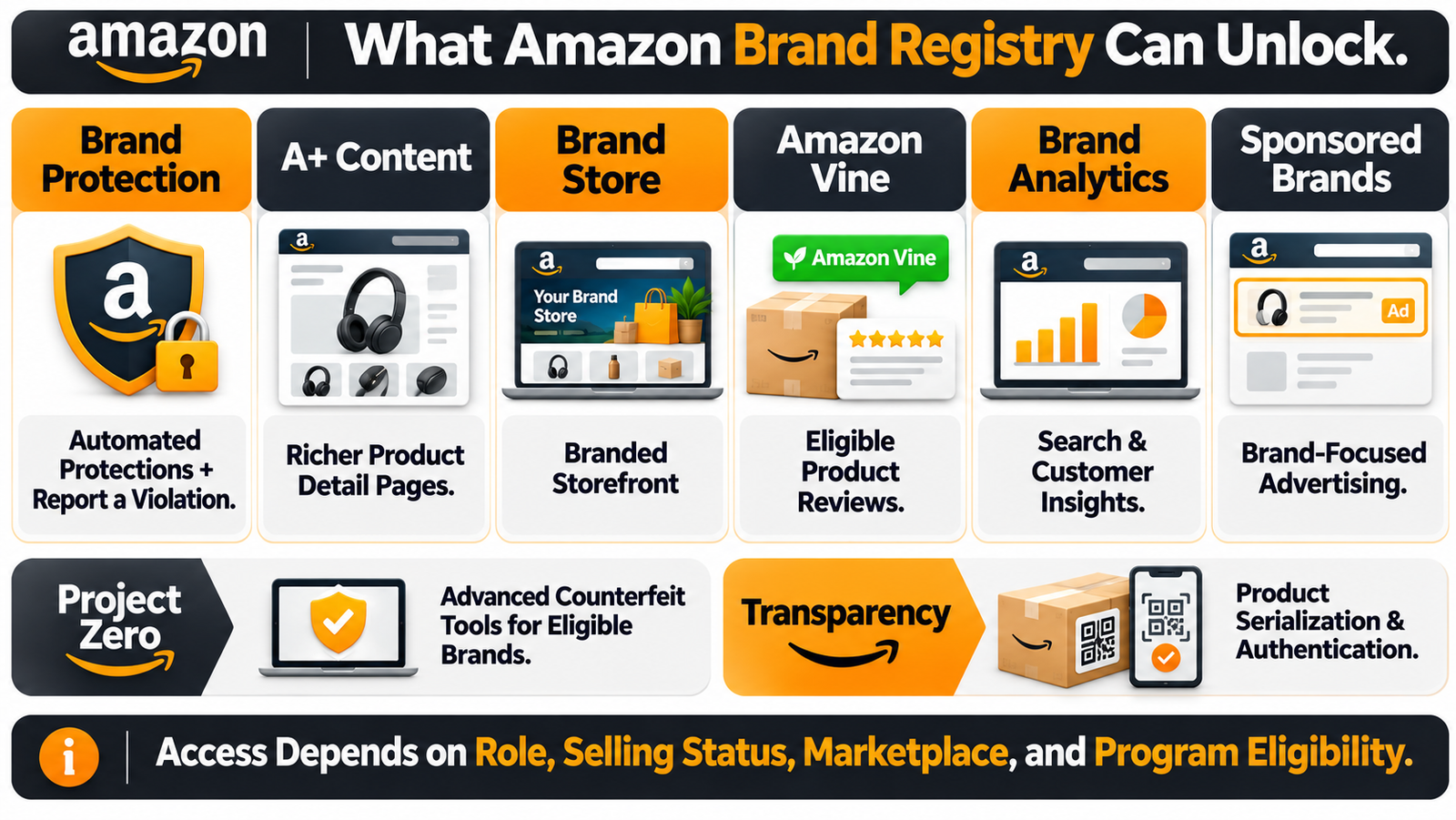 Amazon Brand Registry benefits extend across protection, content, reviews, analytics, storefronts, and advertising.
| Tool | General Purpose |
| Automated protections | Detect suspected IP and brand violations |
| Report a Violation | Submit suspected violations |
| A+ Content | Add richer product-detail content |
| Brand Store | Build a branded storefront |
| Amazon Vine | Collect reviews for eligible products |
| Brand Analytics | Access search and customer insights |
| Sponsored Brands | Run brand-focused advertising |
| Project Zero | Advanced counterfeit-removal capabilities |
| Transparency | Product serialization and authentication |
These benefits of Amazon Brand Registry do not all become available to every user automatically.
Access can depend on role, selling status, marketplace, product, account type, and program-specific eligibility.
How Does Brand Registry Help Protect a Brand?
Amazon brand protection begins with the information you provide about the brand, trademark, and products.
Amazon uses this data to power automated protections intended to detect suspected counterfeit or infringing listings before they affect customers.
Amazon automated brand protection is not absolute. No system catches every possible Amazon IP infringement.
However, the combination of Amazon automated protections and manual reporting gives verified rights owners more tools to protect brand on Amazon than an ordinary unverified brand relationship.
Amazon trademark protection also improves as accurate reports provide additional signals to Amazon’s systems.
What Is Amazon’s Report a Violation Tool?
Amazon Report a Violation lets enrolled brands report suspected problems through Brand Registry.
In July 2026, Amazon updated the tool into a more unified experience for:
- intellectual-property infringement
- store-policy violations
- regulatory-compliance concerns
The current Brand Registry Report a Violation workflow uses guided forms instead of relying mainly on open text, and a Submission History area lets users track report status and outcomes.
This is an important 2027 update because older guides may describe a more fragmented reporting process.
A report Amazon trademark infringement submission still does not guarantee removal. Amazon reviews the information and applies its policies.
Read Amazon’s current Report a Violation update
Which Brand-Building Tools Can Become Available?
A+ Content
Amazon A+ Content lets eligible sellers add enhanced images, text layouts, comparison charts, videos, and other rich modules to product detail pages.
Brand Registry A+ Content requires more than enrollment alone. Amazon currently states that A+ Content users need a Professional selling account plus an eligible Brand Representative or Reseller role for an enrolled brand, unless another qualifying route applies.
Brand Stores
An Amazon Brand Store gives eligible brands a multi-page branded storefront.
Amazon currently ties Brand Store eligibility to Brand Registry plus the appropriate selling and advertising setup.
Amazon Vine
Amazon Vine connects eligible products with Vine Voices who receive products and provide independent reviews.
Brand Registry Amazon Vine access also depends on selling-account, role, product, fulfillment, and review-count requirements.
Amazon Brand Analytics
Amazon Brand Analytics gives eligible brands access to search, customer, and brand-performance data.
Brand Registry analytics can help brands understand search terms, click share, conversion behavior, and related marketplace patterns.
Amazon currently requires a Professional selling plan plus an eligible Rights Owner or Brand Representative relationship for Brand Analytics access.
Sponsored Brands
Amazon Sponsored Brands can help eligible brand advertisers promote products and drive shoppers to branded destinations.
Brand Registry advertising access depends on the relevant Amazon Ads account and assigned brand role.
What Is Amazon Project Zero?
Amazon Project Zero is a separate advanced brand-protection program.
It combines Amazon’s counterfeit-detection systems with self-service counterfeit removal for qualifying brands.
Brand Registry Project Zero access is not automatically unlimited just because a brand has enrolled. Eligibility and responsible use still matter.
What Is Amazon Transparency?
Amazon Transparency is a separate product-authentication and serialization program.
Brands apply unique codes to individual product units. Amazon can then use those codes to verify products as genuine.
Amazon product serialization can therefore add another layer of Amazon counterfeit protection, but Amazon Transparency and Brand Registry are not the same program.
How Do Brand Registry Roles Affect Access?
Amazon Brand Registry roles matter because different users do not automatically receive identical permissions.
Current roles can include relationships such as:
- Rights Owner
- Administrator
- Brand Representative
- Reseller
For example, Amazon notes that some selling roles can use A+ Content, Stores, or Sponsored Brands without receiving access to all private Brand Analytics data.
That is why an Amazon Brand Registry reseller role should not be treated as equivalent to the Rights Owner role.
What If You Don’t Have a Trademark Yet?
Amazon IP Accelerator connects brands with outside legal-service providers that offer trademark services.
Amazon itself is not your trademark attorney.
The Amazon trademark attorney network involved in IP Accelerator consists of external legal providers, and their legal fees are separate from Brand Registry.
IP Accelerator Brand Registry access can help some brands begin using eligible benefits while the trademark application remains pending.
Does Brand Registry Give You Full Control of Amazon Listings?
No.
Amazon Brand Registry listing control is better described as additional protection and influence over brand content, not complete control.
Amazon’s catalog rules still apply.
Verified brands can gain stronger tools for Amazon product detail page control and Amazon listing content control, but other valid catalog contributions and Amazon’s systems can still affect product information.
Do not treat Brand Registry as absolute ownership of every detail-page field.
Amazon Brand Registry vs a Trademark: What’s the Difference?
Amazon Brand Registry vs trademark is a distinction between a legal intellectual-property right and an Amazon program.
| Area | Trademark | Amazon Brand Registry |
| Purpose | Legal IP protection | Amazon verification and tools |
| Managed by | Government trademark office | Amazon |
| Creates legal trademark rights | Yes, subject to law | No |
| Amazon-specific protection tools | No | Yes |
| Brand-building tools | Not directly | Can unlock them |
Trademark vs Brand Registry therefore should never be treated as the same thing.
Brand Registry uses eligible trademark rights. It does not create them.
Brand Registry vs Seller Central
Amazon Brand Registry vs Seller Central is another common beginner confusion.
Seller Central is used to operate an Amazon selling business.
Brand Registry focuses on brand verification, Amazon IP protection, and additional brand tools.
Brand Registry and Seller Central can work together, but they are not interchangeable.
If fulfillment is also part of your setup decision, the Amazon FBA vs FBM guide explains that separate operational choice.
Why Can a Brand Registry Application Be Rejected?
An Amazon Brand Registry rejected application can result from several possible problems, including:
- trademark and brand-name mismatch
- incorrect mark type
- weak or invalid product images
- removable rather than permanent branding
- inconsistent ownership information
- incomplete documentation
- trademark verification problems
- authorization issues
A Brand Registry application rejection decision does not necessarily mean the brand can never qualify.
Amazon currently lets users view application status, add documents to submitted applications in some cases, and copy and correct rejected applications.
How Long Does Amazon Brand Registry Take?
There is no safe universal Amazon Brand Registry approval time to promise.
How long does Amazon Brand Registry take can depend on:
- trademark status
- ownership confirmation
- document quality
- requested verification
- trademark correspondent response
- Amazon’s review requirements
Amazon does publish specific response windows for certain verification steps, but that is not the same thing as guaranteeing a fixed overall Brand Registry application time.
Is Brand Registry Only for Private-Label Sellers?
No.
Amazon Brand Registry private label use is common because private-label sellers own and build their own brands.
But Brand Registry for private label sellers is only one use case.
Manufacturers, established brands, and other eligible rights owners can also enroll.
For a new Amazon brand, the core issue is not whether it is described as private label. It is whether the applicant has the necessary rights, trademark, branding evidence, and verification information.
Conclusion
Amazon Brand Registry is primarily a verification system that connects an eligible brand with trademark rights and additional Amazon tools.
The Amazon Brand Registry requirements now include eligible pending trademarks in supported cases, so brands should not automatically assume they must wait for full registration.
The Amazon Brand Registry process also depends heavily on consistency. Your trademark, brand name, logo, product or packaging images, and rights-owner information should support the same brand identity.
Amazon Brand Registry benefits go beyond protection. Eligible brands may gain access to content, reviews, analytics, advertising, storefronts, and advanced IP tools.
Before applying, compare the trademark record, brand name, product or packaging images, and rights-owner information side by side. Fixing inconsistencies before submission is usually easier than trying to resolve them during verification.
If you need help preparing or managing the broader Amazon operation after enrollment, explore Amazon Wholesale FBA services. For project-specific support, contact HiSellIt.
Frequently Asked Questions
Q. What Is Amazon Brand Registry?
It is Amazon’s free brand-verification program for eligible rights owners. It connects qualifying trademark information with a brand and can unlock additional protection, reporting, product-content, analytics, advertising, storefront, and review tools.
Q. Do You Need a Trademark for Amazon Brand Registry?
Yes. An eligible trademark is required. Amazon currently accepts qualifying registered marks and certain pending trademark applications from supported trademark offices.
Q. Can You Use a Pending Trademark for Brand Registry?
Yes, where the pending application meets Amazon’s current eligibility rules. Not every pending application automatically qualifies, so check the supported trademark office, mark type, ownership information, and other enrollment requirements.
Q. Is Amazon Brand Registry Free?
Yes. Enrollment itself is free. Separate expenses can still exist for trademark registration, legal services, Professional selling accounts, advertising, Vine participation, Transparency codes, and other optional services or programs.
Q. Do I Need a Seller Account for Amazon Brand Registry?
No. An eligible brand can enroll without directly selling on Amazon. However, selling-specific benefits such as A+ Content and Brand Stores generally require the appropriate Seller Central relationship, plan, and role.
Q. What Are the Benefits of Amazon Brand Registry?
The main Amazon Brand Registry benefits include automated brand protection, Report a Violation, stronger product-content tools, A+ Content, Brand Stores, Vine eligibility, Brand Analytics, advertising opportunities, and access to separate advanced protection programs where eligible.