
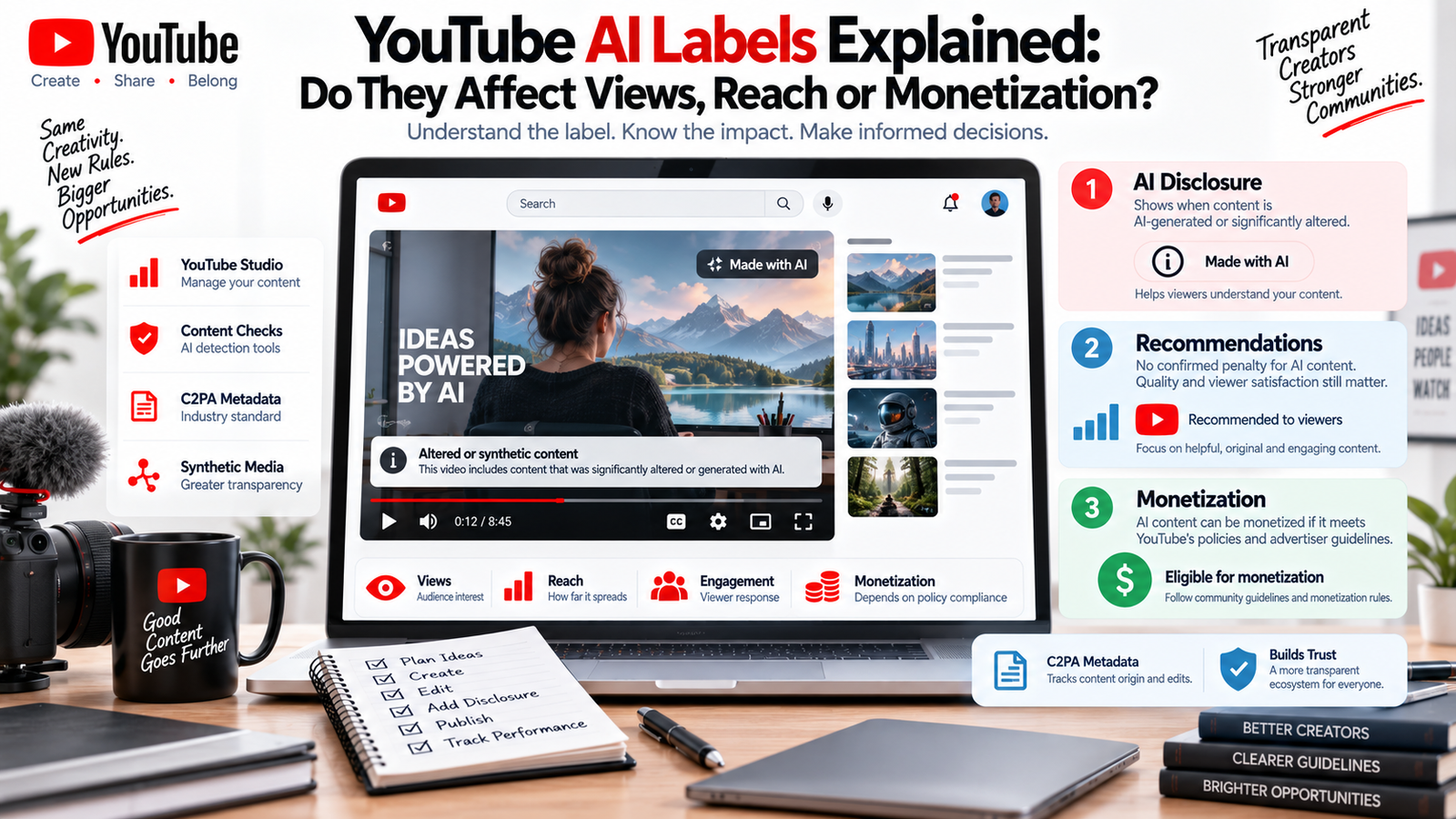
YouTube AI Labels Explained: Do They Affect Views, Reach or Monetization?
YouTube AI labels have expanded fast in 2026, and a lot of creators are unsure what a label actually means for their channel. If YouTube tags a video as AI-generated or altered, does that video get fewer views? Does it lose reach? Does it stop earning money? These are the real questions behind searches for YouTube AI labels 2026.
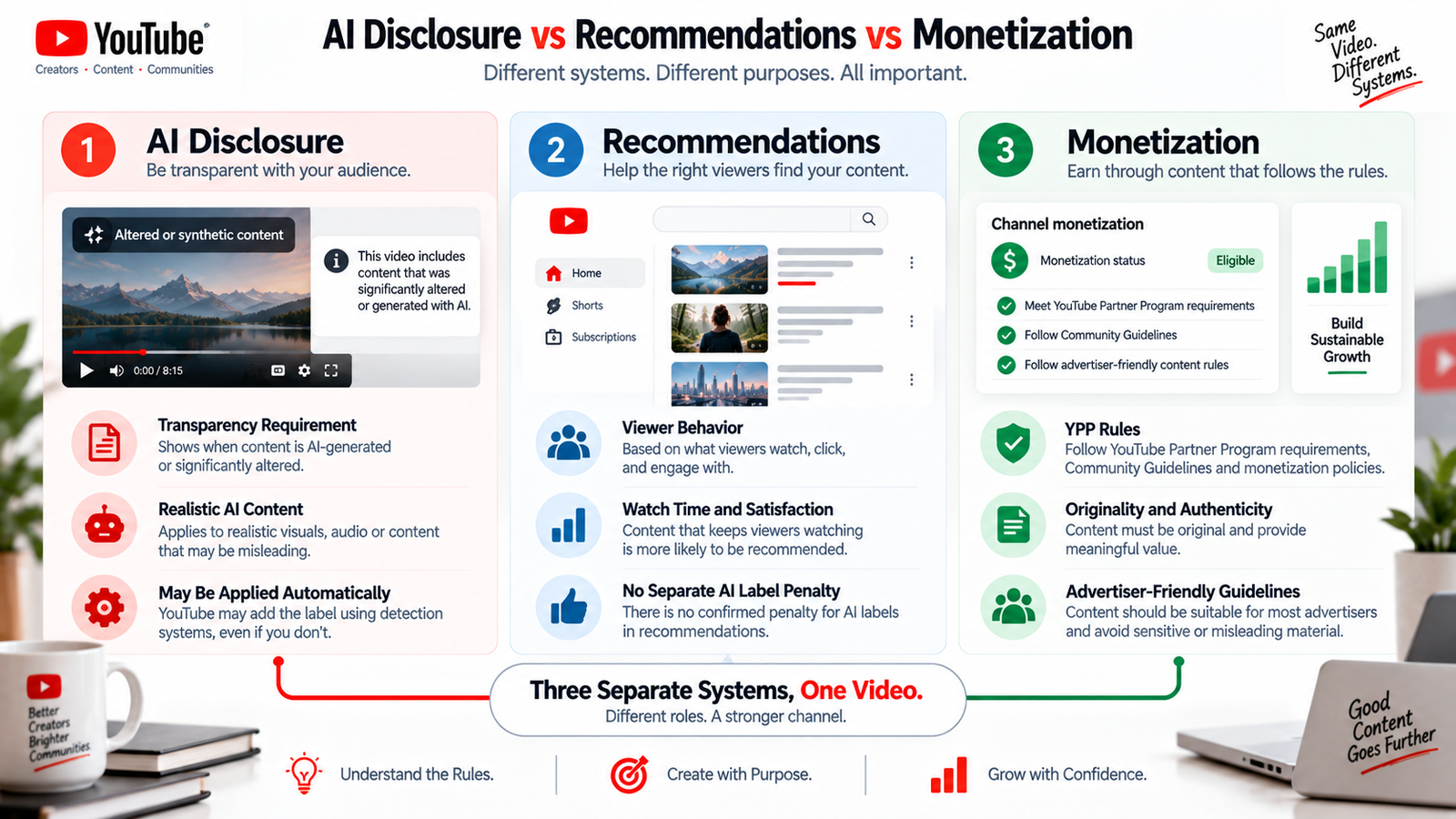
The short answer is that an AI label is primarily a transparency signal, not automatically a reach or monetization penalty. But that answer only makes sense once you separate three systems that often get lumped together: disclosure, recommendations, and monetization.
This guide walks through YouTube AI disclosure rules, what changed with automatic labeling in 2026, and how YouTube AI monetization works alongside those labels.
Quick Answer: Do YouTube AI Labels Affect Views, Reach or Monetization?
No, not by themselves. YouTube says an AI disclosure label alone does not change how a video is recommended or whether it is eligible to earn money. Views and reach still depend on viewer response and recommendation signals, while monetization is governed separately by YouTube Partner Program, advertiser-friendly, originality, and authenticity requirements.
What Is a YouTube AI Label?
A YouTube AI label is a disclosure that tells viewers a video contains material that was created or meaningfully changed using AI.
YouTube’s current upload workflow uses an “AI use” setting in YouTube Studio. When applicable, viewers may see information indicating that the content was AI-generated or altered. YouTube also uses the wording “Made with AI” within its How this content was made information. You can review the current terminology in YouTube’s official AI disclosure requirements.
The label is primarily a transparency tool. It is not, on its own, a policy violation, a strike, or an automatic demonetization signal.
YouTube introduced disclosure requirements for realistic AI content in 2024. What changed in 2026 is how the platform detects qualifying AI content and how prominently some disclosures appear.
What Changed With YouTube AI Labels in 2026?
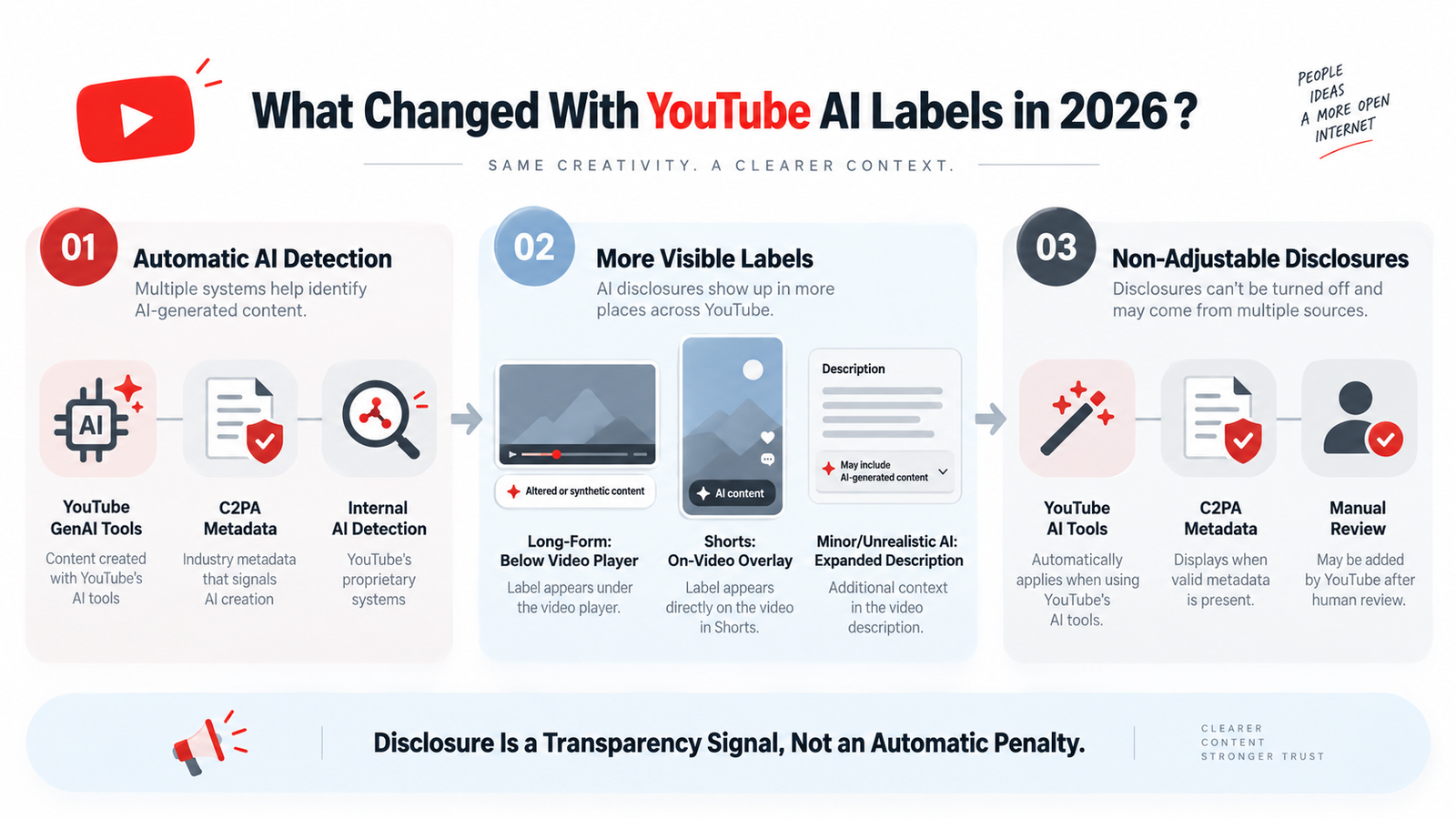
YouTube AI labels 2026 look different from earlier versions of the policy in three important ways: automatic detection, more visible placement, and non-adjustable disclosures in certain cases.
Starting in May 2026, YouTube began rolling out new internal signals to help identify AI-generated content automatically. If a creator does not disclose AI use and YouTube detects significant photorealistic AI content, the platform can apply a label automatically.
This does not replace the creator’s responsibility to disclose qualifying realistic AI content. Automatic detection acts as an additional layer.
YouTube announced the change in its May 27, 2026 update on improving AI labels for viewers and creators.
Label placement also changed.
For photorealistic and meaningfully AI-generated or altered content:
- Long-form videos: the label can appear directly below the video player, above the description
- YouTube Shorts: the label can appear as an overlay on the Short itself
For material that is unrealistic, animated, or only slightly altered, disclosure information may remain in the expanded description.
The third change concerns creator control.
In many cases, creators can correct an automatically applied disclosure if YouTube’s systems made a mistake. However, some disclosures cannot be adjusted, including content:
- made with YouTube’s own GenAI tools
- carrying relevant C2PA metadata
- labeled after manual review
YouTube’s Help Center lists all three exceptions.
 Do YouTube AI Labels Affect Views?
No, not directly.
YouTube says disclosure itself does not limit a video’s audience. It also states that an AI disclosure label alone does not change how a video is recommended.
What can matter is how viewers respond after seeing the label.
A label could affect performance indirectly if viewers react differently to it. That would be the result of normal audience behavior rather than a separate AI-label penalty.
YouTube’s recommendation system looks at viewer response, including whether people choose to watch, continue watching, engage positively, and appear satisfied with the content. Its official recommendation system guidance emphasizes that recommendations follow audience behavior.
So if a labeled video performs poorly, the presence of the label alone should not automatically be assumed to be the cause.
Do AI Labels Reduce YouTube Reach or Recommendations?
No direct reach penalty is documented for the label itself.
YouTube explicitly says that a disclosure label alone does not change how a video is recommended.
Reach can still rise or fall based on the same broader performance signals that affect other videos, such as:
- whether viewers choose to watch
- engagement
- satisfaction
- watch behavior
- audience relevance
There is no official YouTube statement saying AI-generated videos are automatically suppressed as a category simply because an AI disclosure appears.
Claims that every labeled AI video is automatically throttled go beyond YouTube’s published guidance.
Do YouTube AI Labels Affect Monetization?
No. Disclosure alone does not make a video ineligible for monetization.
YouTube’s Help Center directly states that disclosing AI content does not affect a video’s eligibility to earn money.
This is where it helps to separate disclosure from three other systems that can affect revenue:
- YouTube Partner Program eligibility
- Advertiser-friendly guidelines
- YouTube’s originality and authenticity requirements
An AI label does not automatically trigger a failure under any of those systems.
A disclosed AI-assisted video can still be monetizable, while an unlabeled video can still fail monetization rules for completely separate reasons.
For a deeper explanation of those rules, see our YouTube AI monetization guide.
 Can AI-Generated Videos Still Be Monetized?
Yes.
AI-assisted and AI-generated videos can still qualify for monetization when the channel follows YouTube’s monetization requirements.
Current YouTube channel monetization policies say monetized content should be original and authentic and should not be mass-produced, generic, repetitive, or manipulative.
The key question is therefore not simply:
Was AI used?
It is:
What does the final content actually offer the viewer?
Creators can use AI as part of research, editing, scripting, visuals, animation, or other production workflows while still providing genuine creative or educational value.
For channels using scalable or faceless production systems, YouTube automation services can help structure workflows around original production rather than volume alone.
Quick Answer: What Happens If You Don’t Disclose AI Content on YouTube?
YouTube may automatically apply an AI label when qualifying content is not disclosed. Creators who consistently fail to disclose required AI-generated or meaningfully altered content may also face manually applied labels or other penalties, including content removal or suspension from the YouTube Partner Program.
AI Labels vs. YouTube’s Inauthentic Content Policy
The inauthentic content policy governs monetization eligibility based on the nature and pattern of a channel’s content, not whether an AI label appears.
YouTube renamed its former repetitious content policy to inauthentic content in July 2025 to clarify that repetitive and mass-produced material had already been ineligible for monetization.
Its current monetization guidance now more clearly identifies several types of content that can make channels ineligible.
1. Generic or Repetitive Content
This includes videos that appear highly templated, interchangeable, or offer minimal meaningful variation between uploads.
YouTube specifically includes AI-generated material produced with generic or unoriginal templates when it gives the impression of mass production without original creator perspective.
2. Unsatisfying or Off-Putting Content
YouTube also addresses content built around repetitive emotionally manipulative formulas, disconnected AI clips, or misleading shock-based narratives.
Using automated tools or templates is not itself prohibited. YouTube says the final work still needs to demonstrate creative vision and provide educational or entertainment value.
3. AI Personas Related to Sensitive Topics
YouTube’s current monetization guidance also covers AI-generated personas that present themselves as human experts providing advice on sensitive subjects such as:
- health
- legal issues
- finance
- politics
Channels built around those deceptive expert personas are not eligible for monetization under the current policy.
The key distinction remains:
An AI label and monetization eligibility are separate checks.
A disclosed AI video can still fail monetization rules if the underlying content is generic or repetitive. An unlabeled video does not automatically qualify simply because no disclosure appears.
When Does YouTube Require an AI Disclosure?
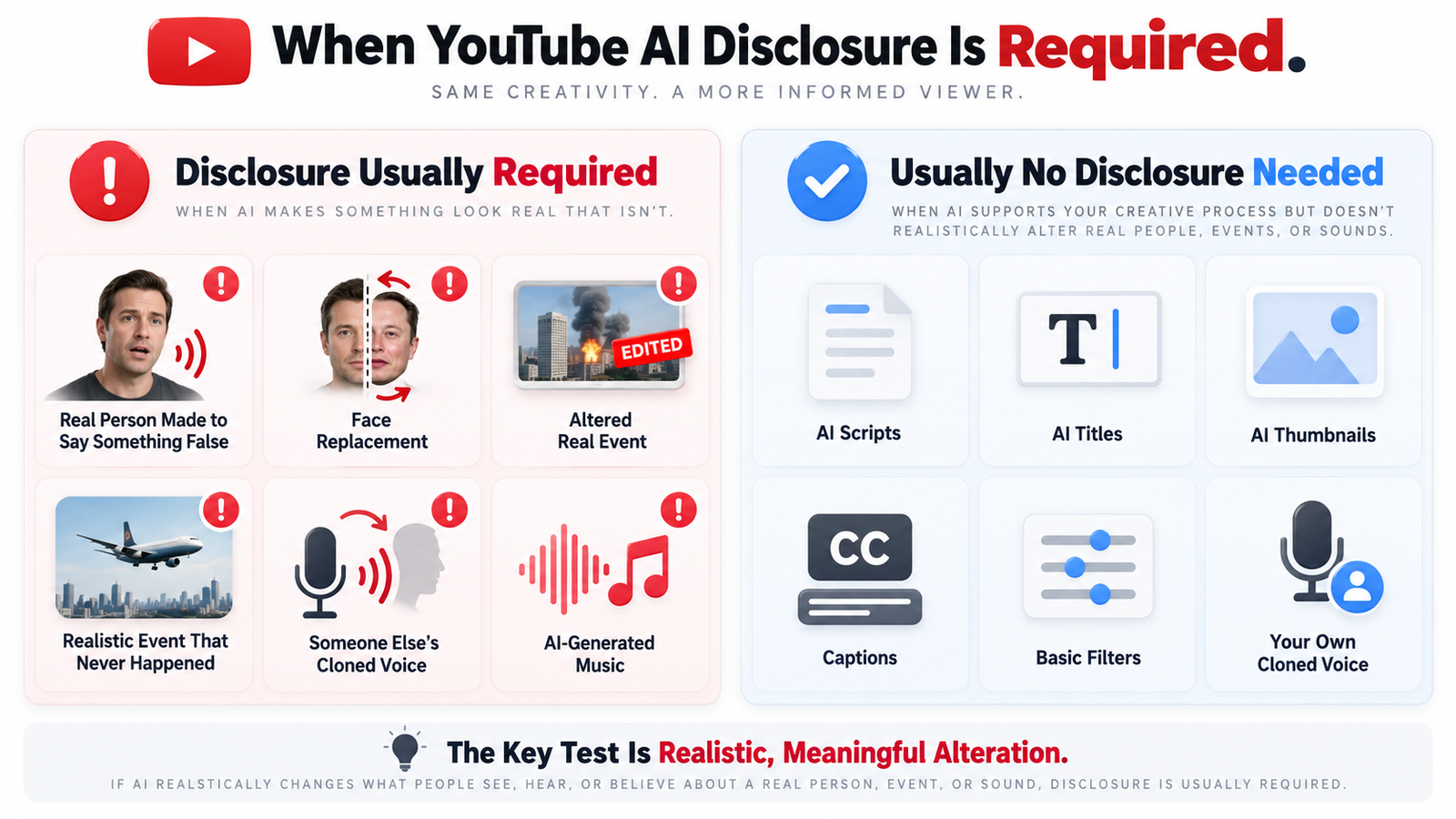
YouTube requires disclosure when content is AI-generated or meaningfully altered and appears realistic enough that viewers could mistake it for genuine footage or audio.
Examples include:
- Making a real person appear to say or do something they did not actually do
- Digitally replacing one person’s face with another’s
- Altering footage of a real event or place
- Generating realistic extra footage of a real location
- Cloning someone else’s voice for a voiceover or dub
- Synthetically generating music
- Generating a realistic depiction of an event that never happened
YouTube’s official GenAI disclosure guidance specifically focuses on realistic AI content and meaningful alterations.
AI Uses That Usually Don’t Require Disclosure
A lot of everyday AI-assisted production does not require the same disclosure.
YouTube’s guidance generally does not require disclosure for uses such as:
- Using AI for a video outline
- Using AI to help write or improve a script
- AI-assisted titles
- AI-assisted thumbnails
- Generating an infographic
- AI-created captions
- Beauty filters
- Color or lighting adjustments
- Background blur or vintage-style effects
- Video sharpening or upscaling
- Repairing recorded audio
- Clearly unrealistic animation
- Cloning your own voice for voiceovers or dubs
That last distinction is particularly important for faceless channels.
Cloning someone else’s voice can require disclosure. Cloning your own voice for a voiceover or dub generally does not.
If your broader workflow relies heavily on faceless or automated production, our guide on whether YouTube automation is saturated explains why differentiation and original creative input still matter.
 How YouTube Automatically Detects AI Content
YouTube’s automatic labeling system can use several sources to identify AI content:
- YouTube’s own GenAI tools
- C2PA metadata
- YouTube’s internal AI-detection systems
YouTube says its internal systems can automatically apply disclosure when they detect AI-generated or altered material.
C2PA is a provenance standard that can carry information about how digital media was created or modified. You can learn more from the official C2PA project.
YouTube has not published a public accuracy percentage for its internal AI-detection system, so claims that it is a specific percentage accurate should be treated cautiously.
Where Does the AI Label Appear?
Placement depends on the type and realism of the content.
Long-Form Videos
For photorealistic or meaningfully AI-generated or altered content, YouTube says the disclosure can appear directly below the video player and above the description.
YouTube Shorts
For Shorts, the AI disclosure can appear as an overlay on the video itself.
Unrealistic or Slightly Altered Content
For content that is clearly unrealistic, animated, or only slightly altered, disclosure information may instead appear in the expanded description.
YouTube introduced this more prominent label placement as part of its May 2026 AI-label update.
Can You Remove an Automatically Applied AI Label?
Sometimes.
If YouTube automatically identifies a video as AI-generated or altered and the system is wrong, creators can generally update the AI disclosure status in YouTube Studio.
However, there are important exceptions.
YouTube says creators cannot adjust disclosures on:
- content made using YouTube’s own AI tools
- content containing C2PA metadata
- Content labeled after manual review
In other words, an automatically generated label is not always editable.
What Happens If You Don’t Disclose AI Content?
If qualifying AI content is not disclosed, YouTube may apply a label automatically.
More importantly, YouTube says creators who consistently choose not to disclose qualifying AI-generated or meaningfully altered content may face additional consequences.
Those can include manually applied disclosures, content removal, or suspension from the YouTube Partner Program.
That makes accurate disclosure the safer approach when a video clearly meets YouTube’s requirements.
AI Labels vs. Copyright and Likeness Claims
Disclosure does not create legal permission.
An AI label tells viewers something about how content was created or modified. It does not give a creator permission to use:
- copyrighted material
- another person’s face
- another person’s voice
- protected music
- protected footage
Copyright and likeness rights remain separate systems.
If copyrighted music, footage, or another protected work is involved, see our guide on how to avoid copyright claims on YouTube.
YouTube has also expanded tools relating specifically to AI likeness.
Its likeness detection feature is currently experimental, is not available everywhere, and allows eligible creators over 18 who complete the required setup to find content where their face may have been altered or generated with AI.
The current detection tool focuses on facial likeness.
A separate likeness claim can also affect a video. YouTube says likeness claims can block a video from being viewed, but they are different from copyright claims and do not create a copyright-style strike against the channel.
Importantly, disclosing that a video is AI-generated does not prevent a likeness claim.
Disclosure and permission are not the same thing.
Should Creators Be Worried About the AI Label?
Not simply because a label appears.
The label itself is a transparency mechanism, not an automatic reach or monetization penalty.
Creators can still use AI for:
- scripting assistance
- editing
- thumbnails
- captions
- animation
- their own cloned voice
- realistic AI production that is properly disclosed
What matters is keeping the finished content accurate, original, valuable, and compliant with the policies that apply to it.
Channel performance still depends largely on viewer response and satisfaction, while monetization depends separately on YPP, originality, authenticity, advertiser-friendly, and other applicable policies.
The presence of an AI disclosure should therefore be treated as one compliance detail within a much larger content strategy.
Quick Reference: YouTube AI Labels in 2026
| Question | Current YouTube Position |
| Does an AI label automatically reduce views? | No |
| Does an AI label directly reduce recommendations? | No |
| Does an AI label automatically demonetize a video? | No |
| Can AI-generated videos earn money? | Yes, if monetization policies are met |
| Must realistic AI-generated content be disclosed? | Generally yes |
| Can YouTube apply AI labels automatically? | Yes |
| Can every automatic disclosure be adjusted? | No |
| Does disclosure grant copyright or likeness rights? | No |
This table summarizes YouTube’s published policy. It does not guarantee how an individual video will perform.
Conclusion
YouTube AI labels in 2026 work primarily as a transparency system, not a performance penalty.
Disclosure, recommendations, and monetization are separate systems that can intersect on the same video.
YouTube has been direct that a disclosure label alone does not change how a video is recommended or whether it is eligible to earn money. Automatic detection, more visible label placement, and non-adjustable disclosures in certain situations are important 2026 changes, but they do not turn properly disclosed AI content into automatically suppressed content.
The practical takeaway for creators is straightforward:
Disclose qualifying realistic AI content accurately, keep AI-assisted videos original and valuable, and treat copyright and likeness rights as separate issues.
For creators building larger AI-assisted or faceless channels, HiSellIt’s YouTube automation services can help structure production around original content and consistent quality. If you want direct help reviewing your YouTube workflow, monetization strategy, or channel setup, contact the HiSellIt team.
Frequently Asked Questions
Q. Do YouTube AI Labels Affect Views?
Not directly. YouTube says disclosure alone does not limit a video’s audience or change how it is recommended. Viewer response can still influence performance through normal recommendation signals.
Q. Does an AI Label Affect Monetization?
No. AI disclosure by itself does not remove monetization eligibility. Monetization is evaluated separately under YPP, originality, authenticity, advertiser-friendly, and other applicable rules.
Q. When Do I Need to Disclose AI on YouTube?
Disclosure is generally required when AI-generated or meaningfully altered content appears realistic, such as making a real person say something they did not say, altering footage of a real event, or creating a realistic event that never happened.
Q. Do AI Thumbnails or Scripts Need Disclosure on YouTube?
Generally no. YouTube lists AI assistance for outlines, scripts, titles, thumbnails, infographics, and captions among examples that usually do not require disclosure.
Q. Can YouTube Detect AI-Generated Content Automatically?
Yes. YouTube can automatically apply AI disclosures based on its own GenAI tools, C2PA metadata, or its internal AI-detection systems.
Q. Can I Remove a YouTube AI Label?
Sometimes. Creators can correct some mistaken automatic disclosures in YouTube Studio, but disclosures tied to YouTube’s own AI tools, C2PA metadata, or manual review cannot be adjusted by the creator.