
Does YouTube Monetize AI-Generated Videos in 2026? Rules Explained
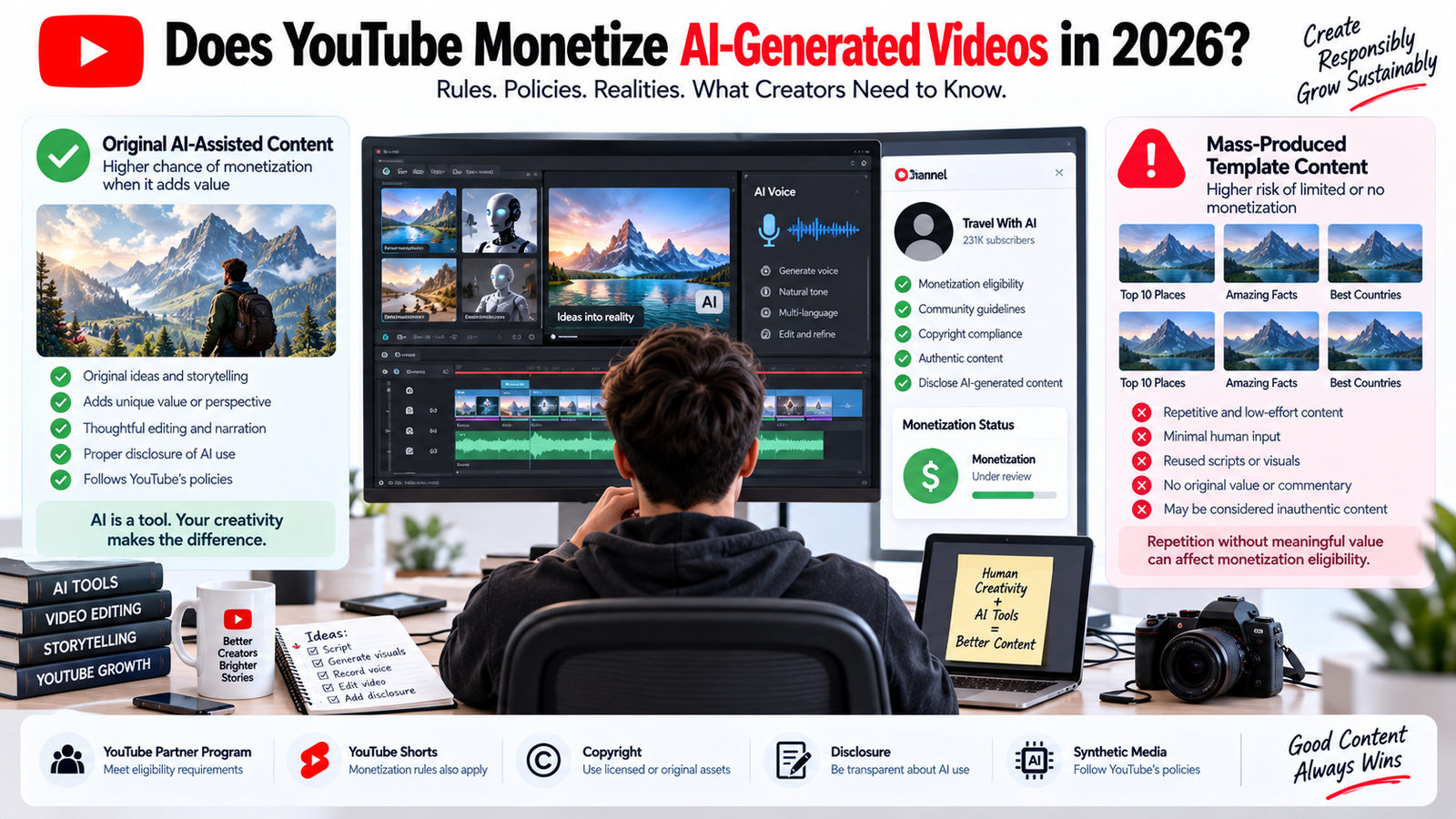
AI-generated videos can be monetized on YouTube in 2026. Using artificial intelligence does not automatically qualify or disqualify a channel. YouTube AI monetization depends on original content, meaningful viewer value, appropriate disclosure, commercial rights, and compliance with wider platform policies.
So, can YouTube monetize AI-created videos? Yes, when the finished work is authentic, useful, and compliant with the YouTube Partner Program. YouTube reviews the result and the channel as a whole, not merely the production tool.
Quick Answer: Can YouTube Monetize AI Videos in 2026?
Yes. AI-generated videos can be monetized when they are original, authentic, useful to viewers, and compliant with YouTube Partner Program policies. AI use alone does not disqualify a channel, but generic templates, mass-produced content, reused material, misleading realistic AI media, and certain AI personas giving sensitive-topic advice can create monetization problems.
Does YouTube Monetize AI-Generated Videos in 2026?
Yes. Current YouTube monetization policy does not ban AI-generated content simply because AI was used.
YouTube’s current channel monetization policies say monetized content should be original and authentic, not mass-produced, generic, repetitive, or manipulative. Reviewers may look at a channel’s theme, top and recent uploads, watch-time leaders, metadata, and About section.
This is the foundation of YouTube AI monetization 2026: what matters is whether the finished channel shows meaningful creative direction and viewer value.
YouTube Partner Program Requirements in 2026
There are now two threshold levels creators should understand.
In eligible countries, the expanded YouTube Partner Program eligibility rules offer earlier access to selected fan-funding and Shopping features at 500 subscribers, three valid public uploads in 90 days, plus either 3,000 qualified public watch hours in 12 months or 3 million qualified public Shorts views in 90 days.
Ad and YouTube Premium revenue sharing still requires 1,000 subscribers plus either 4,000 qualified public watch hours in 12 months or 10 million qualified public Shorts views in 90 days.
Thresholds do not guarantee acceptance. YouTube still reviews the channel before approving YPP access, and these YouTube monetization rules apply to manual, AI-assisted, and automated production alike.
For creators comparing monetization potential after approval, our guide to how much YouTube pays per view explains why earnings vary by audience, topic, ad demand, format, and other factors.
What Changed in AI Monetization Rules for YouTube in 2026?
A major source of confusion is the July 15, 2025 update.
YouTube renamed its former “repetitious content” policy to “inauthentic content” and clarified that it covers repetitive content and mass-produced content. YouTube called this a clarification, not a new ban, and said its reused content policy did not change.
So YouTube AI monetization did not suddenly become prohibited in July 2025. The wording simply became clearer about channels that look interchangeable or template-driven at scale.
The current YouTube AI content policy also addresses unsatisfying or off-putting content and AI personas on sensitive topics, making those points especially relevant in 2026.
What AI-Generated Content Can Be Monetized?
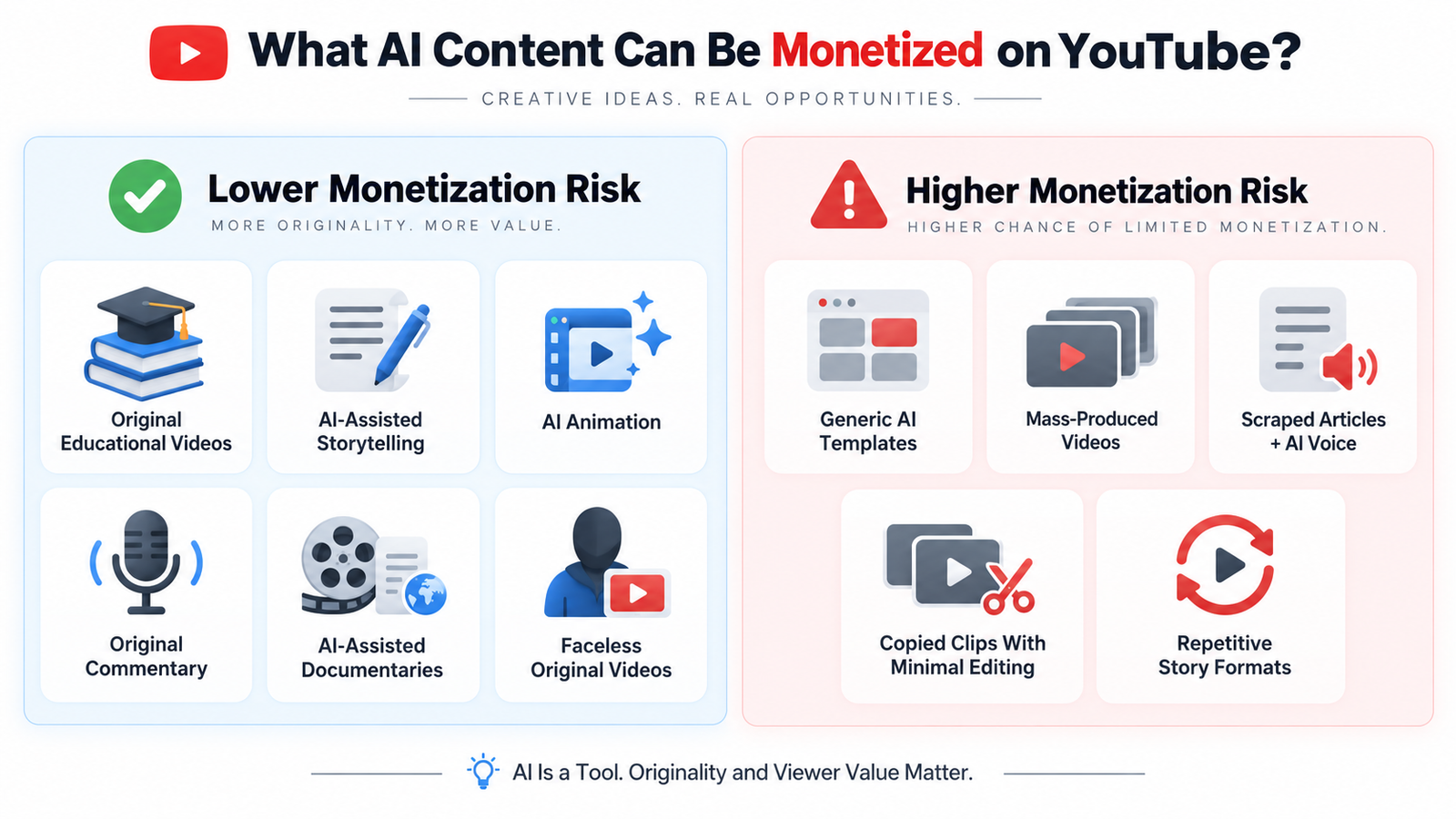
AI-generated content can qualify when the creator clearly contributes the idea, research, structure, perspective, or storytelling.
Examples include:
- Original educational videos where AI helps with visuals, editing, research organization, or narration
- AI-assisted storytelling based on characters and plots created by the channel
- AI animation built around a distinct concept and creative direction
- Original commentary where artificial intelligence supports production rather than replacing the analysis
- Documentary-style videos with human-led research and sourcing
- AI-assisted editing for captions, cleanup, pacing, or visual support
- A faceless YouTube channel with original scripting, research, and editorial decisions
YouTube specifically gives positive examples of creators using AI to visualize a unique character and narrative or to assist with a well-researched or creative story.
The common factor is original content. The finished video should reflect the creator’s own perspective rather than raw automated output, because original content needs recognizable creative input.
 What AI Content May Not Be Monetized?
The highest-risk formats remove meaningful creative contribution.
YouTube lists generic template-based AI-generated videos produced at scale without original insight as problematic, along with image slideshows, templated storylines, scrolling text with little value, and similar uploads with minimal variation.
Other risky examples include scraped articles read aloud with little commentary, nearly identical template videos, untransformed compilations, and generic AI stories where only surface details change.
This is where AI video monetization becomes risky. The issue is whether the channel looks automated, interchangeable, or low-value, not simply whether AI was used.
Quick Answer: What AI Content Does YouTube Not Monetize?
YouTube may reject channels built around generic templates, mass-produced AI videos, repetitive formats with little variation, copied or scraped material with minimal transformation, deceptive synthetic media, and AI personas that present themselves as human experts giving sensitive-topic advice. The safest approach is to make each video meaningfully original and useful to viewers.
Inauthentic Content vs. Reused Content
These policies address different problems.
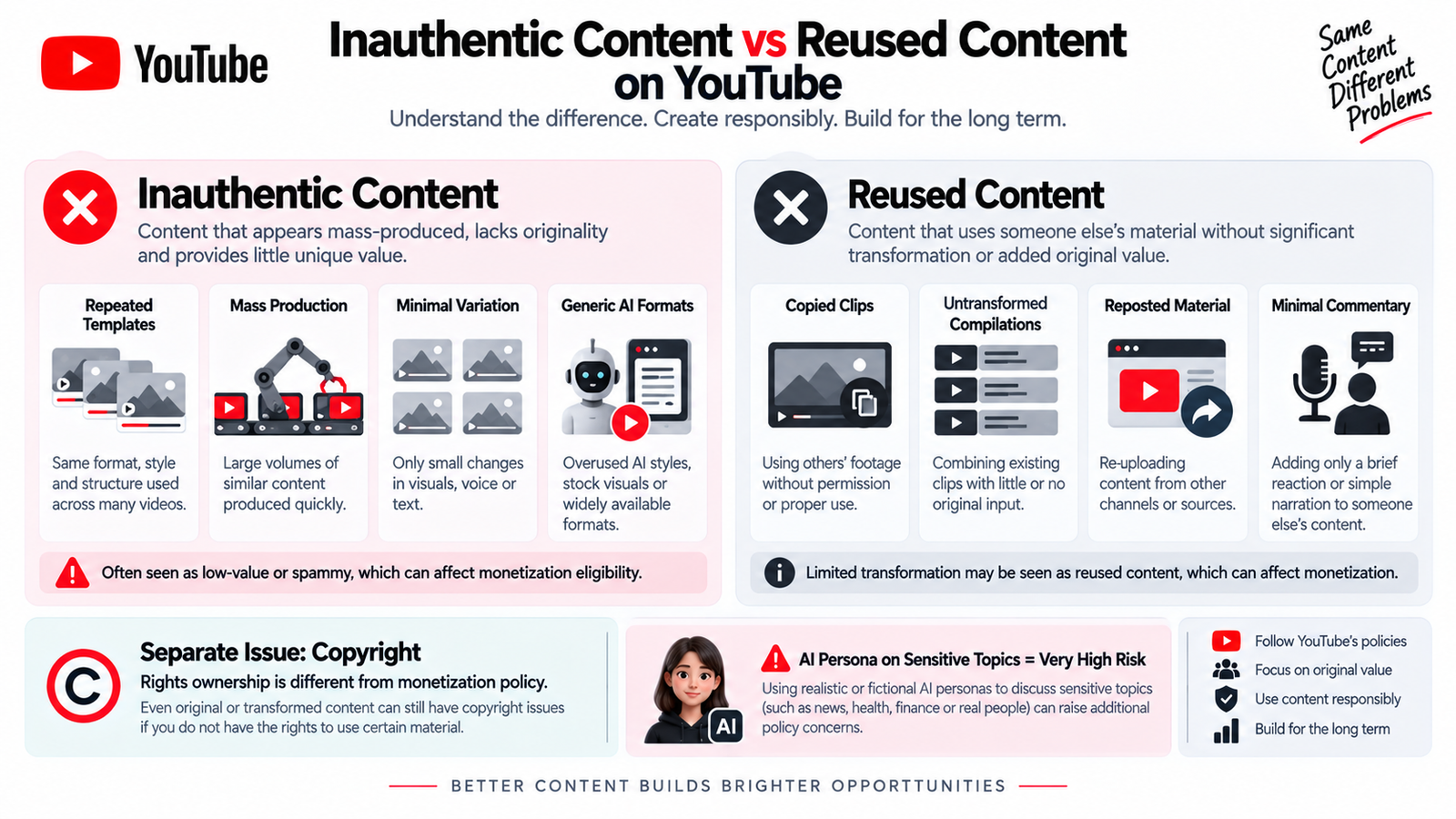
Inauthentic content concerns channels that feel generic, repetitive, templated, or mass-produced. A creator can own every asset and still fail this standard if uploads feel interchangeable. Repetitive content becomes a monetization risk when the videos offer little meaningful variation.
Reused content concerns material taken from YouTube or elsewhere without enough original commentary, modification, or educational or entertainment value.
YouTube makes clear that reused content is separate from copyright enforcement. Permission alone does not guarantee monetization, and a sufficiently transformed video can still face a copyright claim when the necessary rights are missing.
YouTube AI Content Policy: Monetization Risk by Format
| Content Type | Monetization Risk | Why |
| Original AI-assisted video | Lower | Adds original research, narrative, or creative direction |
| Synthetic narration with an original script | Lower | The narration tool alone does not determine eligibility |
| Generic template AI uploads | Higher | Can resemble inauthentic content |
| Copied clips with minimal changes | Higher | Can trigger reuse concerns |
| AI persona giving sensitive-topic advice | Very High | Current policy can make the channel ineligible |
| Realistic generated media without required disclosure | Higher | Can violate disclosure requirements |
 Unsatisfying or Off-Putting AI Content
YouTube now also describes a category called unsatisfying or off-putting content.
This includes emotionally manipulative formulas, interchangeable story patterns, or shock-focused uploads. YouTube gives examples such as repeated distress scenarios, unrelated AI clips stitched together without a coherent narrative, and deceptive realistic imagery of events that never occurred.
For AI video monetization, even technically original material can create problems when the channel is repetitive or misleading. Automated tools remain acceptable when the final video demonstrates creative vision and educational or entertainment value.
AI Personas on Sensitive Topics May Not Be Monetized
One of the most important current rules concerns AI-generated personas presented as human experts.
YouTube states that channels using AI personas to give advice on sensitive topics such as health, legal issues, finances, or politics are not allowed to monetize.
Examples include:
- An AI doctor providing diagnoses or wellness advice
- AI podcast hosts giving investment or wealth-management guidance
- AI personas interpreting laws or giving legal advice
This is not a general ban on AI-generated videos. A fictional entertainment character is different from an artificial persona presented as a trustworthy human expert, so creators in sensitive niches should design AI-hosted formats carefully.
Can AI Voice Videos Be Monetized?
Yes. AI voice monetization is possible because YouTube does not identify synthetic narration by itself as a reason to reject a channel.
An AI voice can narrate original educational, documentary, entertainment, or commentary material. YouTube’s guidance on what content can be monetized also emphasizes originality and having the necessary commercial rights for visual and audio elements.
Synthetic narration of copied articles or feeds without meaningful transformation can create policy concerns. YouTube also says cloning your own voice for voiceovers or dubs does not, by itself, require AI disclosure.
Can Faceless AI Channels Be Monetized?
Yes. A faceless YouTube channel can earn revenue without showing a creator on camera.
The channel still needs human creative direction through original research, scripts, distinct editing, storytelling, fact-checking, and editorial oversight.
A channel that uses YouTube automation should treat automation as an efficiency layer rather than a substitute for authorship.
If you are building this type of business, our YouTube automation services focus on structured channel workflows, while our guide on whether YouTube automation is saturated explains why niche selection and differentiation matter in competitive markets.
Do You Have to Disclose AI-Generated Content?
Sometimes.
YouTube’s GenAI disclosure requirements require AI disclosure when content is meaningfully altered or generated and appears realistic. Examples include making a real person appear to say or do something they did not do, altering footage of a real place or event, or generating a realistic scene that never happened.
Creators use the “AI use” setting in YouTube Studio for this purpose.
Not every AI-assisted edit needs disclosure. YouTube lists outlines, scripts, thumbnails, captions, upscaling, minor visual adjustments, and cloning your own voice for dubs or voiceovers among examples that normally do not require it.
YouTube may also apply labels automatically to content made with its GenAI tools, carrying C2PA metadata, or detected as generated or altered.
Disclosing altered or synthetic content does not by itself reduce audience reach or earning eligibility. Repeated failure to provide required disclosure, however, can lead to labels or penalties. Synthetic media is primarily a transparency issue unless another policy is also violated.
Can AI YouTube Shorts Be Monetized?
Yes. YouTube Shorts created with AI can earn revenue when the channel meets the appropriate eligibility requirements and the views themselves qualify for revenue sharing.
Under YouTube’s Shorts monetization policies, ad revenue is based on eligible engaged views, while non-original Shorts such as unedited movie or TV clips, straight reuploads, and compilations with no original material added can be excluded.
The same YouTube monetization rules apply to AI-generated videos in short-form and long-form work: add genuine value and avoid simply repackaging someone else’s material.
If reach is the problem rather than policy, our guide to why Shorts are not getting views covers visibility separately.
How to Make AI Videos Eligible for Monetization
No checklist guarantees approval, but these practices align with current YouTube monetization expectations:
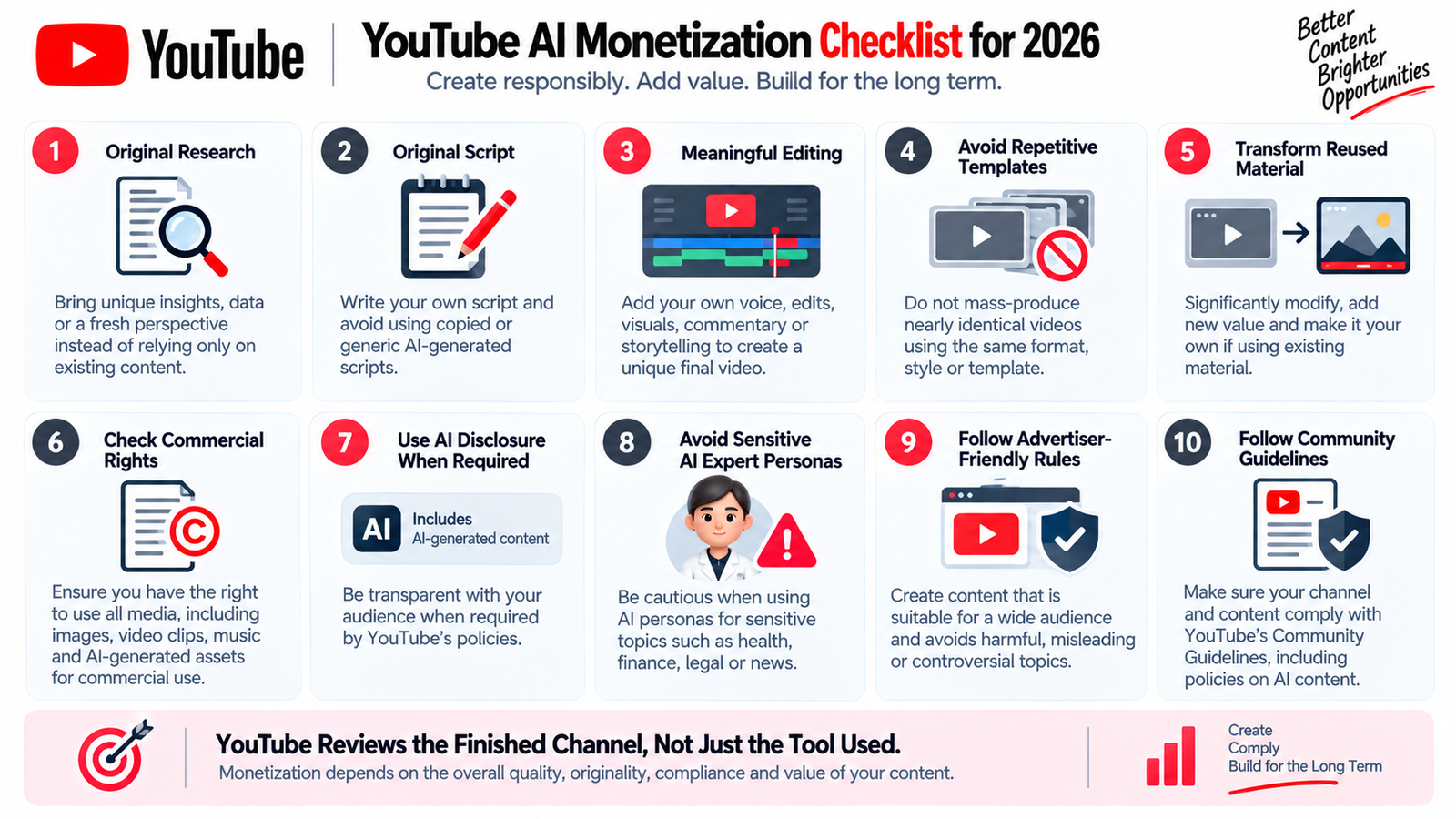
- Start with an original angle. Avoid cloning a popular format.
- Develop the script. Edit AI output so the final script reflects real research and editorial decisions.
- Add original commentary. Explain, compare, analyze, or tell a story instead of merely summarizing sources.
- Vary videos meaningfully. Do not let the channel become a template factory.
- Review every upload. Human oversight helps catch factual, rights, disclosure, and quality problems.
- Transform third-party material. Make your contribution clear.
- Verify licenses. Check licenses for synthetic narration tools, music, footage, images, and generation tools.
- Use disclosure when required. Label realistic generated material when required.
- Follow advertiser-friendly standards. YPP approval does not guarantee full ads on every video.
- Follow Community Guidelines. Compliance applies across the channel.
- Audit the whole channel. Reviewers may assess multiple parts of the channel.
For creators who want help auditing a channel structure before applying for monetization, contact HiSellIt.
AI Video Monetization Checklist for 2026
| Check | What to Verify |
| Originality | Each upload contains original research, writing, storytelling, or creative direction |
| AI production | AI-generated content is edited and shaped rather than published as raw output |
| Channel pattern | Videos do not look like mass-produced content from one generic template |
| Reuse | Third-party footage or ideas are meaningfully transformed |
| Narration | Synthetic narration is paired with an original script and appropriate rights |
| Disclosure | Realistic altered or synthetic content is disclosed when required |
| Sensitive topics | AI personas are not presented as human experts giving restricted sensitive-topic advice |
| Rights | Ownership and licensing are checked for all assets |
| Advertising | Videos meet advertiser-friendly guidelines where ad revenue is desired |
| Platform rules | Community Guidelines and YPP requirements are followed |
 Conclusion
YouTube AI monetization is still available to creators using artificial intelligence in 2026, but the safest channels use AI as a production tool rather than a replacement for creative judgment.
Successful AI video monetization starts with original content, meaningful variation, clear authorship, accurate disclosure where required, proper licensing, and compliance with the wider YouTube monetization rules.
For creators asking can AI videos be monetized on YouTube, the answer is yes, but approval depends on the finished channel rather than the software used to produce it. The strongest approach is to combine AI efficiency with human research, editing, fact-checking, storytelling, and oversight.
FAQs
Q. Can AI Videos Be Monetized on YouTube?
Yes. AI-generated videos can qualify for YouTube monetization when they are original, authentic, useful, and compliant with channel monetization policies. AI itself is not a disqualifier.
Q. Does YouTube Demonetize AI-Generated Content?
Not simply because a creator used AI. Risk rises when AI-generated content is generic, repetitive, misleading, copied, or template-driven.
Q. Can AI Voice Videos Be Monetized?
Yes. Synthetic narration can be used in monetized videos. Eligibility depends on script originality, production quality, rights, and policy compliance.
Q. Does AI Disclosure Affect Monetization?
Disclosure does not automatically reduce monetization. YouTube says disclosure itself does not limit audience reach or eligibility to earn money. The requirement exists to inform viewers when realistic material has been generated or altered.
Q. Can AI-Generated Material Count as Reuse?
It can. If AI-generated content mostly repackages existing material without significant original commentary or transformation, it can fall under the reuse policy. A genuinely original production is different.
Q. Can Automated YouTube Channels Be Monetized?
Yes. Automation is not banned. Automated tools can be used when videos still demonstrate original creative input and do not become a generic high-volume template operation.
Q. Can AI-Persona Videos Be Monetized?
It depends on the format. Entertainment characters and fictional storytelling can qualify, but YouTube says channels using AI personas that present themselves as human experts giving advice on sensitive topics such as health, law, finance, or politics are not eligible for monetization.


One Comment